Friday, July 19, 2013

Oceanography on the Dock Kickoff

This week we rocked our new citizen science project, Oceanography on the Dock. This project is a volunteer and staff led public program. It’s free to the public and meant to familiarize park visitors with some of the basic principles of oceanography and ocean conservation. The best part is that participants get to use actual test equipment to measure parameters such as salinity, pH, dissolved oxygen, temperature, and more.

Many participants of various ages attended our first few sessions on the PTMSC floating dock. I hosted my very first session and two groups joined me – including parents, children, girl scouts, and aspiring geologists and historians. The large group of girl scouts admitted that they did not know what oceanography meant, but after I explained the basic concepts they bravely agreed to help me conduct our research. Every single hand shot up in earnest whenever a helper for a new task was needed. These noble citizen scientists peered over the edge of the railing to watch the secchi disk to measure turbidity, carefully read the YSI meter to find out dissolved oxygen, pressure, and temperature and, fought over the chance to peer into the refractometer to determine salinity. They also tested the pH of the water using old fashioned pH strips and compared what they found with the more precise electronic meters. One dutiful data recorder, always close at hand, filled out the data sheet neatly and competently. The best part about working with these young ladies was realizing that they illustrate how just about anyone can be a scientist.


In addition to educating the public, it’s important to us that park visitors get a chance to contribute to real research. One of the reasons for conducting this research is hanging only feet away from where the program took place. Housed in a small cage, secured to the dock, are 100 baby Pinto Abalone from the Puget Sound Restoration Fund hatcheries. The Pinto Abalone are experiencing such low population numbers in the wild that they are unable to functionally reproduce. It is important to monitor the basic physical conditions of the water surrounding the precious growing mollusks here at PTMSC.


The new Oceanography on the Dock program gives anyone with curiosity and enthusiasm the opportunity to be a scientist. I was thrilled that so many individuals were willing to learn about oceanography and its importance to conservation. Here’s hoping visitors continue to enjoy our new summer program!


Tuesday, July 2, 2013

Adventures With the Junior Explorers

Last week (June 25-29) was our Junior Explorers summer camp with kids ages 5-7. I was a little nervous as that Monday had only been my fourth day working at PTMSC and I was still learning all the ropes. However, this was a fun group of kids and it was a great learning experience for all of us. We went over everything from marine mammals to tide pools to insects to birds.

On Wild Woods Wednesday, we looked at insects we found  on the trail.

It was Tidepool Tuesday with a great low tide! We found crabs and a sea cucumber among many other cools things.

Build-a-bird! We have our "loon" on the left and our "eagle" on the right.

Making sand critters on the beach!

At the end, we somehow ended up digging holes to bury people in...

So as you can see, we had quite the adventures that week! Even some inclement weather couldn't dampen our enthusiasm. I think the kids came away with a better understanding of the creatures we share our home with and hopefully this will make them want to take part in conservation efforts in the future.


Your new PTMSC intern,
Kimberly McClurg

Friday, June 28, 2013

Do your household products or kids’ toys have scary stuff in them?

Find out at PTMSC’s “X Out Toxics” event July 13 

Have you wondered if your children’s toys or clothing, your bedroom pillows or living room cushions have flame retardants or other hidden toxics in them? The Port Townsend Marine Science Center (PTMSC), in partnership with the Washington Toxics Coalition, is holding an ”X Out Toxics” event on Saturday, July 13th from 11 a.m. to 2 p.m. so you can find out. Bring your items to the Natural History Exhibit at Fort Worden State Park and get them scanned by an XRF Analyzer. The event is free with standard admission to the exhibits: $5 for adults, $3 for youth and free to PTMSC members.

The portable XRF Analyzer, formerly confined to laboratory use, safely uses x-ray fluorescence to detect certain chemical elements such as lead and other heavy metals, bromine (indicating the presence of brominated flame retardants) and chlorine (indicating the presence of PVC/vinyl).

“We might worry about toxic chemicals, but it's out of the reach of most people to get tangible evidence of what’s present in our homes and everyday life,” said Jean Walat, PTMSC Program Director.  “If you’ve had a concern about a specific item in your home, bring it down to be analyzed. Although the XRF doesn't show the presence of all potentially hazardous chemicals in objects, this is a great opportunity to become more aware of what's in our personal environments.”

Wednesday, June 19, 2013

PTMSC is looking for a few good roofs for a stormwater runoff study

Are you interested in helping with environmental research? The Port Townsend Marine Science Center (PTMSC), in conjunction with scientists at the University of Washington Center for Urban Waters, is leading a study of toxic chemicals in roof runoff. PTMSC is looking for 10 to 15 Port Townsend area residences where water samples can be taken from their roof during a rainfall. They are also seeking volunteers who can be trained in advance and then collect water samples on short notice. 
“We want to involve the community in this opportunity to learn what potential toxic chemicals are entering our stormwater,” said Jean Walat, PTMSC Program Director.  “If you are unable to sample your own roof, but want it included in the study, a PTMSC volunteer or staffer can sample for you. Likewise, if your roof doesn’t qualify, but you’d like to volunteer, we welcome your participation.”
PTMSC initiated this study, funded by an Environmental Protection Agency (EPA) Urban Waters grant, as part of its focus on toxic chemicals that are part of everyday activities. The Puget Sound Partnership identified toxics in roofing materials as a suspected contributor to stormwater pollution in its 2012 State of the Sound. Roof runoff often flows into storm drains, contributing any pollutants directly to marine waters. Samples will be analyzed for a panel of about 35 chemicals, including many hydrocarbons and chemicals called phthalates that are found in plastics. PTMSC will also train Seattle Aquarium volunteers to provide similar testing in the city.
If your house has been built or re-roofed with composite (‘three-tab”)  roofing material  within the last three years and has metal rain gutters, PTMSC would like to hear from you. Sampling materials and training will be provided and volunteers will receive test results. For more information, contact Jamie Landry, Citizen Science Coordinator, at jlandry@ptmsc.org or call 360.385.5582, ext. 112.

Wednesday, June 12, 2013

Star the Northern Elephant Seal Pup

A Morning Stroll Turns Interesting

by Ella Ashford

My mom and I were taking a morning walk downtown. We had just eaten a wonderful breakfast at The Bayview Restaurant. Stopping at Adam’s Street Park, I sat on a bench and studied a butterfly that had landed on a nearby flower. My mother was standing at the rail looking out at sea. She scanned the beach casually, but then her head jolted back and she stared intensely at one spot. “Ella,” she whispered urgently. I went over to see what had caught her eye. I walked to her side and followed her gaze. All I saw at first was a beach covered in driftwood and logs. Then to my surprise, one of the logs moved! That’s when I realized it was a very sandy seal!

A sandy seal! Photo credit: Steven Urbanc

Marine Mammal Stranding Network
You would have to know that I live half the year in Hawaii. There, the endangered Hawaiian monk seal hauls up on beaches too. Whenever a monk seal hauls itself on a populated area of one of the main islands, marine biologists rush out and put yellow tape up that says: Protected Marine Mammal - Share the Beach! Here in PT, the Marine Science Center works to alert the volunteers of the local Marine Mammal Stranding Network.

Marine Mammal Stranding Network volunteers

They organize the volunteers, who then take shifts watching the stranded mammals, and educating people about them. Seals can be dangerous to people if harassed. People can unfortunately be dangerous to seals too.
                        

In harm's way 
As this thought raced through my mind, I got an idea. “Let’s make a sign to warn people about the seal,” I whisper to my mom. 

The only place we could think of to go to find a pen and cardboard so early in the morning was the Maritime Center. Within 30 minutes, my board was done. It said: "Please Do Not Disturb the Seal!!!"

In the meantime, my mom had called the Port Townsend Marine Science Center to alert the Marine Mammal Stranding Network. 

Wild animals and people
I have been working with injured animals for a long time. When I grow up, I want to work as an animal rehabilitator. So as you can guess, I love animals. But even with my experience, I always call professionals to help. And today, I was reminded why: As we rounded the corner to the beach, I saw a woman and her two young daughters standing within five feet of the seal! The mother of the two girls was holding a camera taking pictures of her girls next to the seal. 

I called out to the mom: “Seals can be dangerous and you shouldn’t be so close!” 

The woman looked up, startled! “Oh,” She replied, “I didn’t think of that! When we went down to collect sea glass, we didn’t see him. Then my four year old daughter almost sat on him, thinking he was a log.” 

Crime scene!
Since the Marine Science Center had not arrived yet, my mom called the City Hall to see if they had any yellow tape that kept people back. The City Hall contacted the Port Townsend Police Department and asked them to help. In the meantime, people passing by asked a lot of questions: “Why doesn’t it have any spots?” “Is it lost?” “Is it dead?” As we tried to look up answers, a police car pulled into the parking lot.


Unfortunately, because the police put up yellow tape that said, “Crime Scene – Do Not Cross,” even more people came! Rumors circulated that someone had shot the seal or that the seal had bit a girl! You would not believe the stories we heard!
                                                                            

Securing the perimeter 
After securing the perimeter, my mom and I hung the sign I made. We decided to stick around until we heard from the Marine Science Center. I was glad we did, because soon after, we faced another problem: As the time was nearing nine o’clock, the town was getting busier. The beach that the seal had pulled up onto was a popular sea glass collecting and dog walking area! The problem was that the seal had pulled up right next to a side trail that leads down to the beach. I stopped people left and right explaining why they couldn’t go onto the beach. One time, I even had to interrupt a man’s phone conversation. A moment later and he would’ve been standing on the seals head. I don’t think that would have gone well with the seal…Throughout the week, because the seal hauled up in a “downtown area,” there were lots of people taking photos! I sure wish I had some of those great shots from those long lenses!!!

Harbor seal or northern elephant seal? 
Before the volunteers arrived, I was researching seals of Puget Sound on the internet using my mom’s Iphone. We found that the most common seals around here were called harbor seals. This seal was about the same size as an adult male harbor seal, which is about five feet. The only difference I could see was that it had no spots as harbor seals usually do. 

I looked closely at the seal and saw that the skin and fur looked like it was peeling off. “The seal must be molting” I said. I had just read a Wikipedia article about molting seals. Molting is where a seal sheds its fur and skin. The process can take four to five weeks and the seal is especially vulnerable during this time.


A young male elephant seal 
Shortly after that a volunteer from the Marine Science Center came. We put up the Marine Mammal Protection Network’s yellow tape and took down the crime scene tape. She measured and examined the seal, then called the expert over the phone. When she got off the phone, she said: “They think he is a young male northern elephant seal, molting. The dark whiskers and big eyes are the giveaway. Harbor Seals have light whiskers. He is approximately five feet long and 300 pounds.”

Shortly afterwards, another volunteer named Roger arrived. By then, I had decided to stay the entire day. I felt that it was my responsibility. Roger came by to “seal sit” and I liked him at first sight. 

We talked to people about the seal that whole day and even if I didn’t know it at that time, I would be “seal sitting” every day for the next 14 days.


Just a kid
 Sometimes it was hard getting people to listen to me. Not all people wanted to listen to a kid. Later on, when I got an orange vest from the Marine Mammal Stranding Network, it was easier. It made people treat me like I was a professional. 


4-H PT STEM Club
I already had leadership roles through 4-H. In my 4-H PT STEM (Science, Technology, Engineering and Math) Club, I begin every meeting by pledging to serve my community. This “seal sitting” turned out to be a very natural role for me to serve Port Townsend in. I started thinking about ways to engage kids and adults. One of the fun projects was “Story Time with Star.” I made a reading nook so that kids could read stories to the seal while it swam nearby in the water or rested near the shore. It gave kids something quiet to do while watching the seal. I had a lot of wonderful books to share about sea animals from Hawaii. One story was even about a monk seal, and seal sitters! 

I also made posters asking people to write down questions they had for the seal. I think it made people feel better, just being able to “talk to the seal.” A lot of people were worried that the seal was sick.


The days flew by after that first day. I was there every day and a few nights too. The community became so attached to the seal we even named him. His name is Star. I felt like the name fit, he was the “star” of Port Townsend, that’s for sure. Star and I even got our names in the newspaper. It felt like the whole City of Port Townsend saw him at least once. Some citizens even became daily visitors to make sure he was okay. My biggest worry when I was away was that something would happen to him. He had an unexplainable desire to “window shop” downtown!

Emergency action plan! 
One day my brother Nathaniel and I were at a wood working class at the Maritime Center. Our class had just ended when my other brother Everest came running up. “Ella, Emergency! Emergency! The seal needs you!!!” my brother shouts. That’s all the information I needed! I began running in the direction of the seal. I had thought the seal was at Adam’s Street Park but he wasn’t there! Where could he be I wondered? Then I remembered that he sometimes goes to a beach near a coffee shop called Better Living Through Coffee.


Before the thought had fully formed, I was of running as fast as could. Millions of horrible thoughts raced through my brain. A few days before, Star had gone to the beach near Better Living Through Coffee’s and even pulled up on the side walk. What if he climbed further and got run over by a car?  When I got there, I tried to make sense of what I saw. My Mom and some volunteers were standing in a crescent shape holding old doors as a barricade. They were facing the water and trying to corral something back to the beach. Suddenly, I understood. The seal had made it all the way to Water Street! And, it was trying to cross over! The volunteers were following the newest NOAA protocol and “crowd boarding” him back to the water. I couldn’t believe it! The volunteers were trying to corral a three hundred pound seal back to the water!!! I badly wanted to help the volunteers. I knew I couldn’t help them corral him. There had to be something a 12 year old could do. Then I saw a volunteer trying to keep the crowd back and corral the seal at the same time. Things were getting crazy. I grabbed the yellow tape and pulled it back so the volunteers had room. Star finally gave up and reluctantly inched his way back towards the sea. A cheer erupted from the crowds when he finally entered the water!


Goodbye Star – I will miss you… 
Star eventually swam back to the Adam’s Street Park Beach. He tucked up under Nifty Fifty's restaurant again. After a couple of days of rest, Star left. I was sad and happy at the same time. I was happy because Port Townsend wasn’t the best place for him. Star had endured stinky cigarette smoke, grimy engine oils, noisy generators, toxic herbicides, AND a bunch of bossy girls pushing him back into the water (that last insult must have been the worst for a male elephant seal!) But, I was sad because I had developed a bond with him. Releasing a wild animal is the hardest part of being a Wild Animal Rehabilitator. I will always remember the experience “Star the Seal” gave me. Star was amazing because he drew everyone in, no matter their differences. I think he truly found a home in the heart of Port Townsend.


I would like to thank all the businesses that helped support the Port Townsend Marine Science Center “seal sitters.” : Pizza Factory, Elevated Ice Cream, Nifty Fifty, Better Living Through Coffee, Jordini's, Fins, Waterfront Pizza, The Clothes Horse, Dons Pharmacy, Boiler Room, and the Maritime Center. And a special thanks to the Community of Port Townsend!!!

Uncaptioned photos courtesy of Gabriella Ashford and Lucy LaRosa

A word from the PTMSC Marine Mammal Stranding Network
All marine mammals are federally protected under the Marine Mammal Protection Act. NOAA advises people to stay 100 yards away, if possible, and do not touch, handle, or feed marine mammals.
Stranded marine mammals in or around Port Townsend should be reported to
PTMSC MMSN at 360-385-5582 ext. 103 


Friday, May 31, 2013

Seals, Squids, Skates, Oh My!

Have you ever wondered what it would be like to babysit an elephant seal? How about dissecting a Humboldt Squid or Big Skate? Or trying to care for baby skates that magically showed up in your tank one day?

Well you've come to the right place...


~Babysitting an Elephant Seal~


Marine Mammal Stranding Network volunteer, Roger Wilson, seal sits Star.
A juvenile Northern Elephant Seal, dubbed "Star", attracted lots of attention in Port Townsend's popular downtown area this past month. The seal (a young male weighing approximately 350 pounds) hauled out on the Adams Street beach on Thursday night, May 2nd to begin the molting process (shedding his old fur). You can imagine his surprise the next morning when he found himself surrounded by curious visitors. He was reported to the PTMSC Marine Mammal Stranding Network at 360-385-5582 ext. 103 who dispatched trained volunteers to respond and set up a seal sitting schedule.


Elephant seals scratch a lot while on shore.
The lighter colored fur is being shed and replaced with a darker silvery coat.
Photo credit: Casey Gluckman (MMSN volunteer)
Note: this photo was taken with a high-powered camera from a safe distance away.


Star flips sand on himself to keep cool on a sunny day.
Photo credit: Casey Gluckman
He stayed downtown for 15 days, mostly sleeping, scratching, and
flipping sand on himself. It takes a lot of energy to shed old fur and dead skin! Occasionally he would go for a dip and cruise over to the beach by Better Living Through Coffee. Which would have been fine, had he stayed on the beach. But like any young boy, he was not content to stay where we told him to. More than once he wriggled his big body onto the pavement and then the sidewalk, causing all sorts of raucous. His "seal sitters" had their hands full putting up a new perimeter each time he moved, educating hoards of curious onlookers, and keeping both people and the seal safe. One very dedicated mother-daughter pair spent many hours watching over Star. Ella, an 11-year old superhero, enthusiastically shared Star's story with anyone who wanted to hear it. Stay tuned for a blog from Ella herself!

Star makes a break for the sidewalk (for the second time)!
PTMSC staff and volunteers used cabinet doors and shutters as impromptu "crowder boards" to coral him back to the water (and away from Water Street). As you can imagine, this was a mostly hysterical spectacle to watch.


~The Mysterious Skate Hatch~


First baby next to the egg case it came out of.

If you have visited the marine exhibit in the past year, and peered into the touch tanks, you may have noticed an oddly shaped object sitting on the sandy bottom… It looked to me like something out of a sci-fi film. Was this thing man made? Is it natural? What is it? I discovered that this strange object has been called a mermaids purse, and it is the egg case of the Big Skate, Raja binoculata, which is a cartilage fish related to sharks and rays. The egg case was brought to us by a crab fisherman, who found it on top of his crab pot when he pulled it up from below the pier. We kept the strange egg case at the Port Townsend Marine Science Center for almost a year, without knowing if it was viable or not.


Recently, while cleaning the tank we discovered a new inhabitant. It was a newly hatched baby skate! We were all very excited to see this beautiful little creature that seemed to fly through the waters of the touch tank. They are amazing hiders and at first the only way you could find it was by spotting the giant eyespots (false eyes like the ones you see on butterfly wings) that are found on their pectoral fins (wing-like fins). Over the next week we continued to find more baby skates that seem to appear out of thin air. Each new discovery amplified the excitement and surprise. In all we now have five baby skates and are still monitoring the egg case to see if more hatch!
Amber sizing up the little guys/girls. So small!
Like a newborn in any family, everyone here at the science center started to get attached to our new friends. We were not sure if we could keep them, we needed to figure out how to take care of them first. So we looked to our friends at the Seattle Aquarium and they gave us hope.

The Seattle Aquarium has had success raising baby skates and they suggesting trying to stick feed them food to get it underneath them where the mouth is. I tried this method and have been having success feeding them live shrimp. They have turned into voracious eaters and we have been able to keep them…for now. The Big Skate can get up to 8 feet across, and we don’t have a tank that big, so sooner or later our hatchlings will get released into the ocean to continue their lifecycle. 

Hopefully we will be able to keep one or two of our baby skates for a few months, but will soon release the rest. So if you want to be amazed my the wonders of a baby big skate come to the Marine Exhibit soon to see all the siblings together before their release.
Eye spots or false eyes on the pectoral fins.


They don't seem to mind cameras!

~Dissecting Marine Wash-ups~

When a marine creature,
Washes on the shore
Who you gunna call?

PORT TOWNSEND MARINE SCIENCE CENTER! 
(I realize Ghostbusters is only 3 syllables, but what can you do...)

Marine mammal stranding calls (Star being a perfect example) aren't the only calls we get here at PTMSC. When there's something strange, in the neighborhood...who you gunna call? ...Sorry, it's so darn catchy. 

No but seriously, please call us. Our Citizen Science program has jumped on board with a new project called the Ocean Genome Legacy (OGL). To be a part of the legacy we want to sample the dead animals you call in (glamorous no, but nonetheless awesomely educational).
“Ocean Genome Legacy is a non-profit marine research institute and genome bank dedicated to exploring and preserving the threatened biological diversity of the sea”. More information here: Ocean Genome Legacy Center

Additional to phone calls we will also sample animals from our aquarium that die of natural causes. Sampling involves collecting tissues from an individual, preserving them, and submitting them for genomic profile testing by OGL.
It's important to keep in mind we won't be able to sample every animal that people call about.  However, when it's something unique like a Humboldt Squid or a huge Big Skate we will do whatever we can to get there!

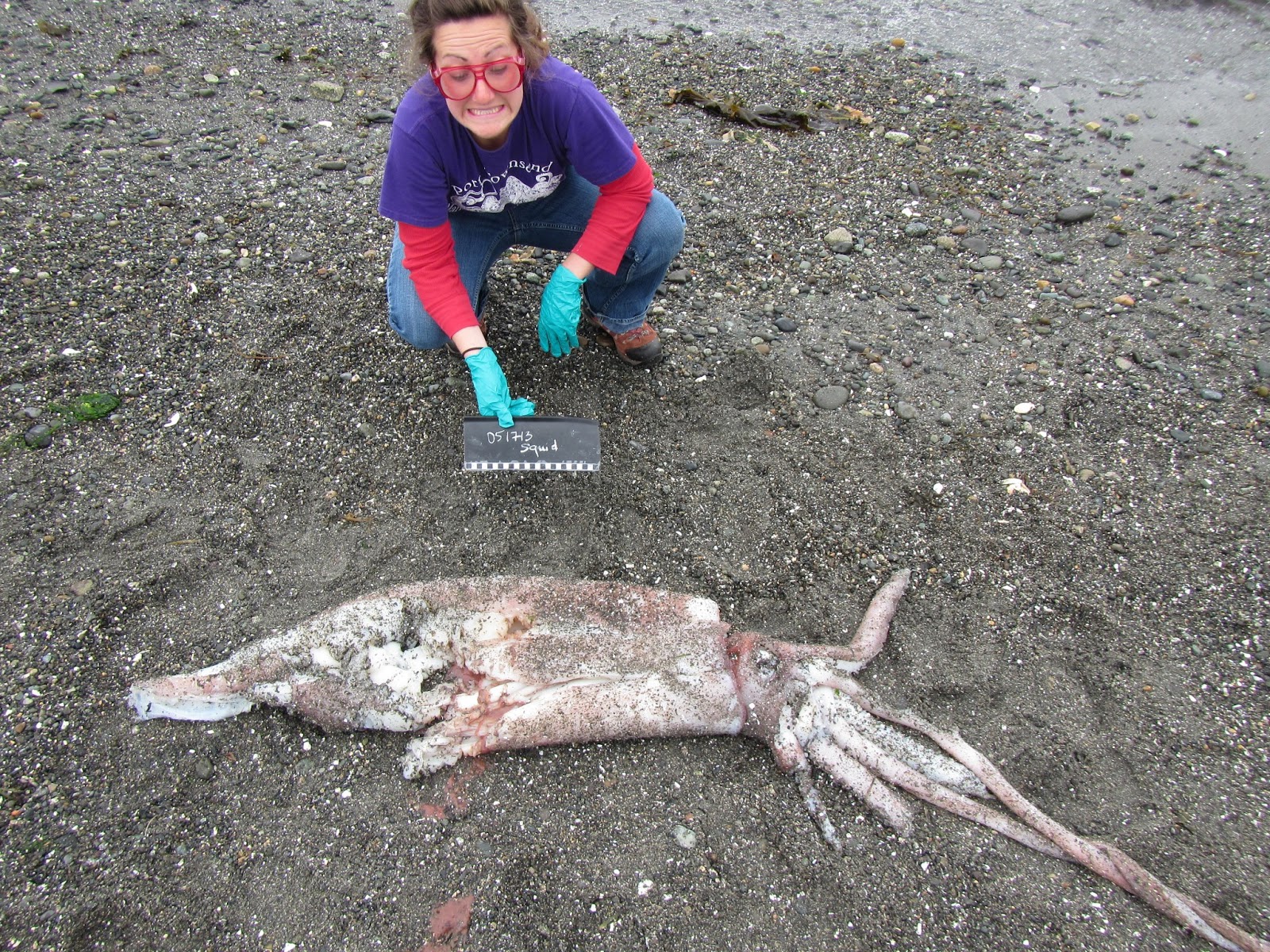
Before we started working with OGL we wouldn't have responded to a phone call about a huge squid (unless it was out of pure curiosity). But now when we received a phone call from our friends at the Northwest Maritime Center that a large squid washed up on their beach, we were pretty excited to have an excuse to go check it out.
Jamie Landry, Citizen Science Coordinator (left), and Megan Veley, AmeriCorps (right) after dissection of the Humboldt Squid on the Northwest Maritime Center's beach.
I was lucky enough to escort PTMSC citizen science coordinator Jamie Landry to our first OGL sample site. You never know what you are going to see when you respond to a phone call. Filled with excitement, people tend to exaggerate or complete misidentify things. So we try hard to be always prepared for the "unknown" (that is my favorite part because I like to let my imagination run wild!).

When we got to the beach there was no doubt it was a squid. After some measurements we identified it as a Humboldt Squid. Jamie was excited to try out the new sampling protocol while I was enamored with remembering squid atomony that I learned last summer when teaching marine biology camp (PTMSC summer camps: http://www.ptmsc.org/summercamps.html)
Megan excited and ready to dissect!
This guy/girl was much bigger than our dissecting specimen, but that didn't make it any easier. The squid was in pretty rough shape by the time we got to it. Regardless we did our best to learn by exploration while we worked through the new sampling protocol.

You would think a Humboldt Squid would be cool enough and probably wouldn't have the opportunity to sample anything that neat for awhile. Think again...

It was only a week later when a phone call was forwarded to me--someone found something on the beach! The beach walker said he was about 150 yards away from us heading towards the light house. He was looking at a huge ray that looked like it might still be alive and stuck. I said I would be right there and took off with the camera.

Sure as he was, there laid a hug ray-like creature in the water right in front on him. However, it was no ray, but one of their close relatives the Skate. I knew immediately the species was Big Skate because of all the images we saw when looking up information on our baby Big Skates that had just hatched in our touch tanks (funny how things work like that)!
The Big Skate swaying in the surf right after being found by beach walkers.
So was it alive or dead? Well I was pretty positive it was dead because these guys are masters at living in sandy bottoms and there was nothing besides sand that was keeping her there. However, when looking at her it was hard not to think she was still alive because of the way her tail and fins were moving--wave action or still holding on?

Well there was only one way to find out and that was to walk into the water and touch it. I'm sure I could have used a stick, but what's the fun in that? Plus I knew it didn't have a barb like its relative the ray so I convinced myself it was completely harmless.

A good poke in the stomach and eye proved that she was no longer alive and was just an extremely fresh wash-up being moved by the wave action. In the name of science it's hard not to be excited that she was dead. Not just because we get to sample her and learn SO much during the dissection, but also because if she had been alive she would have been distressed and there was nothing we could have done to help her.

I explained to the couple who found her that we were going to take some samples for OGL and they could stay and help. They were pretty disappointed she wasn't still alive, but when they learned she wasn't going to die in vain and was helping science instead--it was OK.

The skate was about 5ft from wing to wing and wasn't going to be easy to drag up on shore. The tide was coming in and kept trying to pull her back out. I called in reinforcements and after various tactics and water filled boots we puller her up and out of the water.
AmeriCorps (Emily, Megan & Amber) getting things done! Trying to beat out the high tide.


The muscles! Megan, Jamie, Amber & Claudia (left to right).


After Jamie collected the sample for OGL we continued with dissecting. We were all vey curious to see what was in the stomach (especially because we are trying to figure out what our baby Big Skates want to eat). To our surprise the stomach had fish inside, but no just one--3 full grown sculpin!

If that wasn't cool enough, we also found an egg case! We aren't 100% sure, but we think she was about to deposit it because it was complete and sealed shut. We asked if there could be something inside. We just had an egg case that no one thought was viable and it hatched out 5 adorable skates! Maybe this one could do the same?
Discovering the egg case.
We wanted to honor her gift to science and see if we can give her egg case a second chance. It is now living in our lab tanks, save from the oceans elements and predators.

Who knows maybe next year or even a year after that we will have more baby skates mesmerizing us as they explore their new life?
Thanks to citizen scientist like you and awesome projects like OGL we get to wait and find out...

Thanks for stopping by!

Danae Presler (Babysitting an Elephant Seal) -- AmeriCorps Marine Mammal Stranding Network Educator

Amber Heasley (The Mysterious Skate Hatch) -- AmeriCorps Marine Exhibit Educator

Megan Veley (Dissecting Marine Wash-ups) – AmeriCorps Natural History Exhibit and Volunteer Program Educator
**For more pictures of all these cool critters and our daily adventures check out our Facebook page (even if you don't use it you can still see the pictures if you follow the link and click on photos): https://www.facebook.com/pages/Port-Townsend-Marine-Science-Center/64955379712