Showing posts with label marine mammals. Show all posts

Wednesday, November 8, 2017

The Future of Oceans: Short of Breath―Marine Life in a Warming World

Curtis Deutsch, PhD
Associate Professor, 
School of Oceanography, 
College of the Environment 
University of Washington
Sunday, December 10
3 pm
Curtis Deutsch, PhD
The Fort Worden Commons*

*Please note change of venue


Admission: $5
(students, teachers FREE)


Dr. Curtis Deutsch’s research is aimed at understanding the interactions between climate and ecosystems. He combines numerical models of varying complexity with diverse types of biological and physical data, to discover the ways in which climate produces spatial pattern and temporal variability in ecosystems, and thus influences their basic functioning. Most of this work has focused on biogeochemical cycles in the ocean, with a particular emphasis on the mechanisms that regulate the cycles of nutrients and oxygen over a range of time scales from years to millennia. He also works with terrestrial ecologists to understand how climate influences the patterns of thermal fitness, and their implications for biodiversity in a changing climate. He received an Investigator Award from the Gordon and Betty Moore Foundation, and is a Fellow of the Kavli Frontiers of Science.

This is the third installment of The Future of Oceans lecture series (learn more about the series here).

This event is offered with generous support by the Darrow Family.

Assisted Listening Devices available

Wednesday, September 20, 2017

The Sonic World of the Amazonian Pink Dolphin

Sunday, October 8, 2017 
3 pm
David Bonnett, Citizen Scientist
The Fort Worden Chapel

Admission: $5
(students, teachers FREE) 


Mr Bonnett will present his most recent finding of his acoustical research with Amazonian Pink Dolphin (Inia geoffrensis) including how ecosystem changes in the Amazon are impacting this species and how this research relates to our local species of Cetacea. His research grows from decades of underwater acoustical research and designing ultra-quiet vessels. 

This is the first installment of The Future of Oceans lecture series. 
This event is offered with generous support by the Darrow Family.

Assisted Listening Devices available

Monday, August 21, 2017

Sunning The Whale Day

Friday, September 1

11am-5pm

Fort Worden Pier


Come visit the PTMSC when we "daylight" the gray whale bones on the Pier for a long dose of sun and warmth. For this one-day-only event, staff and volunteers will be on hand to answer questions about gray whales, how this one came to be part of the PTMSC collection, and what we can learn from marine mammals in our midst. You can also learn more about the Marine Mammal Stranding Network at work right here in Port Townsend.


In May of 2016, a juvenile gray whale died in Elliott Bay in Seattle and was towed to a site on Indian Island provided by the US Navy. A team of volunteers, staff, and AmeriCorps members assisted with the necropsy and additional preparation of the body for preservation of her skeleton. The PTMSC has been storing the skeleton until it can be articulated for use in educational programs and exhibits. 

Thursday, February 2, 2017

Way of Whales Conference 2017

Way of Whales
IMG_5713.JPG
The view from the Coupeville ferry. Photo by Mattie Stephens
The time has come and gone for the annual Way of Whales Conference, or as I like to call it, Whalefest 2017. Coupeville high school was the host, and in order to arrive in time, Jan North, Betsy Carlson and I caught the 8 am ferry to make our way into Whidbey Island. When we arrived, I caught a whiff of the local agriculture before setting up our exhibition table while Jan and Betsy signed us in. We displayed skulls of all kinds, including a steller sea lion that took many as a bear skull. Our save the shore sign was displayed and many a pamphlet were spread around to give the good word. After speaking to a few visitors to our booth, I was able to walk around and explore the other organizations and their tables while awaiting the day’s many presentations.  
IMG_5715.JPG
Our proud table! Photo by Mattie Stephens
As I wandered, looking at all the tables, gathering stickers and snacks, I realized how nice it was to be surrounded by fellow “whalers.” My goal of the conference was to expand my marine science network, including my interesting new friends, London, and her father. I spoke with them after overhearing London is heading to New Zealand to work with a graduate student – something I didn’t expect to have in common with a nine year old. London is invited to come to the Port Townsend Marine Science Center (PTMSC) and train her brain on our many cetacean skeletons.
The first presentation was by Howard Garrett of Orca Net, welcoming us all to Whalefest. After introducing the day, he spoke about freeing Lolita, an orca taken from the Salish Sea in the 70s, currently kept at Miami Seaquarium.
Howard Garrett.jpg
Howard Garrett of Orca net. Photo by Betsy Carlson
John Calambokidis.JPG
John Calambokidis of Cascadia Research Collective and others. Photo by Betsy Carlson
Image result for langley whale center
The second presenter was John Calambokidis. He gave a presentation about Sounders – local gray whales. It was fairly early for a PowerPoint, but I was wide awake when he presented awesome videos of gray whales he received from suction cup video tags. I met him afterwards, and he knew the professor I worked with in Galveston. He said he would happily be in correspondence.
I’ll remember you all when I’m famous.
Val Viers, an environmental physicist, spoke on his 15 year quest to learn about orcas and acoustics in the Salish Sea. He presented interesting and rare footage of orca communication sequences matched with recorded orca actions and position. What I found most interesting was Val’s deciphering of an orca mother scolding her offspring, which we were able to see on film. Val and his son work with PTMSC and installed our hydrophone, a device that allows us to hear boat and animal noise underwater. We work with his son Scott in the Salish Sea hydrophone network, monitoring ship noise and orca/marine mammal communication.
Current hydrophone network of the Salish Sea. 
Lastly, we watched a beluga whale documentary on the endangered St. Lawrence whales. An orphaned baby beluga is found alive on the beach with time running out. The responding scientist tries something unusual – releasing it back into the wild in hopes another mother will adopt the calf as her own. I’m no movie critic, but the message of the movie was critical – there needs to be widespread knowledge and support of environmental and animal stewardship. Without a change in human behavior, the environment of these whales will deteriorate.
Drone footage of St. Lawrence beluga whales. Photo by Suzanne Chisholm and Michael Parfit
Whalefest was closed with a special music video about saving the Salish Sea and played a part in explaining the inter-connectivity of the diverse organisms. Helping people connect emotionally with a place like the Salish Sea can inspire them to protect it. This resounds soundly with the Port Townsend Marine Science Center’s mission of inspiring conservation of the Salish Sea. The Way of Whales conference and its presenters, all wonderfully well-spoken and knowledgeable, moved strongly for the Salish Sea's conservation. I enjoyed my experience at Whalefest 2017, hope to return, and would recommend a visit to anyone.


See more of our wonderful organization on our Facebook and Instagram, and please consider donating today.
Matthew (Mattie) Stephens is an AmeriCorps serving at the Port Townsend Marine Science Center.

Tuesday, April 26, 2016

Learning from Whales

"Earth and sky, woods and fields, lakes and rivers, the mountains and the sea, are excellent school masters, and teach some of us more than we can ever learn from books" —John Lubbock

After months of cold, dark, windy days, the warmth has finally arrived. I find myself looking for more excuses to stay outside and explore everything from the woods to the sea. I'm noticing flowers blooming and birds singing, all new species to me as a newcomer to the Pacific North West. But one this is for sure, with the warmth comes the familiar creatures that I have known and loved for as long as I can remember — whales.

 After almost two hours of not seeing any whales,
 we came across this Humpback Whale lobtailing
 (slapping its fluke on the ocean surface)

Every day I scan the horizon looking for whales — their great exhale or their tall dorsal fins. And while I am excited for Orcas and Grey Whales to be swimming through the Puget Sound, I am most excited to see the Humpback Whales.

Dyad.
This was the first Humpback Whale I identified off of the fluke patterns
Photo Credit: Blue Ocean Society

In the summer of 2012, I was working on a whale watching boat out of Portsmouth, New Hampshire, recording whale behavior and educating the passengers. With each trip out to sea, my love for the ocean grew deeper (as deep as the Mariana Trench!). I learned not only about these wonderful creatures, but how connected they are to their surroundings. I was finally able to apply what I had learned in school to the real world. From then on, my curiosity and desire to learn more about the ocean led me to where I am today. With every job and every move, I become engulfed in a new ecosystem with all of its critters.

Pinball (Left) and another Humpback whale.
Photo Credit: Blue Ocean Society

So as each spring comes, and the whales start coming in, I always think back to that summer on the boat where it all began. While I won't recognize any of the patterns on the underside of Pacific Humpbacks' caudal fins, I am excited to learn the individuals on the West Coast.


KATIE CONROY is the Marine Mammal Stranding Educator and an AmeriCorps member serving at the Port Townsend Marine Science Center.


Next Tuesday, May 3, the Port Townsend Marine Science Center is trying to raise $15,000 for our mission and programs through GiveBIG, a one-day, online charitable giving event hosted by the Seattle Foundation, but we can't do it without your help! Thanks to a challenge match from a group of local donors, your donation will be matched dollar-for-dollar before being stretched even further by the Seattle Foundation! Schedule your gift today!

Tuesday, March 1, 2016

How to tell the difference between California Sea Lions and Steller Sea Lions


California Sea Lion

Steller Sea Lion
Males: 800lbs Females: 250lbs
Weight
Males: 2200lbs Females: 800lbs
Males: 8ft Females: 5ft
Length
Males: 8-11ft Females:6-7ft
Dark brown coat. Females and juveniles may have a lighter coat. Beige or brown whiskers
Color
Light tan to gold or reddish brown. No markings, pale whiskers.
Vancouver Island, BC to Southern tip of Baja California
Distribution
Steller sea lions are found in coastal waters of the North Pacific Ocean from Japan to central California.
California sea lions may hunt continuously for up to 30 hours, with each dive lasting three to five minutes.
Fun Fact
Steller Sea Lions swallow stones up to 12 cm—and no one knows why!


Male California Sea Lion 

California Sea Lion:

  • visible sagital crest
  • large, wing like fore flippers
  • short hairs all over body
  • California Sea Lion Calls (From Macaulay Library at Cornell University)


Male Steller Sea Lion


Male Steller Sea Lion:
  • blunt face and boxy, bear like head
  • no visible sagital crest 
  • bulky build
  • very thick neck
  • thick coat of hair on neck
  • Steller Sea Lion Calls (From Marine Mammal Center)


In the News: 

Researchers are breaking down the science behind how a Sea Lion propels itself in an effort to apply similar mechanics to an underwater robot. After hundreds of hours of video the researchers at George Washington University noticed a distinct propulsion system. "First the animal collects water in its fore flippers, and then quickly scoops the water in toward its body. Then it claps its flippers against its torso, pushing the water toward its rear flippers and propelling it forward in a glide."


also in the news:

The other week, a Sea Lion pup was found sleeping in the booth of a popular seaside restaurant in San Diego! I guess the food was so good, he didn't want to leave.


Did you know: 

Sea lions are the first non-human mammal that we know of that has the ability to keep a beat, suggesting that rhythm may be more common in the animal kingdom than we thought.

And remember!!


If you see a stranded marine mammal, call the PTMSC Marine Mammal Hotline
360.585.5582 x 103


KATIE CONROY is the Marine Mammal Stranding Educator and an AmeriCorps member serving at the Port Townsend Marine Science Center.

Tuesday, December 22, 2015

Play the Game: How to Tell the Difference Between Seals and Sea Lions

Really think about it, if you were walking along the beach as the sun was going down and saw a marine mammal in the distance, would you be able to identify it? It is okay if you are quietly saying to yourself, "no," I am going to help with that!

I have created a matching game. I am going to introduce different marine mammals that look very similar to each other and provide information about how to identify them, life history, and some fun stories and facts. I will post pictures at the bottom and you must see if you can guess the correct species! Next month, I will post the answers along with a new set of species, so make sure you check back and see if you got it right! Come summer, you will all be experts at identifying marine mammals!  

A little information about marine mammals:

Marine mammals are mammals that live in the marine environment for the majority of their lives. These mammals get their food from the ocean and their water from their food. We have over 31 species of marine mammals that call the Pacific North West home. So let’s jump right in and learn about them!

Week 1: Seals vs Sea Lion

Do you think you know the difference between a seal and a sea lion? What key characteristics would you look for to tell them apart?

Our seals and sea lions are fin-footed carnivorous marine mammals within the suborder Pinnipedia (meaning “wing-foot” or “feather-foot”). This suborder, which includes Seals (Family: Phocids), Sea Lions (Family: Otariids) and Walruses (Family: Odobenidae), have the widest distribution of any other suborder and inhabit all the oceans. Pinnipeds main sources of food are fish and squid, however some will eat mollusks, crustaceans and much larger prey.

Photo from National Geographic 1987
So how can you tell them apart?

There are a couple of noticeable differences between Seals and Sea Lions. When I am differentiating between the two, I focus on two characteristics: their flippers and their ears. 

The forelimbs of sea lions are longer and more developed than those of seals. They use them to move through the water and to prop themselves up and move quickly on land. Another noticeable characteristic is that their hind flippers can rotate forward. In contrast, a seal uses its hind flippers when propelling through the water, cannot prop themselves up, are awkward when moving on land, and cannot rotate their hind flippers forward.  

Another way to differentiate between the two would be by observing their ears. Sea lions have external ear flaps where true seals do not. This is not something you would see unless you were standing over a dead individual or you had binoculars. Never go up to a seal or sea lion to see if it has ear flaps or not, I promise you, it will not end well.

From "Guide to Marine Mammals of Alaska" Kate Wynne

Below you can see some other characteristic differences between the two species:

Now that you have all the information do you think you can tell them apart? 

Who am I? 
                                                                           
Who am I?
Who am I? 
Who are we?
I am going to start off easy, just so that you can focus on noticing the differences. Don’t worry, the pictures will get more difficult. You can put your answers in the comment section below so I can see who gets them right! 


KATIE CONROY is the Marine Mammal Stranding Educator and an AmeriCorps member serving at the Port Townsend Marine Science Center.  

Tuesday, December 1, 2015

"Zella" the Seal Pup

Yesterday I responded to my first Marine Mammal Stranding Network call! Luckily for me, I didn't have to travel far to see this marine mammal because she was hauled out on the beach right next to the PTMSC pier.

Zella, the harbor seal pup, resting on the beach

Maybe she'll come tour the exhibit next weekend!

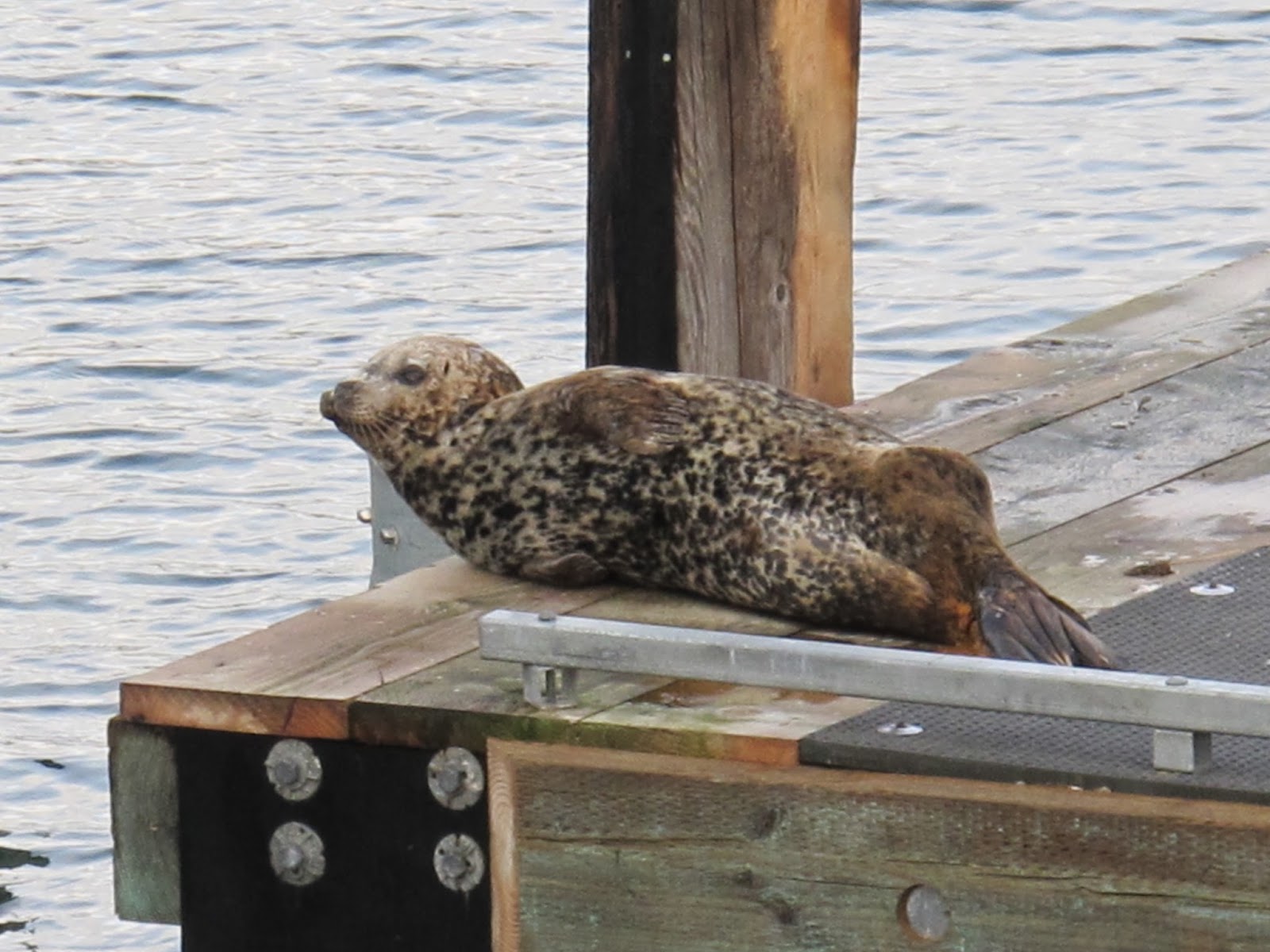
Around 1 o'clock on Saturday, a harbor seal pup climbed up on the sandy, protected shore right in front of the Marine Exhibit. She looked healthy, chubby, and relaxed. I think this is the same pup we've seen playing and hunting by the pier for the past month or so. On Friday, one of our smallest visitors decided to name her Zella. All the visitors to the Marine Exhibit on Saturday got to see her resting on the beach from the safe distance of the pier. We reminded everyone to admire her from afar and not to approach her.


REBECCA MOSTOW is the Marine Exhibit Educator and an AmeriCorps member at the Port Townsend Marine Science Center.

Monday, July 6, 2015

Training Triumph for Stranding Responders

With numerous calls coming into PTMSC's Marine Mammal Stranding Network Hotline, it was about time to have our annual Stranding Responder Training. On June 16th, volunteers, new and old, came to learn the skills needed to respond to stranded marine mammals.

First, volunteers enjoyed talks on the Marine Mammal Protection Act, the history of stranding networks, and safety concerns while out on a response. They learned about the marine mammals native to the Salish Sea and aced their quiz on how to identify them!

PTMSC's stranding network team, from left, Jamie Montague, Citizen Science Coordinator, Erika Winner, Marine Mammal Stranding Educator, and Chrissy McLean, Marine Program Coordinator. 

Erika discusses the importance of stranding networks. 

Next, new volunteers received their own stranding response kits. Among the many contents of the kit are "Share the Shore" caution tape to close off a section of beach for resting seals, signs to educate the public, chalk slates with scale bars to take excellent photographs, and the all important Level A form to record data from a stranding.

Brand new responder kits complete with everything from our handy dandy Stranding reference packet to 40 feet of yellow "Share the Shore" caution tape. Special thanks to Casey Gluckman, Merce Dostale, and Michael Tarachow for helping put them together. 

Last, the training headed outside to get hands-on experience with previously frozen harbor seals. There were three seals to check out: a lanugo (prematurely born) pup, an emaciated pup, and a small adult. Volunteers got to see up close the anatomy of each seal. Volunteers then got to practice recording their observations on a Level A form, the main reporting form for marine mammal strandings.
Chrissy shows volunteers the anatomy of a harbor seal pup carcass. 

Volunteers learn to inspect a harbor seal pup and fill out a Level A reporting form. 

Thank you to everyone that could make it to the training, and as always to all of our hardworking stranding network volunteers. Here's to a great and exciting summer!

Friday, April 10, 2015

Marine Mammal Stranding Network Newsletter

It’s that time of year!

Spring migrations bring gray whales, California sea lions, and elephant seals up the coast. Our local harbor seals are ready to burst with new pups on the way. Yearlings are claiming their own territory, sometimes at a local marina! Before we know it, the hotline will be ringing off the hook and I’ll be calling you, my wonderful volunteers. We’re going to have plenty of strandings to respond to and seal pups to sit. And for those animals that unfortunately will get selected out of the gene pool (but stay fresh), we’ll perform necropsies to find their cause of death. There’s so much to learn about these wonderful mammals of the sea.

With so much to look forward to, let’s first take a look back at 2014. It was a busy year, with a record number of calls on the hotline and strandings on the beach. So join us in seeing all the hard work we put in last year!


Thank you!
Erika Winner
MMSN Educator - AmeriCorps

Call Volume Explodes with  “Share the Shore” Sign Installations

Holy moly, we sure got a lot of calls on our hotline last summer! Does that mean there were more marine mammals getting stranded? Unlikely. We hope it’s because of our “Share the Shore” signs. Through our Prescott Grant, we have installed 21 signs across East Jefferson County. Not only are they beautiful, but they share valuable information to the public about marine mammals. Beaches are a great place for relaxation and recreation, but it’s often forgotten that beaches are also vital habitat for amphibious marine animals. 


Above: Number of calls each month to the MMSN message-line in 2014 as compared to monthly averages from 2007-2013.

The “Share the Shore” signs aren’t pulling all of the weight though. Rack cards distributed by volunteers to local organizations and businesses have also proved priceless in our education efforts!
If you’re interested in helping with public outreach, check out page 6 for more information.

Right: Locations of installed “Share the Shore” signs across East Jefferson County. Think you know a great place to install a sign? Let us know!


How Many Marine Mammals are Reported Each Year? 

After a two year decline from 2011 to 2012, reports on marine mammals has steadily climbed in East Jefferson County. In 2014, we broke our record with 91 marine mammals reported! Of those 91 animals reported, just over half were actually stranded (whew!).
Number of calls each month to the MMSN message-line in 2014 as compared to monthly averages from 2007-2013.
75 of those animals that were called in were harbor seals, yet again demonstrating the abundance of the species in our region. Many of those seals were not stranded, but pups hauled out on busy beaches. Luckily, we have so many wonderful volunteers willing to seal-sit these young animals. Seal-sitting has also been a great opportunity to educate the public about marine mammals.


Rehabilitated Seal Pup, EJC-2014-012 

On July 9th, a harbor seal pup was reported on a private beach in Brinnon. The mother had not attended to the pup in 24 hours. Seeking comfort, the pup was calling out and attempting to suckle on some beach walkers. The reporting party observed a neighbor trying to feed the pup.
On the 11th, Chrissy McLean checked on the pup and found it laying next to a dog! She decided to relocate the pup to Point Whitney to be on public land, near other seals, and away from people (and dogs).

 The next day, the pup was back into mischief, attempting to suckle a women’s toes at the Point Whitney boat ramp. Sergeant Andersen of Washington Department of Fish and Wildlife picked up the pup. After so much human interaction and no mother to be found, it was decided to send the pup to a rehabilitation center.

She was transferred to PAWS Wildlife Center. She stayed with PAWS for 68 days before being successfully released  by NOAA at Jetty Island.

Pictures: Left: EJC-2014-012 takes a rest in Sgt. Andersen arms before transport to PAWS in Lynnwood. Right: EJC-2014 -012 happy and healthy, hanging poolside at PAWS.

Artemis the Sea Lion Skull

The skeleton collection at the Natural History Exhibit has a new member. Come in and see a male Steller Sea Lion skull! EJC-2011-017, A.K.A Artemis, was spotted by a paraglider at Fort Flagler in November of 2011. After examining the carcass, Chrissy McLean and Jamie Montague collected Artemis’ head for the PTMSC education collection. Strangely, Artemis is lacking the diastema between the fourth and fifth post-canines usually characteristic of Steller sea lions.


Necropsy Program

We completed five necropsies (animal autopsies) in 2014, on three harbor seals and two harbor porpoise. Staff and trained volunteers examined the animals looking for:
  • cause of death
  • signs of human interaction
  • presence of parasites

Collected tissue samples are sent to an Oregon State University lab to be tested for disease.

Right: Chrissy McLean and inter, Carolyn Woods perform an external examination on a harbor seal before making the first incision.

Though necropsies can often bring out more questions that answers, this years necropsies did come up with some noteworthy results. Evidence of net impressions helped determine that one of our harbor porpoise and two of our harbor seals had suspect or probable fisheries interaction. This is a stark reminder that bycatch is still a challenge that marine mammals face in the Salish Sea. Without a dedicated stranding network, such problems would go unrecorded. 

Necropsy team members,  Karen DeLorenzo, Carolyn Woods, Rae  Bronenkant, Danae Presler, and Chrissy McLean demonstrate just how long the small intestine of a  harbor seal is!


Want to learn more about necropsies?

Check out our new necropsy video! Learn about the data we collect and the importance of performing necropsies. Look for it soon on the PTMSC blog or on our Facebook page. Special thanks to Carolyn Woods, Danae Presler, and Matt Eschbach for their hard work.

What’s Happening in 2015?


A new year brings new projects! Check out these opportunities:

1. Responder training
2. Sign installations
3. Distribute rack cards
4. Harbor porpoise monitoring

Responder Training
We will be having a training June 16th for new and seasoned responders alike. If you would like to brush up on marine mammal basics, go over protocol for responding, and hear about special cases, (among other marine mammal topics), RSVP to Erika.

Sign Installations
Our “Share the Shore” signs have helped PTMSC educate more people about marine mammal strandings than ever before! So you’re probably asking: what’s next? Well, we have more signs to install! You might have noticed that most of the signs are located in the northern section of our response zone. We are hoping to increase our outreach farther south. If you know an ideal location to install a “Share the Shore” sign, contact Erika. Photos of the location are appreciated.

Rack Card Distribution
These cards are a quick and easy way to educate the public on the marine mammals in our area. We need your help distributing the rack cards. If you are interested, contact Erika.

Harbor Porpoise Monitoring
PTMSC is partnering with the Pacific Biodiversity Institute! This spring and summer, we will be conducting shore-based observations of Port Townsend’s harbor porpoise population. Data gathered from this project will  help confirm acoustic recordings from our hydrophone and document porpoise behavior. This project is still in the planning stages, so stay tuned for future updates. 


Erika Winner
MMSN Educator
(360) 385-5582 ext. 116