Showing posts with label marine mammal stranding educator. Show all posts

Thursday, February 2, 2017

Way of Whales Conference 2017

Way of Whales
IMG_5713.JPG
The view from the Coupeville ferry. Photo by Mattie Stephens
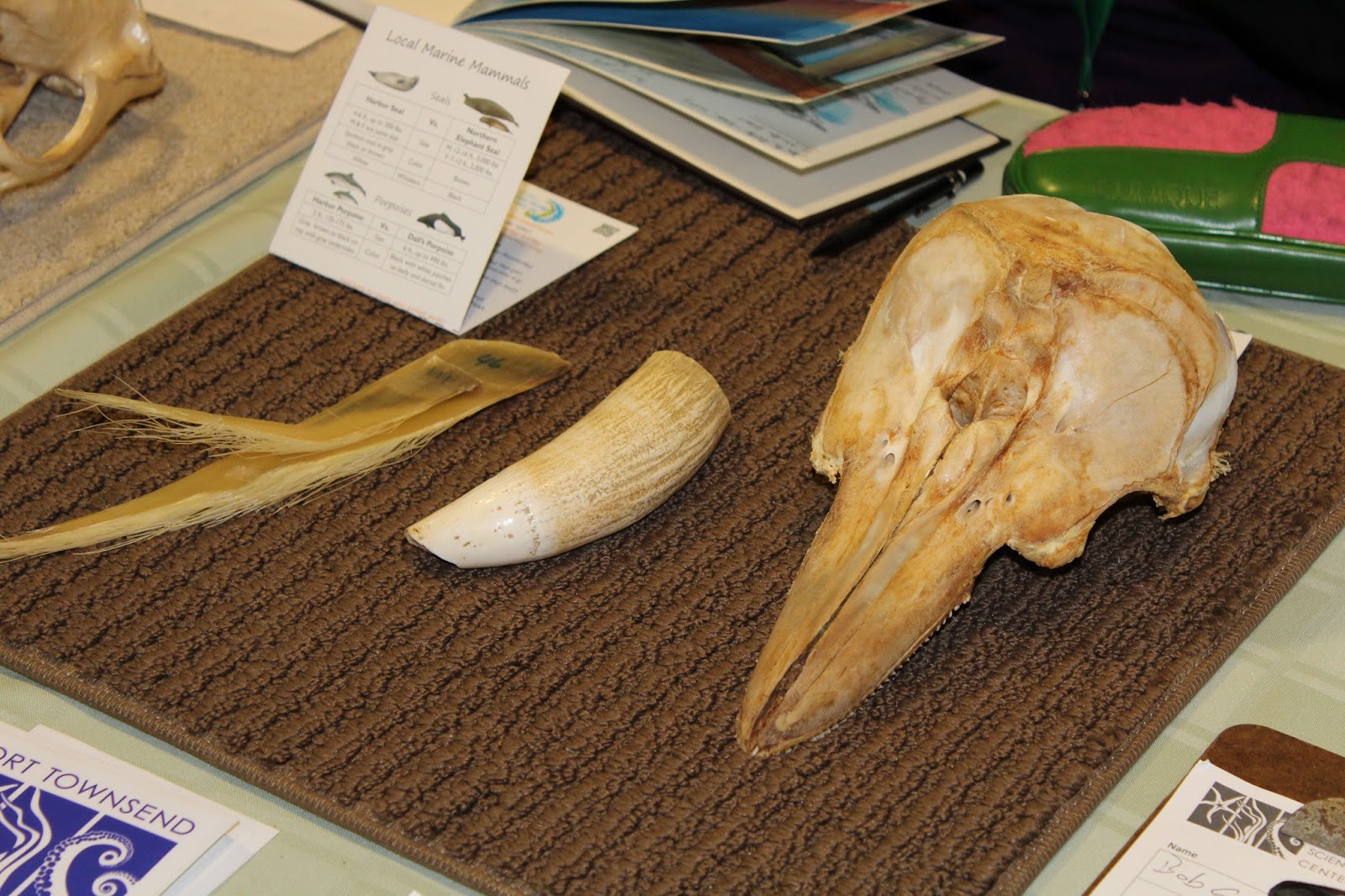
The time has come and gone for the annual Way of Whales Conference, or as I like to call it, Whalefest 2017. Coupeville high school was the host, and in order to arrive in time, Jan North, Betsy Carlson and I caught the 8 am ferry to make our way into Whidbey Island. When we arrived, I caught a whiff of the local agriculture before setting up our exhibition table while Jan and Betsy signed us in. We displayed skulls of all kinds, including a steller sea lion that took many as a bear skull. Our save the shore sign was displayed and many a pamphlet were spread around to give the good word. After speaking to a few visitors to our booth, I was able to walk around and explore the other organizations and their tables while awaiting the day’s many presentations.  
IMG_5715.JPG
Our proud table! Photo by Mattie Stephens
As I wandered, looking at all the tables, gathering stickers and snacks, I realized how nice it was to be surrounded by fellow “whalers.” My goal of the conference was to expand my marine science network, including my interesting new friends, London, and her father. I spoke with them after overhearing London is heading to New Zealand to work with a graduate student – something I didn’t expect to have in common with a nine year old. London is invited to come to the Port Townsend Marine Science Center (PTMSC) and train her brain on our many cetacean skeletons.
The first presentation was by Howard Garrett of Orca Net, welcoming us all to Whalefest. After introducing the day, he spoke about freeing Lolita, an orca taken from the Salish Sea in the 70s, currently kept at Miami Seaquarium.
Howard Garrett.jpg
Howard Garrett of Orca net. Photo by Betsy Carlson
John Calambokidis.JPG
John Calambokidis of Cascadia Research Collective and others. Photo by Betsy Carlson
Image result for langley whale center
The second presenter was John Calambokidis. He gave a presentation about Sounders – local gray whales. It was fairly early for a PowerPoint, but I was wide awake when he presented awesome videos of gray whales he received from suction cup video tags. I met him afterwards, and he knew the professor I worked with in Galveston. He said he would happily be in correspondence.
I’ll remember you all when I’m famous.
Val Viers, an environmental physicist, spoke on his 15 year quest to learn about orcas and acoustics in the Salish Sea. He presented interesting and rare footage of orca communication sequences matched with recorded orca actions and position. What I found most interesting was Val’s deciphering of an orca mother scolding her offspring, which we were able to see on film. Val and his son work with PTMSC and installed our hydrophone, a device that allows us to hear boat and animal noise underwater. We work with his son Scott in the Salish Sea hydrophone network, monitoring ship noise and orca/marine mammal communication.
Current hydrophone network of the Salish Sea. 
Lastly, we watched a beluga whale documentary on the endangered St. Lawrence whales. An orphaned baby beluga is found alive on the beach with time running out. The responding scientist tries something unusual – releasing it back into the wild in hopes another mother will adopt the calf as her own. I’m no movie critic, but the message of the movie was critical – there needs to be widespread knowledge and support of environmental and animal stewardship. Without a change in human behavior, the environment of these whales will deteriorate.
Drone footage of St. Lawrence beluga whales. Photo by Suzanne Chisholm and Michael Parfit
Whalefest was closed with a special music video about saving the Salish Sea and played a part in explaining the inter-connectivity of the diverse organisms. Helping people connect emotionally with a place like the Salish Sea can inspire them to protect it. This resounds soundly with the Port Townsend Marine Science Center’s mission of inspiring conservation of the Salish Sea. The Way of Whales conference and its presenters, all wonderfully well-spoken and knowledgeable, moved strongly for the Salish Sea's conservation. I enjoyed my experience at Whalefest 2017, hope to return, and would recommend a visit to anyone.


See more of our wonderful organization on our Facebook and Instagram, and please consider donating today.
Matthew (Mattie) Stephens is an AmeriCorps serving at the Port Townsend Marine Science Center.

Tuesday, July 26, 2016

The Wailing Seal

Back in November, I wrote about my first (and cutest) stranding response. Since then, It has been a quiet couple of months; a dead seal here, a dead whale there. Well … maybe not quiet. Now summer has arrived, and with warm weather comes Harbor Seal pupping season. That means cute baby seals will be littering our beaches to rest. I have already had a few calls about sleeping seals, but one call is worth mentioning.


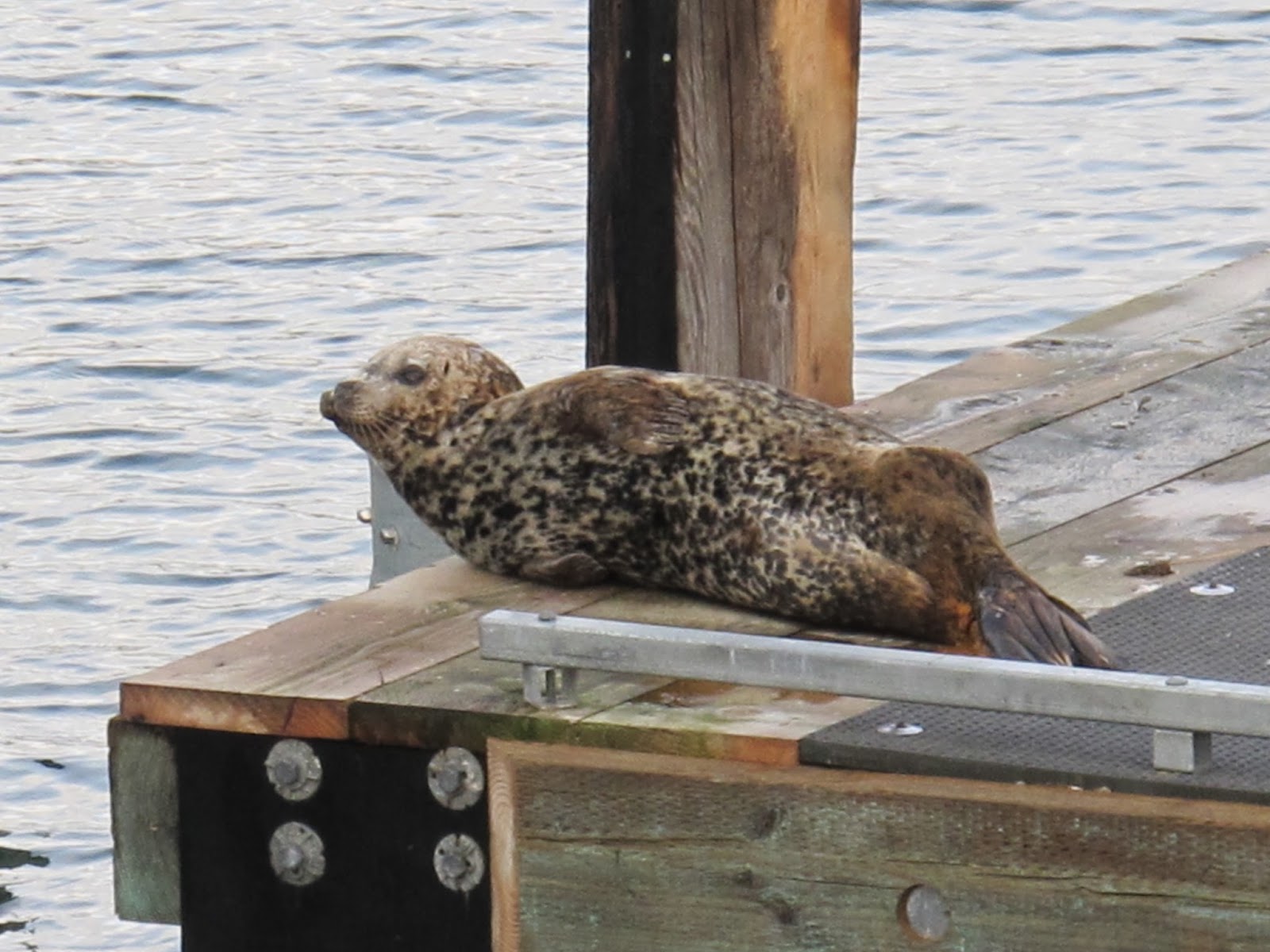
Two weeks ago, I received a call about a young seal pup on a busy dock in Quilcene. After viewing photos sent by the caller, I was able to identify it as a lanugo pup. A lanugo pup is a premature seal pup; they have a silvery coat that is normally shed within the womb before birth. Sadly, because they are premature and thus underdeveloped, they do not normally survive. But like all other seals, the mother temporarily left it on shore while it went to forage.

A concerned citizen called in, and as I was talking to him, I could hear the pup in the background crying out for its mom. I would have raced down there and sat with the animal if I wasn’t backup for the exhibits that day. Luckily I have an entire database of volunteers who are trained to respond to calls like this one. I sent one of those volunteers to the marina to monitor the seal and educate anyone curious about the wailing animal. I only intended for the volunteer to be there for an hour, but she insisted on staying. She took five hours out of her Saturday to sit with the seal.

Eventually the mother did return, and she and her pup swam off together. I am very happy that we were able to get a volunteer to the beach to make sure no one interacted with the seal. Each time I interact with the Marine Mammal Stranding volunteers I am reminded how dedicated they are, not only to the health of the seals, but to the stranding network as well.


As mentioned in the first blog post, no matter how cute a seal may be, no matter how much your heart melts, please give them space. Pups may be seen resting on the shore in the same area for several days; this is a natural behavior and does not mean they are abandoned. Not only are these animals protected by the Marine Mammal Protection Act, but they can become aggressive if approached. Please Share the Shore — stay back 100 yards if possible, keep your dogs on a leash, and if the animal is injured, call our hotline at 360-385-5582 ext. 103.


In the past, the Marine Mammal Stranding Network Hotline and training for the team of Marine Science Center volunteer responders has been funded by a highly competitive grant from the National Oceanic and Atmospheric Administration (NOAA). Unfortunately, funds are very limited and this year our grant was not renewed. We urgently need your help to protect the future of our marine mammals in the Salish Sea. Please donate today to help us raise $10,000 for the Marine Mammal Stranding Network by August 31.

—

KATIE CONROY is the Marine Mammal Stranding Educator and an AmeriCorps member serving at the Port Townsend Marine Science Center.

Photos 1 & 2 by William Clark | Photo 3 by Carolyn Avery

Tuesday, May 31, 2016

Operation Burrito Whale

When I think back to this past month, it was one big blur. It was as if my whole month of work just melded together into one big pot of marine science education. It is hard to explain, but I know I taught schools groups, led tours, ran the exhibits, but it feels like it happened so long ago! Then, as if May wasn't big enough, a HUGE opportunity fell into our laps, and we just couldn't say no. I'm sure most of you already know what I am about to say, but in the middle of the craziness that was May, the Port Townsend Marine Science Center acquired another full Grey Whale skeleton (the gray whale in our possession now is used for our Whales of the Salish Sea classes).

I have been waiting for an experience like this to happen again. The first necropsy I ever did was on a Sperm Whale four years ago in Bar Harbor, Maine. I didn't know when/if I would ever get to take part in a large whale necropsy after that, but luckily, I did. It was a hectic but exciting week where we were just about completely consumed with dealing with this whale. And let me tell you, dealing with a 30 ft. Grey Whale with only a week to plan is no easy job. But we were successful! A group of about 25 people spent 8.5 hours cutting up, wrapping and then sinking the whale. By the end we were all exhausted and smelled horrible — my watch and two pairs of rain boots still have a faint smell of decomposing whale.

It is still hard to truly comprehend what happened. Below I have added some pictures from what has become affectionately known as Operation Burrito Whale.

If you want to have further details, check out the article that appeared in the Port Townsend Leader last week!

Megan dabs essential oils under her nose.
This will only partially mask the smell of the whale.

Our knives became dull very quickly.
Even though we had 20 knives to use,
there were always knives to sharpen.


We could not have pulled this off without the help of all our
volunteers! Whether they were digging holes, cutting the whale,
or dealing with the net, they were helping out. 

Sometimes you just have to stand in a puddle of blood to
get the job done. 

By far the hardest part of cutting the whale
was getting the scapula and the pectoral fins. It took
about and hour to get just one out!
Karlisa and Carolyn after they cut the fin off

It took three people to get the scapula and fin out.
Michael! You were supposed to put the net over the whale, not
the net team!
Mallory and the net team turning our whale
into a "burrito" 
Burrito rolling time!


None of this would have been able to happen without the knowledge, resources and help from different organizations. So a BIG thank you goes out to NOAA Fisheries, the U.S. Navy, Washington Deparment of Fish and Wildlife Marine Mammal Investigation, Cascadia Research Collective, the MaST Center, Dr. Pete Schroeder, Washington Department of Fish and Wildlife Enforcement, Washington State Parks, Washington Department of Natural Resources, U.S. Coast Guard, Orca Network, Seattle Aquarium and the Sea Doc Society.

 And of course, a big thank you goes out to all of the wonderful volunteers and staff who took time out of their normal schedule to help out. Wade C, Sue L, Megan A, Mallory W, Michael T, Merce D, Stewart P, Howard T, Ashley M, Rebecca M, Carolyn W, Zofia K, Amy J, Karlisa C, Betsy C, Janine D, Alison R, and Phil D.

—

KATIE CONROY is the Marine Mammal Stranding Educator and an AmeriCorps member serving at the Port Townsend Marine Science Center.

Don't forget to join us this Saturday, June 4, at 9 am for a guided low tide walk! We're expecting to have great weather, so if you haven't ever participated in one of PTMSC's low tide walks, this would be a great weekend to grab your brand-new PTMSC hat and come out to explore!

Tuesday, April 26, 2016

Learning from Whales

"Earth and sky, woods and fields, lakes and rivers, the mountains and the sea, are excellent school masters, and teach some of us more than we can ever learn from books" —John Lubbock

After months of cold, dark, windy days, the warmth has finally arrived. I find myself looking for more excuses to stay outside and explore everything from the woods to the sea. I'm noticing flowers blooming and birds singing, all new species to me as a newcomer to the Pacific North West. But one this is for sure, with the warmth comes the familiar creatures that I have known and loved for as long as I can remember — whales.

 After almost two hours of not seeing any whales,
 we came across this Humpback Whale lobtailing
 (slapping its fluke on the ocean surface)

Every day I scan the horizon looking for whales — their great exhale or their tall dorsal fins. And while I am excited for Orcas and Grey Whales to be swimming through the Puget Sound, I am most excited to see the Humpback Whales.

Dyad.
This was the first Humpback Whale I identified off of the fluke patterns
Photo Credit: Blue Ocean Society

In the summer of 2012, I was working on a whale watching boat out of Portsmouth, New Hampshire, recording whale behavior and educating the passengers. With each trip out to sea, my love for the ocean grew deeper (as deep as the Mariana Trench!). I learned not only about these wonderful creatures, but how connected they are to their surroundings. I was finally able to apply what I had learned in school to the real world. From then on, my curiosity and desire to learn more about the ocean led me to where I am today. With every job and every move, I become engulfed in a new ecosystem with all of its critters.

Pinball (Left) and another Humpback whale.
Photo Credit: Blue Ocean Society

So as each spring comes, and the whales start coming in, I always think back to that summer on the boat where it all began. While I won't recognize any of the patterns on the underside of Pacific Humpbacks' caudal fins, I am excited to learn the individuals on the West Coast.

—

KATIE CONROY is the Marine Mammal Stranding Educator and an AmeriCorps member serving at the Port Townsend Marine Science Center.


Next Tuesday, May 3, the Port Townsend Marine Science Center is trying to raise $15,000 for our mission and programs through GiveBIG, a one-day, online charitable giving event hosted by the Seattle Foundation, but we can't do it without your help! Thanks to a challenge match from a group of local donors, your donation will be matched dollar-for-dollar before being stretched even further by the Seattle Foundation! Schedule your gift today!

Thursday, April 14, 2016

Volunteer Appreciation: an interview with Betty Petrie

Today I sat down with Betty Petrie to ask about her experience as a volunteer for the Port Townsend Marine Science Center. Originally from Houston, Texas, Betty has been living in Port Townsend for the past 18 years and has been volunteering with us for just as long! 


How long have you been a Marine Science Center Volunteer? 
18 years. 

Are you a member of the Marine Science Center?
Yes 

In what capacity do you volunteer here?
Homecrew: 18 years
On the board of directors: 3 years
Docenting the Marine Exhibit: 18 years
I also help out with fishprinting.

I used to docent at the cold water tank at the Houston Zoo and I taught zoology, so this was an easy transition. Years ago, docents used to give short presentations to the public about different subjects. I have presented about a lot of different topics such as crabs and whale evolution.

What aspect of the Marine Science Center's work resonates with you?
Just about everything really. But I really enjoy telling people what the different animals and plants are, what they do, and how they live. During homecrew, I like to clean the tanks so I can see all the new animals close up without a big crowd. 

What was your favorite day or memory of volunteering so far? 
That is hard to say, but flintsing the Grey Whale was definitely the best. I have never seen so many maggots in one place! 

What is your personal relationship/connection with the Salish Sea?
We saw so much of it from our boat when we first moved out here. At first it freaked me out because it was salt water and yet it was so clear. I could see all the animals! It also surprised me how deep it was and how quickly it became so deep.  I was not used to that coming from the Gulf of Mexico. 
On one of my first trips to downtown, I looked at the pilings at low tide and noticed all the animals! I thought to myself that I could have taught a whole zoology class right there. 

What inspires you, personally?
I am an active person, I like to move around and check things out. When I am in my boat I like to see what is at the bottom of the ocean, and I like to see what might be coming up with my crab pots. 

Can you tell me about a particular experience or moment of awe you've had with the Salish Sea that's stuck with you?
I saw a big pod of Orcas from Spieden Island. You can hike on it and at the far end we saw Orcas. I also saw many humpback whales. 

Why do you feel the Marine Science Center's work is important to the conservation of the Salish Sea? 

Mostly because it is giving people the awareness of what is going on and the realization of individual need to stop pollution. It shows people what is around and that you need to keep it pristine.

—

KATIE CONROY is the Marine Mammal Stranding Educator and an AmeriCorps member serving at the Port Townsend Marine Science Center.

Thursday, March 10, 2016

Free Science Classes

At the beginning of November, I had my first meeting to begin organizing the 8th annual Free Science Classes. I had heard a lot about this program, but it seemed always so far in the future. Finally the day to start planning arrived, so I jumped right in.

Free Science Class is a program started to provide schools that have a large percentage of their students on free or reduced-cost lunches the opportunity to learn about marine biology outside of their classroom. After months of emails, organizing with schools, and making sure everything was up to date, the day has finally arrived to start teaching.


From January 25 through February 26, my fellow AmeriCorps members and I taught over 600 third- and fourth-grade students about crabs and the marine birds of the Puget Sound. For children of such a young age, I was very surprised and impressed by how much these students already knew. Without any prompting, they brought up words, like "exoskeleton," that I did not learn about until college. I found there were few times that my questions went unanswered and many times students wanted to share a personal story or just about any thought that ran through their head. “I wish I could unzip MY spine and just walk backward out of it! I would leave my old body there, just like the crab," said one student. What was most memorable was when the children’s eyes grew wide with excitement as they learned something new, or when they could not control their embarrassed laughter as I told them a gross-but-cool fact about the creatures we were studying (one of my favorite things to do).


We teach the inquiry method, asking more open ended questions instead of overloading with facts. When a child learns this way, not only do they retain the material better, but it teaches them to think and figure things out on their own. I have been teaching in this style for almost two years now and it is always so wonderful to see that moment when a student connects the dots. It is also satisfying and very amusing when they continue to figure things out on their own. We had one student whose interaction with one of our volunteers was an example of a child working things out on his own, but also of some of the great quotes one hears when teaching.

This was during our class on crabs, when the students explore the touch tanks to find all the different crabs we have — a crabenger hunt as I like to call it. One child took it upon himself to identify some of our other animals in the tanks based off of the interpretive signs lining the exhibit. The child then approached our volunteer:

Child: "Can you eat the sea peach?"
Volunteer: "You can, but it wouldn’t taste like a peach. But you know, some people eat sea cucumbers." (points at sea cucumber close by)
Child: "Yeah, but I bet it doesn’t taste like a cucumber."

By the end of the program, I was able to notice a difference not only in myself as a teacher, but in the other AmeriCorps members as well. With each class, our confidence in ourselves as teachers grew. We have become more comfortable in front of a classroom and are now ready for all the teaching opportunities that lie ahead.


This has been an amazing journey for all of us, but we would never have been able to accomplish such a successful program without the help of our volunteers! Over the course of five weeks, we had over 600 students from 13 different schools walk through our doors. Our 10 wonderful volunteers put in a total of 162 hours to help with everything from setting up the classroom to breaking it down at the end of the day. We wouldn't have been able to do it without you guys! 


—

KATIE CONROY is the Marine Mammal Stranding Educator and an AmeriCorps member serving at the Port Townsend Marine Science Center.

Tuesday, March 1, 2016

How to tell the difference between California Sea Lions and Steller Sea Lions


California Sea Lion

Steller Sea Lion
Males: 800lbs Females: 250lbs
Weight
Males: 2200lbs Females: 800lbs
Males: 8ft Females: 5ft
Length
Males: 8-11ft Females:6-7ft
Dark brown coat. Females and juveniles may have a lighter coat. Beige or brown whiskers
Color
Light tan to gold or reddish brown. No markings, pale whiskers.
Vancouver Island, BC to Southern tip of Baja California
Distribution
Steller sea lions are found in coastal waters of the North Pacific Ocean from Japan to central California.
California sea lions may hunt continuously for up to 30 hours, with each dive lasting three to five minutes.
Fun Fact
Steller Sea Lions swallow stones up to 12 cm—and no one knows why!


Male California Sea Lion 

California Sea Lion:

  • visible sagital crest
  • large, wing like fore flippers
  • short hairs all over body
  • California Sea Lion Calls (From Macaulay Library at Cornell University)


Male Steller Sea Lion


Male Steller Sea Lion:
  • blunt face and boxy, bear like head
  • no visible sagital crest 
  • bulky build
  • very thick neck
  • thick coat of hair on neck
  • Steller Sea Lion Calls (From Marine Mammal Center)


In the News: 

Researchers are breaking down the science behind how a Sea Lion propels itself in an effort to apply similar mechanics to an underwater robot. After hundreds of hours of video the researchers at George Washington University noticed a distinct propulsion system. "First the animal collects water in its fore flippers, and then quickly scoops the water in toward its body. Then it claps its flippers against its torso, pushing the water toward its rear flippers and propelling it forward in a glide."


also in the news:

The other week, a Sea Lion pup was found sleeping in the booth of a popular seaside restaurant in San Diego! I guess the food was so good, he didn't want to leave.


Did you know: 

Sea lions are the first non-human mammal that we know of that has the ability to keep a beat, suggesting that rhythm may be more common in the animal kingdom than we thought.

And remember!!


If you see a stranded marine mammal, call the PTMSC Marine Mammal Hotline
360.585.5582 x 103


—

KATIE CONROY is the Marine Mammal Stranding Educator and an AmeriCorps member serving at the Port Townsend Marine Science Center.

Tuesday, January 26, 2016

Ways of Whales 2016

Last Saturday, January 23, I awoke to my alarm going off at 6:15 am. It was the earliest I had risen in a very long time. As I slowly climbed out of bed, I grumbled to myself and wondered why I was up so early on a Saturday. Then I remembered — it is Whale Workshop day!

All of the AmeriCorps members will be going to one of two conferences this winter. Being the Marine Mammal Stranding Educator, it was already decided that I would attend the Ways of Whales Workshop on Whidby Island. Now that day had finally arrived, so I shot out of bed, quickly threw on my clothes and was ready to go. I met up with my fellow whale enthusiasts, Betsy, Amy, Carolyn, and Sue and we got on our way.

Dr. Fred Sharpe speaking about one of my favorite creatures
The conference was held in the auditorium of the middle school, just inside the front doors. Even though the heat was broken, no one seemed to care — there was a strong line-up of speakers and everyone was excited.  Dana Lyons warmed up the crowd with a song about Granny, the oldest Southern Resident Orca (104 years old!) From there we heard from speakers such as Howard Garrett with the Orca Network, Fred Sharpe with Alaska Whale Foundation, and John Calambokidis with Cascadia Research Collective (John is the next lecturer in our monthly lecture series. Don't miss his talk on February 14!). Each one spoke passionately as the crowd stayed silent, listened intently to the research being conducted in their own waters. At the end of each talk, the crowd produced insightful questions, which at times stumped the speakers.

Carolyn and me at the PTMSC booth
When we were not in the lectures, we returned to the halls where a dozen nonprofits had set up informational booths covered with free stickers and brochures.


We had brought skulls from three different marine mammals and our Be A Toxic Free Zone pamphlets. We had visitors guess the species the skulls belonged to, and how a jar of mayonnaise would be able to protect these creatures.

Mayo anyone? 
I was happy to hear that many people already knew the importance of making the switch to more ocean-friendly cleaning products.

We introduced PTMSC in front of the entire crowd!
Carolyn proved herself an excellent public speaker,
I was so nervous!
Overall, this was a fantastic event and I am very happy that I was able to attend. At the end of the day, we were all exhausted and when I dropped everyone back off at my house they quickly slipped away with a weary goodbye.  Even with their quiet departure, I knew we all had a whale of a time.

Answers from last month’s quiz:
  1. Seal
  2. Sea Lion
  3. Sea Lions
Well done you guys! I slipped in a trick question on that last one. Now on to this month's species:


Harbor Porpoise vs. Dall’s Porpoise

A Porpoise is a type of toothed whale or Odontocete Whale. Similar in body shape to dolphins, porpoises are generally smaller, have rounded rostrums and spaded teeth. Additionally, while you will see dolphins swimming in pods, porpoises are less social creatures and will be swimming alone or in small groups. 


  Harbor Porpoise                                                                                   Dall’s Porpoise

137 – 170lbs
Weight
480lbs
5 ft.
Length
6-8 ft.
Back and dorsal is grey, their stomach and throat are white. 
Color
Dark grey or black body with white patches on side of body and dorsal fin
Wide distribution across temperate waters. Found commonly in bays, estuaries, harbors and fjords less than 650 ft.
Distribution
Found predominately in the North Pacific Ocean in temperate waters greater than 600 ft.
Their name is derived from the Latin word for pig (porcus) and are sometimes referred to as puffing pigs
Fun Fact
They are considered the fastest swimmers among the small whales. They are capable of reaching speeds of 30 knots (34 MPH) over short distances.


Identifying Dall’s Porpoises and Harbor porpoises can be difficult in the field. While you may not be able to see the color difference, look for the presence or absence of water spray. Because of their speed in the water, Dall’s Porpoises create a stream of water known as a rooster spray. Harbor Porpoises will not.  


—

KATIE CONROY is the Marine Mammal Stranding Educator and an AmeriCorps member serving at the Port Townsend Marine Science Center.

Tuesday, December 22, 2015

Play the Game: How to Tell the Difference Between Seals and Sea Lions

Really think about it, if you were walking along the beach as the sun was going down and saw a marine mammal in the distance, would you be able to identify it? It is okay if you are quietly saying to yourself, "no," I am going to help with that!

I have created a matching game. I am going to introduce different marine mammals that look very similar to each other and provide information about how to identify them, life history, and some fun stories and facts. I will post pictures at the bottom and you must see if you can guess the correct species! Next month, I will post the answers along with a new set of species, so make sure you check back and see if you got it right! Come summer, you will all be experts at identifying marine mammals!  

A little information about marine mammals:

Marine mammals are mammals that live in the marine environment for the majority of their lives. These mammals get their food from the ocean and their water from their food. We have over 31 species of marine mammals that call the Pacific North West home. So let’s jump right in and learn about them!

Week 1: Seals vs Sea Lion

Do you think you know the difference between a seal and a sea lion? What key characteristics would you look for to tell them apart?

Our seals and sea lions are fin-footed carnivorous marine mammals within the suborder Pinnipedia (meaning “wing-foot” or “feather-foot”). This suborder, which includes Seals (Family: Phocids), Sea Lions (Family: Otariids) and Walruses (Family: Odobenidae), have the widest distribution of any other suborder and inhabit all the oceans. Pinnipeds main sources of food are fish and squid, however some will eat mollusks, crustaceans and much larger prey.

Photo from National Geographic 1987
So how can you tell them apart?

There are a couple of noticeable differences between Seals and Sea Lions. When I am differentiating between the two, I focus on two characteristics: their flippers and their ears. 

The forelimbs of sea lions are longer and more developed than those of seals. They use them to move through the water and to prop themselves up and move quickly on land. Another noticeable characteristic is that their hind flippers can rotate forward. In contrast, a seal uses its hind flippers when propelling through the water, cannot prop themselves up, are awkward when moving on land, and cannot rotate their hind flippers forward.  

Another way to differentiate between the two would be by observing their ears. Sea lions have external ear flaps where true seals do not. This is not something you would see unless you were standing over a dead individual or you had binoculars. Never go up to a seal or sea lion to see if it has ear flaps or not, I promise you, it will not end well.

From "Guide to Marine Mammals of Alaska" Kate Wynne

Below you can see some other characteristic differences between the two species:

Now that you have all the information do you think you can tell them apart? 

Who am I? 
                                                                           
Who am I?
Who am I? 
Who are we?
I am going to start off easy, just so that you can focus on noticing the differences. Don’t worry, the pictures will get more difficult. You can put your answers in the comment section below so I can see who gets them right! 

—

KATIE CONROY is the Marine Mammal Stranding Educator and an AmeriCorps member serving at the Port Townsend Marine Science Center.