Showing posts with label Critters. Show all posts

Friday, February 13, 2015

Our 'Squidlets' Have Hatched!


Curious about these mysterious opalescent egg casings? So were we! 


On the morning of December 7, 2014, Fort Worden's Ranger Todd found them on his crab pot. Citizen Science Assistant AmeriCorps member, Ashleigh, decided to document the development of these Loligo opalescens, California Market Squid, eggs. Typically laid on sandy or hard substrates on the seafloor bottom, California Market Squid eggs hatch in 3-5 weeks but may require longer in colder water.

Over the course of the first 26 days, the eggs slowly transformed from circular yolks to more distinct shape.  Day 31 brings the initial development of the eye stalks which are then followed by rapid developmental changes.

In the Day 45 photo, one can note the eyes at the base of the mantle, the external yolk sac has decreased in size, and the rapidly developing chromatorphores. These chromatophores, or pigment spots, can be contracted and expanded to allow adult squid to turn from a transparent white to an opaque red-brown. Day 53 shows the yolk sac almost completely gone and the chromatophores expanded.


Finally, Day 55 brought us the moment we have been waiting for! Several 'squidlets' (non-technical term) have hatched!  The hatching of the paralarvae from each capsule was staggered over several days.  One can observe in the final 'Post-hatch Egg Capsule' photo where the juveniles emerged from small slits in their chorions. Using powerful contractions from their mantel, the squidlets entered the waters of our beautiful Salish Sea, fully capable of rapid movement in any direction and sustaining themselves on the remains of their internal yolk sacs. 

Check out this link to see a video of a squidlet mobilizing for their grand entry to the Salish Sea!  You can see the rapid movement of the mantel and changing chromatophores, both essential for life in their abundant and diverse ecosystem.

Thank you to Ranger Todd for sharing these eggs with us back in December! While our eggs took approximately three weeks longer to hatch than the expected 3-5 week gestation period, scientists have noted that development is delayed in colder water. Let's keep stunning creatures like the California Market Squid in mind and continue to inspire conservation of the Salish Sea together! 

Feel free to contact Ashleigh (apilkerton@ptmsc.org) if you have any additional questions!


Friday, May 31, 2013

Seals, Squids, Skates, Oh My!

Have you ever wondered what it would be like to babysit an elephant seal? How about dissecting a Humboldt Squid or Big Skate? Or trying to care for baby skates that magically showed up in your tank one day?

Well you've come to the right place...


~Babysitting an Elephant Seal~


Marine Mammal Stranding Network volunteer, Roger Wilson, seal sits Star.
A juvenile Northern Elephant Seal, dubbed "Star", attracted lots of attention in Port Townsend's popular downtown area this past month. The seal (a young male weighing approximately 350 pounds) hauled out on the Adams Street beach on Thursday night, May 2nd to begin the molting process (shedding his old fur). You can imagine his surprise the next morning when he found himself surrounded by curious visitors. He was reported to the PTMSC Marine Mammal Stranding Network at 360-385-5582 ext. 103 who dispatched trained volunteers to respond and set up a seal sitting schedule.


Elephant seals scratch a lot while on shore.
The lighter colored fur is being shed and replaced with a darker silvery coat.
Photo credit: Casey Gluckman (MMSN volunteer)
Note: this photo was taken with a high-powered camera from a safe distance away.


Star flips sand on himself to keep cool on a sunny day.
Photo credit: Casey Gluckman
He stayed downtown for 15 days, mostly sleeping, scratching, and
flipping sand on himself. It takes a lot of energy to shed old fur and dead skin! Occasionally he would go for a dip and cruise over to the beach by Better Living Through Coffee. Which would have been fine, had he stayed on the beach. But like any young boy, he was not content to stay where we told him to. More than once he wriggled his big body onto the pavement and then the sidewalk, causing all sorts of raucous. His "seal sitters" had their hands full putting up a new perimeter each time he moved, educating hoards of curious onlookers, and keeping both people and the seal safe. One very dedicated mother-daughter pair spent many hours watching over Star. Ella, an 11-year old superhero, enthusiastically shared Star's story with anyone who wanted to hear it. Stay tuned for a blog from Ella herself!

Star makes a break for the sidewalk (for the second time)!
PTMSC staff and volunteers used cabinet doors and shutters as impromptu "crowder boards" to coral him back to the water (and away from Water Street). As you can imagine, this was a mostly hysterical spectacle to watch.


~The Mysterious Skate Hatch~


First baby next to the egg case it came out of.

If you have visited the marine exhibit in the past year, and peered into the touch tanks, you may have noticed an oddly shaped object sitting on the sandy bottom… It looked to me like something out of a sci-fi film. Was this thing man made? Is it natural? What is it? I discovered that this strange object has been called a mermaids purse, and it is the egg case of the Big Skate, Raja binoculata, which is a cartilage fish related to sharks and rays. The egg case was brought to us by a crab fisherman, who found it on top of his crab pot when he pulled it up from below the pier. We kept the strange egg case at the Port Townsend Marine Science Center for almost a year, without knowing if it was viable or not.


Recently, while cleaning the tank we discovered a new inhabitant. It was a newly hatched baby skate! We were all very excited to see this beautiful little creature that seemed to fly through the waters of the touch tank. They are amazing hiders and at first the only way you could find it was by spotting the giant eyespots (false eyes like the ones you see on butterfly wings) that are found on their pectoral fins (wing-like fins). Over the next week we continued to find more baby skates that seem to appear out of thin air. Each new discovery amplified the excitement and surprise. In all we now have five baby skates and are still monitoring the egg case to see if more hatch!
Amber sizing up the little guys/girls. So small!
Like a newborn in any family, everyone here at the science center started to get attached to our new friends. We were not sure if we could keep them, we needed to figure out how to take care of them first. So we looked to our friends at the Seattle Aquarium and they gave us hope.

The Seattle Aquarium has had success raising baby skates and they suggesting trying to stick feed them food to get it underneath them where the mouth is. I tried this method and have been having success feeding them live shrimp. They have turned into voracious eaters and we have been able to keep them…for now. The Big Skate can get up to 8 feet across, and we don’t have a tank that big, so sooner or later our hatchlings will get released into the ocean to continue their lifecycle. 

Hopefully we will be able to keep one or two of our baby skates for a few months, but will soon release the rest. So if you want to be amazed my the wonders of a baby big skate come to the Marine Exhibit soon to see all the siblings together before their release.
Eye spots or false eyes on the pectoral fins.


They don't seem to mind cameras!

~Dissecting Marine Wash-ups~

When a marine creature,
Washes on the shore
Who you gunna call?

PORT TOWNSEND MARINE SCIENCE CENTER! 
(I realize Ghostbusters is only 3 syllables, but what can you do...)

Marine mammal stranding calls (Star being a perfect example) aren't the only calls we get here at PTMSC. When there's something strange, in the neighborhood...who you gunna call? ...Sorry, it's so darn catchy. 

No but seriously, please call us. Our Citizen Science program has jumped on board with a new project called the Ocean Genome Legacy (OGL). To be a part of the legacy we want to sample the dead animals you call in (glamorous no, but nonetheless awesomely educational).
“Ocean Genome Legacy is a non-profit marine research institute and genome bank dedicated to exploring and preserving the threatened biological diversity of the sea”. More information here: Ocean Genome Legacy Center

Additional to phone calls we will also sample animals from our aquarium that die of natural causes. Sampling involves collecting tissues from an individual, preserving them, and submitting them for genomic profile testing by OGL.
It's important to keep in mind we won't be able to sample every animal that people call about.  However, when it's something unique like a Humboldt Squid or a huge Big Skate we will do whatever we can to get there!

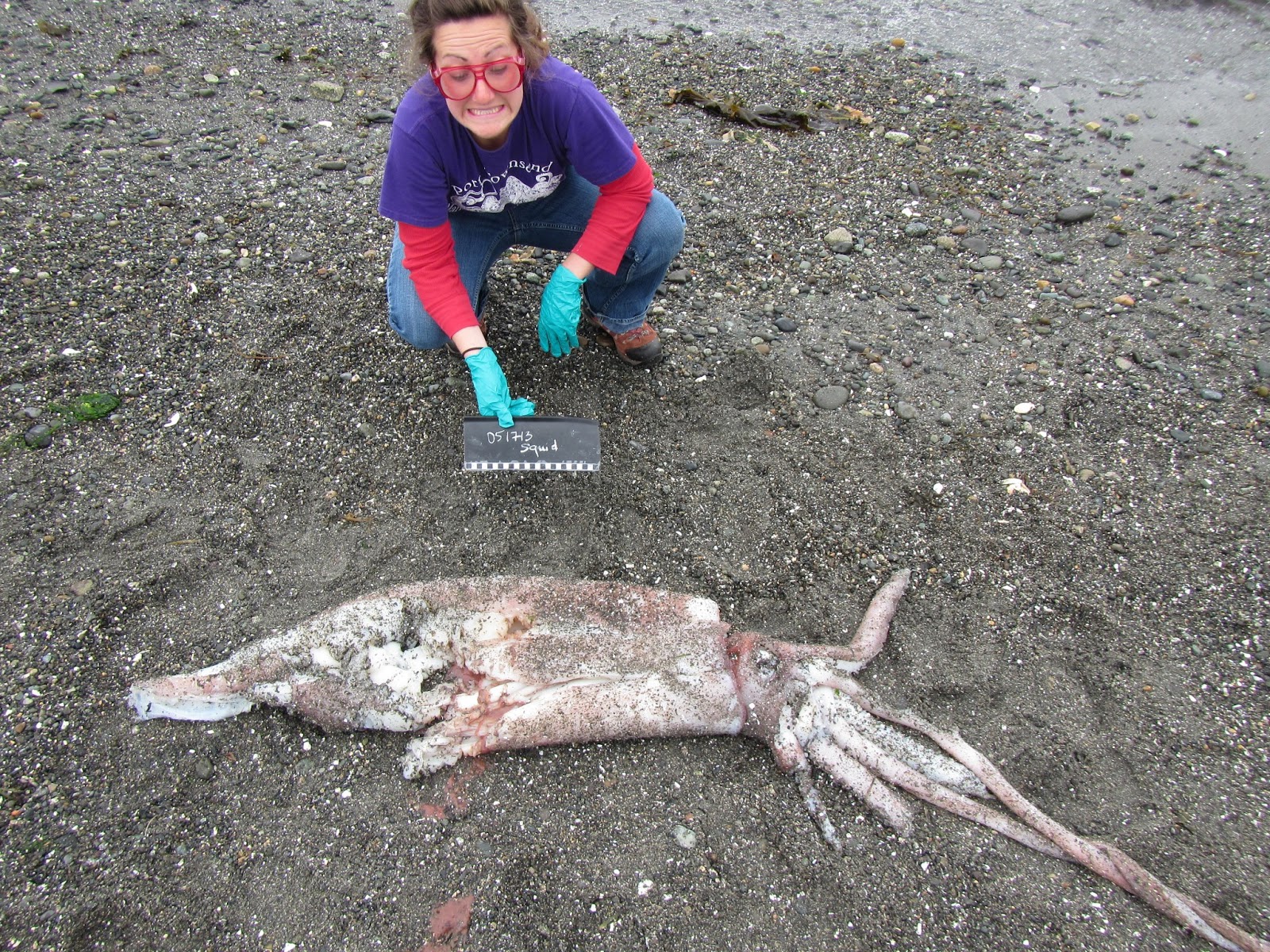
Before we started working with OGL we wouldn't have responded to a phone call about a huge squid (unless it was out of pure curiosity). But now when we received a phone call from our friends at the Northwest Maritime Center that a large squid washed up on their beach, we were pretty excited to have an excuse to go check it out.
Jamie Landry, Citizen Science Coordinator (left), and Megan Veley, AmeriCorps (right) after dissection of the Humboldt Squid on the Northwest Maritime Center's beach.
I was lucky enough to escort PTMSC citizen science coordinator Jamie Landry to our first OGL sample site. You never know what you are going to see when you respond to a phone call. Filled with excitement, people tend to exaggerate or complete misidentify things. So we try hard to be always prepared for the "unknown" (that is my favorite part because I like to let my imagination run wild!).

When we got to the beach there was no doubt it was a squid. After some measurements we identified it as a Humboldt Squid. Jamie was excited to try out the new sampling protocol while I was enamored with remembering squid atomony that I learned last summer when teaching marine biology camp (PTMSC summer camps: http://www.ptmsc.org/summercamps.html)
Megan excited and ready to dissect!
This guy/girl was much bigger than our dissecting specimen, but that didn't make it any easier. The squid was in pretty rough shape by the time we got to it. Regardless we did our best to learn by exploration while we worked through the new sampling protocol.

You would think a Humboldt Squid would be cool enough and probably wouldn't have the opportunity to sample anything that neat for awhile. Think again...

It was only a week later when a phone call was forwarded to me--someone found something on the beach! The beach walker said he was about 150 yards away from us heading towards the light house. He was looking at a huge ray that looked like it might still be alive and stuck. I said I would be right there and took off with the camera.

Sure as he was, there laid a hug ray-like creature in the water right in front on him. However, it was no ray, but one of their close relatives the Skate. I knew immediately the species was Big Skate because of all the images we saw when looking up information on our baby Big Skates that had just hatched in our touch tanks (funny how things work like that)!
The Big Skate swaying in the surf right after being found by beach walkers.
So was it alive or dead? Well I was pretty positive it was dead because these guys are masters at living in sandy bottoms and there was nothing besides sand that was keeping her there. However, when looking at her it was hard not to think she was still alive because of the way her tail and fins were moving--wave action or still holding on?

Well there was only one way to find out and that was to walk into the water and touch it. I'm sure I could have used a stick, but what's the fun in that? Plus I knew it didn't have a barb like its relative the ray so I convinced myself it was completely harmless.

A good poke in the stomach and eye proved that she was no longer alive and was just an extremely fresh wash-up being moved by the wave action. In the name of science it's hard not to be excited that she was dead. Not just because we get to sample her and learn SO much during the dissection, but also because if she had been alive she would have been distressed and there was nothing we could have done to help her.

I explained to the couple who found her that we were going to take some samples for OGL and they could stay and help. They were pretty disappointed she wasn't still alive, but when they learned she wasn't going to die in vain and was helping science instead--it was OK.

The skate was about 5ft from wing to wing and wasn't going to be easy to drag up on shore. The tide was coming in and kept trying to pull her back out. I called in reinforcements and after various tactics and water filled boots we puller her up and out of the water.
AmeriCorps (Emily, Megan & Amber) getting things done! Trying to beat out the high tide.


The muscles! Megan, Jamie, Amber & Claudia (left to right).


After Jamie collected the sample for OGL we continued with dissecting. We were all vey curious to see what was in the stomach (especially because we are trying to figure out what our baby Big Skates want to eat). To our surprise the stomach had fish inside, but no just one--3 full grown sculpin!

If that wasn't cool enough, we also found an egg case! We aren't 100% sure, but we think she was about to deposit it because it was complete and sealed shut. We asked if there could be something inside. We just had an egg case that no one thought was viable and it hatched out 5 adorable skates! Maybe this one could do the same?
Discovering the egg case.
We wanted to honor her gift to science and see if we can give her egg case a second chance. It is now living in our lab tanks, save from the oceans elements and predators.

Who knows maybe next year or even a year after that we will have more baby skates mesmerizing us as they explore their new life?
Thanks to citizen scientist like you and awesome projects like OGL we get to wait and find out...

Thanks for stopping by!

Danae Presler (Babysitting an Elephant Seal) -- AmeriCorps Marine Mammal Stranding Network Educator

Amber Heasley (The Mysterious Skate Hatch) -- AmeriCorps Marine Exhibit Educator

Megan Veley (Dissecting Marine Wash-ups) – AmeriCorps Natural History Exhibit and Volunteer Program Educator
**For more pictures of all these cool critters and our daily adventures check out our Facebook page (even if you don't use it you can still see the pictures if you follow the link and click on photos): https://www.facebook.com/pages/Port-Townsend-Marine-Science-Center/64955379712

Wednesday, August 10, 2011

What lies in the lines?

Have you ever wondered who lives in our pipes at the marine science center? Yeah, we never gave much thought to it either, until one day when the flow to our touch tanks stopped. We were forced to look for a reason why and found an entire ecosystem thriving in our pipes. After taking out nearly half a bucket of marine critters in three feet of line, water began to flow again in the tanks. Lets meet the critter cast that so often calls our pipes home.
The bucket full of critters!
Imagine all those critters growing in a four inch pipe!

Marine Worms

Giant Barnacles

Gooseneck Barnacles

Clumps of mussels and barnacles

So what makes our pipes a great place for these marine critters? Maybe it's because of the free buffet of plankton that comes through our pipes every second, the cheap rent or the protection they get from being enclosed in plastic.

Valerie Lindborg and Kelsee our guest blogger
Lab Coordinator