Saturday, May 4, 2013

The Countdown to GiveBig is on!

photo courtesy Wendy Feltham

You met Jeeps last week. Today, we'd like to introduce you to Pinkie. Jeeps and Pinkie are tankmates, sharing the same watery space at the Port Townsend Marine Science Center. Jeeps (short for GPO or Giant Pacific Octopus) and Pinkie (our Giant Pink Sea Star) spend their days entertaining visitors as they roam around their home in search of food.


Giant Pink Sea Stars, like Pinkie, can reach a diameter of two feet and weigh up to two pounds. They’re often found on sand or mud eating clams or sand dollars. Smaller ones live on rocks or pilings where they prey on barnacles, mussels and tube worms. As water-loving creatures, they’re normally only seen on the beach at very low tides since they can’t tolerate being out of the water for long.


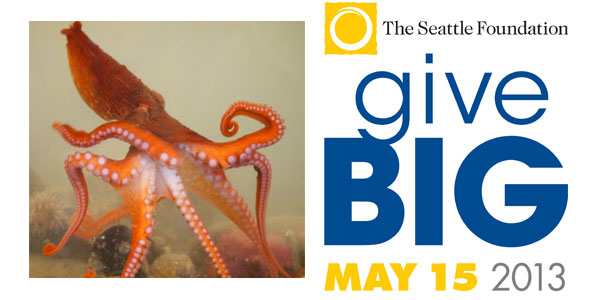
In 12 days, you can help the PTMSC care for amazing marine animals like Jeeps and Pinkie. By participating in the Seattle Foundation’s GiveBig campaign on May 15th you will be part of inspiring conservation of the Salish Sea. For 24 hours, whatever amount you give toward our goal of $10,000 is “stretched” by the Seattle Foundation, meaning they’ll add to the amount you contribute.


Look for more behind-the-scenes photos and videos of our much-loved marine animals on Facebook leading up to the GiveBig day on May 15th, and follow us on Twitter.


Stay tuned for more information about this exciting way to extend your donation in support of marine animals through GiveBig.

Wednesday, April 24, 2013

GiveBIG on May 15th


Jeeps, our Giant Pacific Octopus 
Photo courtesy of Wendy Feltham
 

Jeeps is hungry. She unfurls a slender red arm and slides up the smooth acrylic wall of her tank at the Port Townsend Marine Science Center (PTMSC) in search of her daily snack. Jeeps (short for GPO or Giant Pacific Octopus) is one of many marine animals we nurture at the center in order to generate awareness of marine life conservation in our local Salish Sea.

Did you know Jeeps and her species can learn to distinguish shapes and patterns and solve mazes? They have individual personalities and show emotions by changing their colors.

How to train your octopus
Jeeps is curious and likes to interact with children, often stirring from her den and flashing from bright red to mottled white when students come to visit. She is even learning to open a jar lid to get her food- check out this video of the first time she did it. 

You can help the PTMSC support the continued care and public education for beautiful marine animals such as Jeeps by participating in the Seattle Foundations' GiveBig campaign on May 15th. It's easy and it's fun! Whatever amount you give toward our goal of $10,000 is "stretched" by the Seattle Foundation, meaning they'll add to the amount you contribute.

Look for more behind-the-scenes photos and videos of our much-loved marine animals on Facebook leading up to the GiveBig day on May 15th, and follow us on Twitter.

Stay tuned for more information about this exciting way to extend your donation in support of marine animals through GiveBig.

Tuesday, April 16, 2013

PTMSC Lecture Series: KUOW's Ashley Ahearn to speak on coal exports

Thursday April 18
7 pm 
Quimper Unitarian
Universalist Fellowship, 
 
Port Townsend  
  
Join us as we welcome KUOW's Science and Environmental Reporter Ashley Ahearn and her presentation "Coal Export Terminals In The Northwest: A Look At The Policy, Science and Economics of Selling American Coal to Asia" 

$5 members 
$7 non-members 
FREE for ages 18 and younger
Learn more about Ashley Ahearn and her Earthfix blog here.

Monday, April 15, 2013

Orcas, Octopuses and Urchins… Oh My!


All sessions are open to both new and current volunteers
RSVP to Jamie Landry at jlandry@ptmsc.org or call 385.5582, ext 112

April 17 @3:00 – Marine Food Webs – The Diverse Ecosystem of the Salish Sea   (In the Marine Exhibit on the pier)
                  
April 23 – Trip to Fiero Marine Life Center, Port Angeles -RSVP to cpadilla@ptmsc.org 

May 8 @ 3:00 – The Story of Hope and the Toxics Project (In the Natural History Building)              

May 15 @ 3:00 –  Marine Exhibit/Aquarium training (In the Marine Exhibit on the pier)

May 22 @ 3:00 – Natural History Building Training includes the class: Life at the Top: Building an Orca Food Chain (In the Natural History Building)

May 24 @ 9:30am – Low Tide Walk at Indian Island RSVP to jlandry@ptmsc.org

June 5 @3:00 –Giving a testimony – how to tell your story and connecting with your visitor (In the Natural History Building)
                  
June 12 @3:00– Science on the Pier at PTMSC (In the Marine Exhibit on the pier)

View and download the PDF here.

Friday, April 5, 2013

Buddy has left the building— or rather, the beach.


Northern Elephant Seal, "Buddy", on February 26th,
one day after hauling out to molt.
Note: Photo taken with telephoto lens from safe distance away.
Staff photo.


On February 25th, residents of an apartment complex in Port Townsend's downtown area were startled to find a 400-pound seal on their back patio. They were concerned that the seal was injured and reported the animal to the East Jefferson County Marine Mammal Stranding Network (EJCMMSN) at 360-385-5582 ext. 103. The EJCMMSN is run by PTMSC staff and volunteers, who promptly responded.   

The seal was identified as a juvenile Northern Elephant Seal (Mirounga angustirostris) that was beginning to molt.  Molting is a natural condition all elephant seals go through. Once a year, they shed their short, dense pelage along with large patches of old skin. The process can take 4 to 5 weeks. During this time, the seal will haul out along the shoreline, which warms up the skin and speeds up the molting process. Molting looks horrible and is often mistaken for injuries to the animal. Sometimes juveniles get what is called scabby molt with skin lesions-- this looks particularly gruesome.  


Photo taken March 3rd, six days after hauling out to molt.
Note: Photo taken with telephoto lens from safe distance away.
Photo credit: Patt Roche.

This elephant seal, affectionately named Buddy by apartment residents, is likely a juvenile male. Adult male elephant seals sport the attractive trunk-like snout that gives the species its name. You may have seen videos of these colossal animals, averaging 14 feet in length and weighing upwards of 5,000 pounds. Females are significantly smaller but still quite large, measuring closer to 10 feet and around 1,300 pounds. Northern Elephant Seals are polygamous, with an adult male dominating a large group of females during the breeding season. Young males are commonly pushed out of the breeding colony and may stray far away. Enter Buddy. 


Apartment residents hand-crafted a sign to keep people and dogs away.
Staff photo. 

Just why did Buddy haul out to molt on this busy beach? We don't know. Nature is often mysterious like that. Whatever the reason, we wanted to make his stay as stress-free as possible and keep people safe. EJCMMSN volunteers, in conjunction with apartment residents, set up signs and yellow tape to keep people and dogs a safe distance away. On the weekend, an entourage of caring EJCMMSN volunteers "seal sat" around the clock during daylight hours. Together, they educated more than 100 people about Buddy, the molting process, and elephant seals in general, all while attempting to minimize disturbance to the seal.

A quick story about Buddy: Dana Kovac and I were taking our turn at seal sitting one cool sunny Saturday, and chatting with an apartment resident. This day Buddy had quite neatly lodged himself in between the apartment building and some pilings jutting out from the beach, in what looked like a terribly uncomfortable place to lay. But then we were told that Buddy had chosen the exact spot the residents plant their tomatoes, which is the warmest place on the patio. How's that for clever?

Buddy was last seen on March 7th. After a week and a half of lounging on the apartment's back patio, he headed into the water and did not return. Presumably, to find a better place to finish molting. 

Here's to you Buddy, may you have finished sloughing your old dead fur on a peaceful sandy beach void of our prodding eyes and curious canine friends. Thank you for gracing us with your presence

And many thanks to the kind and protective residents who watched over Buddy and the EJCMMSN volunteers who donated their time and skills to help this special elephant seal!

What should YOU do if you see a marine mammal in distress on the beach?

1. Stay back (NOAA recommends a distance of 100 yards). Keep people and dogs away.
2. Call the appropriate number below

To report a marine mammal in Eastern Jefferson County, call PTMSC at 360-385-5582 ext. 103
To report a marine mammal anywhere else, call NOAA Stranding Hotline at 1-800-853-1964
If a marine mammal is being harassed or harmed, call NOAA Enforcement Hotline at 1-800-853-1964

It is against federal law, under the Marine Mammal Protection Act, to disturb a marine mammal. 

Danae Presler
AmeriCorps
EJCMMSN Educator


Friday, March 29, 2013

Gearing up for Summer

It seems fitting that on this spectacular sunny afternoon, I am sitting down to write about joining the Port Townsend Marine Science Center staff in getting ready for summer! We have some excellent opportunities coming up for volunteers new and current. Come get involved and make sure you don't miss out on unforgettable summer days on the pier at Ft. Worden. 


Sunglasses and smiles are a must!
Sunny summer days and low tides are just around the corner! 
The Port Townsend Marine Science Center is gearing up for our most exciting summer yet and we want YOU to be a part of it! 


Beginning on April 10 at 3:00pm in our Natural History Building, join PTMSC staff for an entertaining, hands-on, and thought provoking enrichment series. 
Science on the dock classes will include adventures in bird watching.  You may even see some orcas passing through Admiralty Inlet!


The entire series is open to newcomers as well as current volunteers. 
The series continues on most Wednesdays through mid June.  Session topics include: new classes on marine food webs and marine mammals, low tide walks, science on the dock, and hands-on experiences in our aquarium and natural history buildings. 
Bring yourself and a friend!
Come get a little sand in your boots!
The series includes low tide walks and more.


 For details, please contact Jamie Landry at jlandry@ptmsc.org or (360) 385 5582 x112. 

Tuesday, March 5, 2013

How I found the courage to tame the toxic monster


My name is Jamie Landry and I am one person in a world of many. Despite this I deeply believe that I, one person with a voice, can make a difference. 

Sounds familiar, right?

I grew up in a quaint New England town with a supportive community and parents who encouraged me to speak my mind. The combination made believing I could make a difference very easy for me. My beliefs and morals had yet to be challenged by the reality of politics, consumerism, and a cacophony of societal pressures.

Out of high school and feeling ready to take on the world, I sought to escape the comforts of a small town. I moved eight hours from home to attend college. It wasn't until graduating four years later, when I realized I had still been living in a bubble all that time! To my surprise  I was a college graduate staring the “real world” straight in the eyes: having to make my own dinners, purchasing my first car, and making every life choice from picking out floss to buying furniture. I had to do it all on my own.

Fortunately, I transitioned out of college and found myself surrounded by an extraordinary circle of friends and living abroad in Iceland. I decided to pursue a graduate degree in a progressive European country and from a considerable distance began to re-examine the culture in which I had spent the first 22 years of my life. All the pressures I had so conveniently avoided in my youth –politics, economics, natural resources, health, and society were being heavily debated by my peers in academic and social settings. Realizing the weight of these issues, I fearfully considered the possibility that perhaps one person couldn't make a difference.

Living abroad in Iceland was where my battle with toxics began. It took stepping outside my comfort zone to recognize just how serious the issue is.


You must be wondering – what does this have to do with my story of toxics?
While my personal story of contamination began long ago, it wasn't until I turned 22 that I took control and became the writer of my own toxics story. While abroad, my forward-thinking and inspiring colleagues pushed me to question things I had always taken for granted in that picturesque, New England town where I grew up. A question introducing the notion of harmful chemicals being added to so many of our daily goods and products was posed by a Finnish classmate who asked, “Do you know if Parabens are banned in the US?” I replied, “Para- what”? I didn't know it at the time, but her question sparked a passionate fire that now burns within me. With support from many along the way I find myself, four years later, speaking up and sharing my story. It’s a story about me, one person in a world of many, making a difference.

I have challenged the presence of toxic chemicals in my personal and professional life for only a short time. At first I wasn't so confident going to battle. Confronting and fighting toxics is an emotionally challenging journey. Initially I was confused: you mean to tell me manufacturers can put untested chemicals in products and not even tell us? Then self-conscious: do I have anything in my home that doesn't have toxic chemicals in it? What kind of person does that make me? Later I was angry and panicked: I went completely off the deep end, throwing out nearly all my products and belongings. I lost friends over the issue and argued constantly with my family that we were killing ourselves and the precious environment. Time passed and I began rationalizing my emotions – understanding how it wasn't my fault that healthy consumer decisions were so difficult to make. At present, I am empowered. I am proactive by speaking up for myself, friends and family, and future generations. I have realized we don’t need to be scientists, politicians, lawyers, or manufacturers to choose to make a change; all you have to be is human.

I am one living (and positive!) example of someone who has been through the toxic wringer. I came out on the other end a little bruised, battered, and perhaps contaminated, but I also came out ready to turn the tide.

How can you do the same? 
Begin by understanding that we are not protected by our laws and regulations on toxic chemicals. Sadly, many people are not even aware of this. Acknowledge that you have a voice and the power to help yourself and future generations. Start by using your voice when making choices about food, personal care, and lifestyle. As a consumer you have the power to vote with your dollar. Every purchase you make says something about the kind of world you want to live in. If you’re looking to do more, get involved in local and state government. Write a letter, attend a lobby day, or financially support organizations that fight against dangerous chemicals.

Here I am on the right - This year I went to my first 
Environmental Lobby Day at the Capitol in Olympia. 
Photo Credit: Al Bergstein

Toxics are toxic. They have the power to corrode your spirit and body – But just as love defeats hatred, knowledge will defeat toxics. Knowledge is power. If you and I educate ourselves, we will have the knowledge and therefore the power to choose an alternative. We can choose health over sickness, courage over fear, and having a voice over oppression.

Jamie Landry is the Citizen Science Coordinator at the Port Townsend Marine Science Center and a resident of Port Townsend, WA.  She works closely with The Toxics Project – an effort by the PTMSC to empower people with knowledge and resources to fight for their health, and the health of the marine environment. Please visit our exhibits and be inspired to start your own journey.