Wednesday, December 14, 2011

Port Townsend Marine Science Center finds unique phytoplankton


PHYTOPLANKTON NEWS FLASH!


Last week Port Townsend Marine Science Center Sound Toxins volunteers Linda Dacon and Darryl Hrenko identified the presence of the relatively rare phytoplankton species, Dinophysis tripos:


Photo of Dinophysis tripos taken by Linda and Darryl on 12/7/2011 in the Discovery Lab at Port Townsend Marine Science Center

The sample containing D. tripos was collected at the Cape George Marina in Discovery Bay of Puget Sound and was an exciting find for our Sound Toxins team. This is the first identification of D. tripos at Port Townsend Marine Science Center since the start of the Sound Toxins program (formerly known as ORHAB) in 1999.
Dinophysis tripos is a type of phytoplankton that falls under the phylum of Dinoflagellata. Some of its defining characteristics are:
  

  • A toxic marine species that is commonly found in tropical to warm temperate coastal waters
You are probably wondering… what is D. tripos doing in the chilly waters of Puget Sound at Port Townsend Marine Science Center?!?! We consulted our contacts at NOAA and found that as far as distribution goes, it is commonly found in warmer coastal waters but sometimes detected in Puget Sound.

  • D. tripos is found in neritic (coastal), estuarine and oceanic waters
  • It is rather large, measuring in at about 100µm in length

 This little guy (actually it is sexless but we will call it this as a term of endearment) is about 100 µm (micrometers or microns) long! To give us some perspective, that’s equal to one tenth of a millimeter! If you’re wondering how Dinophysis tripos sizes up to some other common miniatures, here are some comparisons for you:

Dinophysis tripos is…
  • About 10 times bigger than a red blood cell 
  • Only 5 to 10 times bigger than most bacteria cells

  • The Genus Dinophysis was discovered in the mid-1800s


  • D. tripos is connected to Diarrhetic Shellfish Poisoning (DSP)

There are many species of Dinophysis connected to historic events of DSP. DSP is one of four recognized symptomatic types of shellfish poisoning (others being paralytic, neurotoxic, and amnesic). D. tripos releases the toxin dinophysistoxin-1 (DTX-1) which is linked to DSP.

Here’s what Brian Bill, a phytoplankton expert at NOAA had to say about the finding:

“As far as toxin content or production from this specific species, not much is known. It is known to produce some amounts of Okadaic acid and Dinophysis toxins, but how much and whether more or less than other species if something we don't know. They are particularly hard to culture in the laboratory because their normal mode of feeding is preying on ciliates such as Mesodinium rubrum, which in turn prey on small cryptophytes for their nutrition. With all those levels of complexity, it's difficult to culture them and find out what conditions facilitate production and what types and ratios of toxins they produce. Hopefully in the near future we can answer some of those questions... the recall of shellfish from Sequim Bay last year and the outbreak in Canada during the same time will hopefully translate into funding so some of those questions can be answered.”

So thanks for checking in with us and stay tuned for more updates on marine science, phytoplankton, coastal issues...

Port Townsend Marine Science Center


Wednesday, November 16, 2011

Necropsy Training at PTMSC!

Hello all!

Port Townsend Marine Science Center had a very exciting (and smelly) Harbor Seal pup necropsy training early last week with marine mammal veterinarians, Pete Schroeder and Betsy Lutmerding. This training was to inform our staff and stranding network volunteers how to perform a basic necropsy and collect samples/data. The purpose of a necropsy is to determine the cause of death of the animal and to collect information used for monitoring and learning about local marine mammals. During the necropsy we looked for notable wounds, unusual tissue or organs, and signs of human interaction. To search for pathogens and toxins, samples were taken of blubber, major organs, internal fluids, and stomach contents. This time collecting samples was just for the training; during future necropsies we will interpret and use the results of the analyzed samples.

Receiving Prescott Grant funding, which started in October, has made training and future necropsies possible for our stranding network. The East Jefferson County Marine Mammal Stranding Network (EJCMMSN) now has funding to install information signs at 10 beaches, create and print a brochure, improve the marine mammal stranding information on our website, plan additional trainings, and perform and analyze samples from 5 necropsies.

Chrissy Mclean (PTMSC’s Marine Program Coordinator) and I would like to thank our wonderful stranding network volunteers as well as Pete Schroeder and Betsy Lutmerding for their time, effort, and smiling faces they contribute to our stranding network. Thank you all very much!

Jen Stevens
Marine Mammal Citizen Science Assistant


(See photos from the necropsy training below! CAUTION: Photos are Graphic)


Interested in joining our team of stranding network volunteers? Contact Jean Walat at jwalat@ptmsc.org for more information!
Examining the stomach contents from one of the seal pups– all that was found were a few very small fish bones. Photo by Richard Smith

Marine Mammal Veterinarian Betsy Lutmerding measuring the blubber layer during the necropsy training. Photo by Sandy
Dengler

PTMSC staff, stranding network volunteers, and marine mammal veterinarians worked together to perform two successful Harbor Seal pup necropsies. Photo by Sandy Dengler

Marine Life Trivia

Okay so here’s a little Marine Life Trivia for you…


What species…

• Lives to be somewhere between 20 and 30 years old, with the females reaching the upper limit of this range…

• Has an average adult male that can weigh up to 1500 lbs (!) with females averaging 600 lbs…

• Will regularly travel up to 250 miles to find food and as deep as 600 feet…

• Needs to eat at least 6% of its body weight each day in order to survive? Let’s do the math… average male is 1500 lbs. x 6% = 90 lbs. a day!! *


So… we’ll give you a hint… it’s a mammal!

   ** Puzzled?......


Okay, here’s another hint… Our Marine Program Coordinator Chrissy McLean and AmeriCorps Citizen Science Assistant Jamie Landry responded to a stranding of one of these guys last week! So can you guess now???


Okay, Okay, I’ll tell you!!


A Steller Sea Lion!!


PTMSC’s Marine Program Coordinator, Chrissy McLean and Artemis the male Steller Sea Lion


PTMSC's AmeriCorps Citizen Science Assistant Jamie Landry helps document Artemis' stranding


The Port Townsend Marine Science Center is part of NOAA’s Marine Mammal Stranding Network (MMSN) and responds to calls of mammal stranding on a regular basis. Last week, a local citizen reported a dead and beached Steller Sea Lion on Marrowstone Island. After collecting basic information on this endangered species, Chrissy and Jamie collected the head in hopes to get tissue samples and a fully intact skull which the Marine Science Center will use for educational purposes. We have named the male Steller Sea Lion Artemis and are looking forward to having his skull in the Natural History Museum at Fort Worden State Park. It was an exciting call and we want to give special thanks to our volunteers who participate in the MMSN and all locals who place calls to inform us of marine mammal stranding in the East Jefferson County area.


If you find what you believe to be a stranded mammal, please visit our website http://www.ptmsc.org/mmstranding.html for more information on what to do and who to call.

* Statistics credit: The Alaska Sea Otter and Steller Sea Lion Commission
** Cartoon Credit: Mark A. Hicks


Until next time,
PTMSC

Tuesday, November 8, 2011

What's New at the Marine Science Center?

Hi there guys and gals!  It's been a while since we've posted on the blog- partly because we wanted to let Chris' thoughts on "poop" really sink in- and partly because we've been so busy with all the transitions around here.


So what kind of transitions are we talking about? And who is "we"?

Well, "we" is the new AmeriCorps team for the 2011-2012 season!


From the left: Jamie, Elise, and Jen are getting settled in and finding their way at the Port Townsend Marine Science Center.  (Clarification: Jamie doesn't actually drink the lab chemicals, Elise is not stored in the Eelgrass Tank, and Jen is not part fish.)

So here's a little bit more about these ladies and what they hope to bring to the Marine Science Center this coming year:

Jamie Landry comes to us from her hometown of Gilford, NH.  After graduating from the University of Rochester, she moved to Iceland in 2009 to pursue her Master's Degree in Coastal and Marine Natural Resources.  After spending an additional year in Iceland as a head volleyball coach, she moved back to the US to work as a naturalist and environmental educator with the Adirondack Mountain Club outside Lake Placid, NY.  Now residing in Uptown Port Townsend, she can be found at PTMSC in the Discovery Lab, around town on her early morning runs, playing volleyball with the local club, or knitting traditional Icelandic sweaters. 

Elise Gorchels is a very busy, well-caffeinated, scuba diving conservation biologist whose greatest fear in life is being boring, followed closely by being bored.  She is a transplant from Madison, WI and can most frequently be heard discussing cheese, microbrews, and Badger football.  When she isn't at work she's probably underwater photographing all the great life the PNW has to offer!  After graduating from UW Madison in 2008 she spent two seasons as an educator on Orcas Island and one year as an AmeriCorps member at a community center in Madison.

Jen Stevens is originally from Minnesota and has a Bachelors Degree in Marine Zoology from The Evergreen State College in Olympia. She spent time doing husbandry and research of sea turtles at Mote Marine Laboratory in Florida and recently worked as a zoological aide at Point Defiance Zoo and Aquarium. Jen’s main objective at PTMSC is the East Jefferson County Marine Mammal Stranding Network and lately has been helping run seal necropsy trainings. When not at PTMSC she can be found exploring downtown, hanging out with her two felines, or playing Dungeons and Dragons with her friends in Olympia.

So there you have it!  These three vivacious ladies look forward to working with all of our wonderful volunteers and inspiring future Marine Science Center visitors with their enthusiasm and passion for the magnificent Salish Sea.


Aaaaannnnd... we have more exciting news! Some of you might recognize this lovely lady...


You may have recently seen former PTMSC 2010 Summer/Fall Intern, Claudia Padilla around a bit more than usual. After spending last winter and spring working various jobs around town and traveling, she's back as staff through October 2012. She will serve as the Education and Volunteer Program Organizer to assist with a variety of tasks such as working with the volunteer program, writing education curricula, organizing and planning Free Science Classes, and helping to maintain the NHE among many other responsibilities.

Claudia is originally from Pennsylvania where she attained her Journalism degree from Penn State. She served as an AmeriCorps as part of the Maryland Conservation Corps, before moving to Washington, DC in 2006. After a few years in DC at different non-profits, she was ready for career shift, starting with PTMSC in June 2010. Being in the Pacific NW has rekindled her love of the outdoors and educating the public about the environment. Swimming, cooking, exploring the Olympic National Park and reading are some of her favorite things to do.


So, stay tuned for more updates and thanks for reading!
PTMSC


Sunday, October 9, 2011

Boy, am I pooped...

Hey all,

What is the first thing that comes to your mind when you think of the Port Townsend Marine Science Center? Education, you might say. You would be pretty spot on, I think. Maybe...citizen science. Another good call on your part. What about marine ecosystems? I would say that is a pretty obvious answer, but nonetheless, a good one.

Well, for the entire month of August, and some of September, I had a completely different answer in mind...

Lets play a game. I will show you a picture, and you tell me what you see. here is the first one:


A rock. That is what you are thinking. I was a psychic in a past life. Here we go again:

This sentence is an independent claws.


A crab molt. 2 for 2 here. Excellent. Now here is the last one:


How much for dinner!? Ehh, just put it on my bill.


A sea bird, and a terrible pun. Yep check, and check. You are good at this! But, wait.

What if I told you that there was a common theme between all of these pictures? Something underlying, and slightly insidious. Something that really ruins these pictures. A party pooper if you will.

So, some of you have probably guessed what I am talking about, but for those who have not...I am talking about feces.

The word feces is derived from the latin faex (sediment, dregs). It is also known as poo, doody, poopy, dookie, doo doo, or any combination of p's, o's, and d's. It is the commonly accepted way in nature to rid oneself of waste. It is comprised mainly of food byproducts, some nitrogenous waste, bile, and bilirubin (deceased red blood cells). The bile and bilirubin give poo its rather bland, brown appearance.

The characteristic odor of scat comes from compounds produced by the individual animal's gut flora. These bacteria produce aromatic aromatics, such as indole, skatole, and thiols, butt thats not all. The main offender of our noses is our good buddy: hydrogen sulfide. That is right, the rotten egg smell.

So, why all the talk of poo, you might be asking yourself? Well, good question.

When the weather started getting warmer, and drier, here at PTMSC a strange thing happened. A large flock of Heermann's gulls started to reside on our roof. That is not particularly strange in itslef, but then a terrible smell started to infiltrate the Marine Science Center. It smelled like a mixture between my worst nightmares and a petting zoo. What was happening was a phenomena I will call Armageddung! Due to the dry, hot conditions the gull guano (guano is the the commonly accepted term for seabird feces) started to pile up, superheat, and practically weld itself to our roof. It was a scatastrophe. Look for yourself:


The white color of this guano comes from crystals of uric acid in the waste. Birds only have one all purpose shute, the cloaca, so everything has to come out together.

In the end, one enterprising ranger, and some extremely helpful rain, removed most of our pesky poo problem. However, one guy was probably sad to see it go:


He filled the ecological niche of looking like poop.

Although you know what? All this talk of feces really has me down in the dumps (pun intended). I think we need some comedic relief to juxtapose with this gross subject matter. Here is a picture of a spiny lumpsucker riding an umbrella crab. Enjoy.

Who sucks now?

Thanks again for reading!
Chris


Friday, October 7, 2011

Fog Blog

Have you missed us?
Sorry we've been out of touch.
I guess we've been lost in the fog.


My experience with sea fog was minimal before moving to the Pacific Northwest.  Now the presence of it almost feels comforting.  In the morning when I hear the fog horns out over the water while I lie in bed, I await the call from my rowing friends to let me know it is too foggy to go out.  For me, fog feels like an opportunity to slow down and become more intrigued with my surroundings.  Everything looks much more mysterious in the fog.

Photo by: ellieericsonphotography
Why do we experience fog in Port Townsend? 
Where does the fog come from?
Most of the fog we see in PT is a form of advection fog that occurs at sea (more commonly known as sea fog).  Advection fog forms when air travels over a surface with a temperature below the dew point of the traveling air.  Here in Port Townsend this occurs when warm air on land (when we have warm air on land) moves out over the colder ocean.  This is the reason we see fog during our warmest months (typically July-September).

As we rapidly transition into the Fall, we say, "hello" to the rain and "good-bye" to the fog.

We'll be in touch soon,
Heather
Sources:
www.giantsteps.co.uk/the-causes-of-fog.html
www.crh.noaa.gov/jkl/?n=fog_types

Wednesday, August 31, 2011

So long, farewell...

Reflecting on our past two years here in Port Townsend we came up with some 'secrets' that we would like to share with our blog followers. These are things we have learned about ourselves, about each other and fun sayings that got us through the day. 

"Port Townsend helped me heal in more ways than one."

"I don’t know which smell of death is worse… mammals or inverts."

"Sometimes I think in tweets and facebook status updates."

"Is afraid of being forgotten."

"I thought I didn’t need any more friends before I came here. I couldn’t have been more wrong."

Sometimes you just need to take a break and go “collect some eel grass”

"Every once in a while you just need to go have a cry on the dock."

"This year has been completely different than last year."

"One of the funnest things about new friends is the things that rub off on each other."

"The act of killing encrusting tunicates and barnacles has become disturbingly satisfying for all of us."

"You know it’s been a long day when you start sassing the hydrophone."

"Port Townsend has made me realize I am stronger."


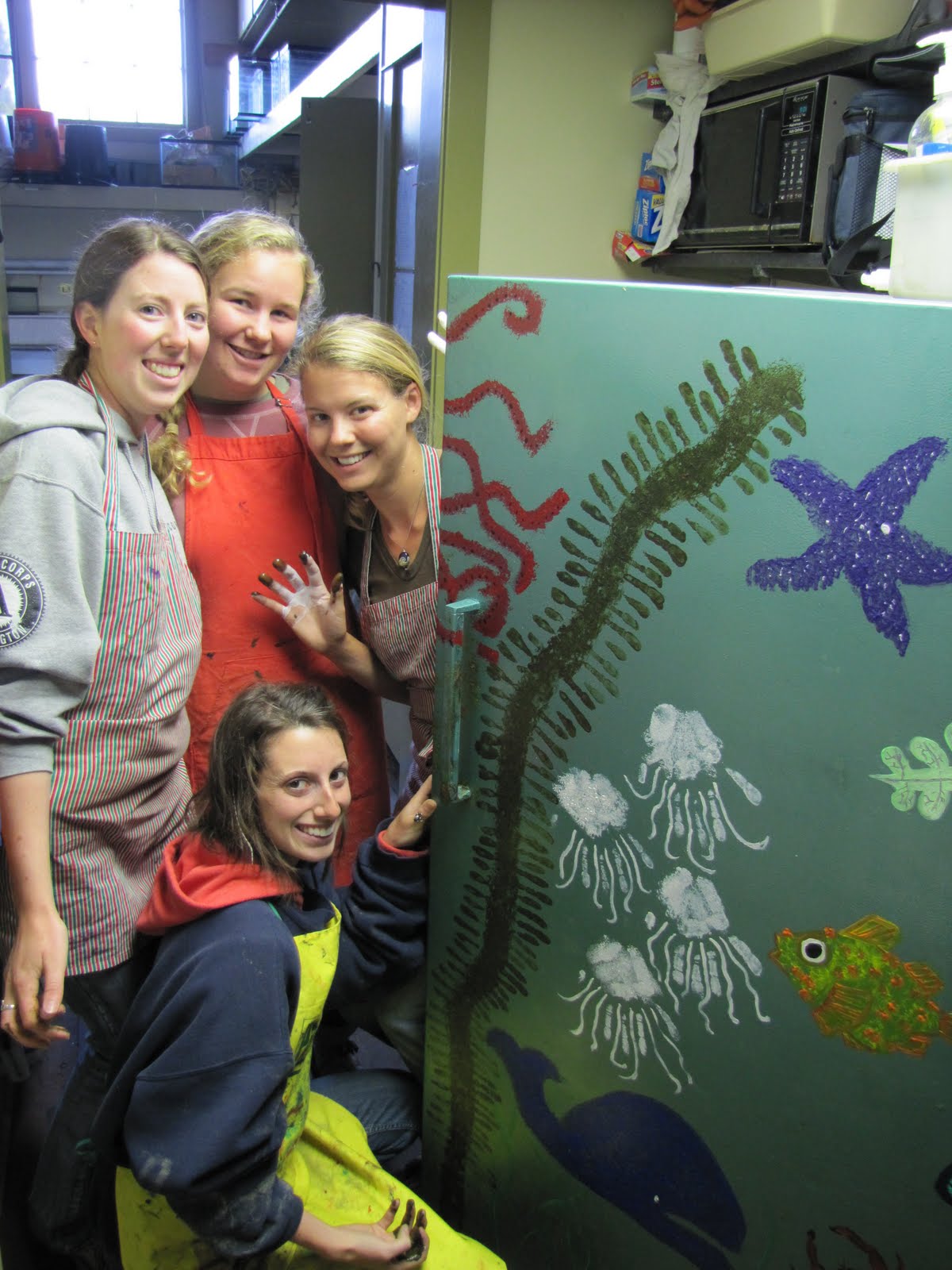
Our last attempt to leave our prints at PTMSC

Farewell Port Townsend, all the wonderful people, amazing animals, and beautiful scenery. We take with us a strong sense of community, lasting relationships and the strength that we have found within ourselves.

Thank you for all your comments and love Blogger family!

The Sanderlings
2009-2011 PTMSC Team

*Inspiration comes from Post Secret (http://www.postsecret.com/).