Showing posts with label marine. Show all posts

Thursday, June 1, 2017

Big Announcement! The Anne Murphy Ocean Stewards Scholarship Winner Is...


The Port Townsend Marine Science Center is pleased to present the Anne Murphy Ocean Stewards Scholarship to Tyler Sudlow.
 
Tyler did his senior project at the Marine Science Center, volunteering as a docent for a total of over 30 hours. He said in his application regarding environmental conservation, "There is a lot to be done and the world needs people working to protect it. I am particularly fond of the marine environment and the Salish Sea because I have lived near it my whole life and my dad is an avid fisherman so I know the benefits it has to offer."

This scholarship was created as a way to honor the legacy that Anne Murphy created at the Port Townsend Marine Science Center during her 24 years there as Executive Director. Anne's passion for learning and a deep love of the marine environment helped create the Marine Science Center. This scholarship supports these qualities in graduating high school seniors as a way of sending these qualities from the Marine Science Center out into the world. 
 

Thursday, May 18, 2017

Thank You for Giving BIG!


Thank you for your generous donation during the recent GiveBig campaign. Because of you, the one-day campaign ended with a total of $24,794, exceeding our goal of $22,000.

Didn't get a chance to donate on the Big Day? You can Donate now and help support kids summer camps today! 

The funds are critical now as we receive camp scholarship requests for families with financial need and as we work toward increasing our capacity to offer camps to more kids. In this time of computer games and screens, getting kids out to the beach to get sandy and wet, is transformative. Your generous donation will change lives. Thank you!

Monday, January 2, 2017

40 YEARS OF CHANGE: COOPER ISLAND'S SEABIRDS RESPOND TO A MELTING ARCTIC


Sunday | January 8, 2017 | 3 pm
presented by George Divoky, PhDDirector/Researcher, Friends of Cooper IslandThe Fort Worden ChapelAdmission: $10 ($5 for PTMSC members)
George Divoky has studied seabirds in arctic Alaska since 1970 when, as a researcher at the Smithsonian Institution, he participated in the Coast Guard’s survey of the Arctic Ocean adjacent to Prudhoe Bay. Since then he has been involved in Alaskan seabird research relating to a diverse group of conservation issues including the Alaska Native Land Claims Settlement Act, oil and gas exploration of the outer continental shelf, the Exxon Valdez oil spill, and regional climate change. Since 1975 he has maintained a continuing study of Black Guillemots on Cooper Island, Alaska, that is one of the longest longitudinal bird studies in the Arctic. The Cooper Island study’s findings on the consequences of recent snow and sea ice reductions provide some of the best examples of the biological consequences of climate change. 

Dr. Divoky’s research was featured in a cover story in the New York Times Magazine entitled “George Divoky’s Planet,” in the PBS’s Scientific American Frontiers program “Hot Times in Alaska,” and on ABC Nightly News and Nightline. He has appeared on The Late Show with David Letterman, been interviewed NPR’s Talk of the Nation and Science Friday, and his story and findings were featured in a play about climate change, Greenland, staged by the Royal National Theatre in London in 2011. He helped found and has twice been chair of the Pacific Seabird Group, an international organization working to advance conservation and research of Pacific Basin seabirds. Currently, as Director of the nonprofit Friends of Cooper Island, he is working to ensure the continuation of research on Cooper Island seabirds in coming decades when they will have to deal with the complete disappearance of summer ice, offshore drilling, increased shipping and commercial fishing. 

Divoky was born and raised in Cleveland, Ohio, has Bachelor’s and Master’s degrees from Michigan State University and a doctorate from the University of Alaska Fairbanks. When not in the field he lives in Seattle, Washington.

Tuesday, July 7, 2015

Roof Runoff Survey Completed

One stormy night in October of 2014, the PTMSC volunteers and staff completed the second and final round of roof runoff collection. Over 10 volunteers valiantly weathered the storm to collect runoff from 11 residential roofs in Port Townsend. With funding from the U.S. Environmental Protection Agency, PTMSC was able to send samples for analysis to the University of Washington labs in Tacoma. Our goal was to analyze for presence and abundance of a class of contaminants called PAHs (polycyclic aromatic hydrocarbons).

This class of chemicals is considered ubiquitous in the marine environment. The atmospheric origin of PAHs are by-products of the incomplete combustion of fossil fuels, wood, residential heating, and vehicular emissions. Many variations of PAHs are considered to be human carcinogens
(Delhomme, et al., 2008).

The same 11 roofs were sampled in November of 2013 and October of 2014. Methods of contaminant analysis for the 2013 and 2014 sampling differed slightly. The 2013 sampling looked at contaminants soluble in the runoff. The 2014 sampling looked at those, as well as all solid materials in the sample. We changed the method due to concern that compounds fixed to the sample's debris were not being accounted for.

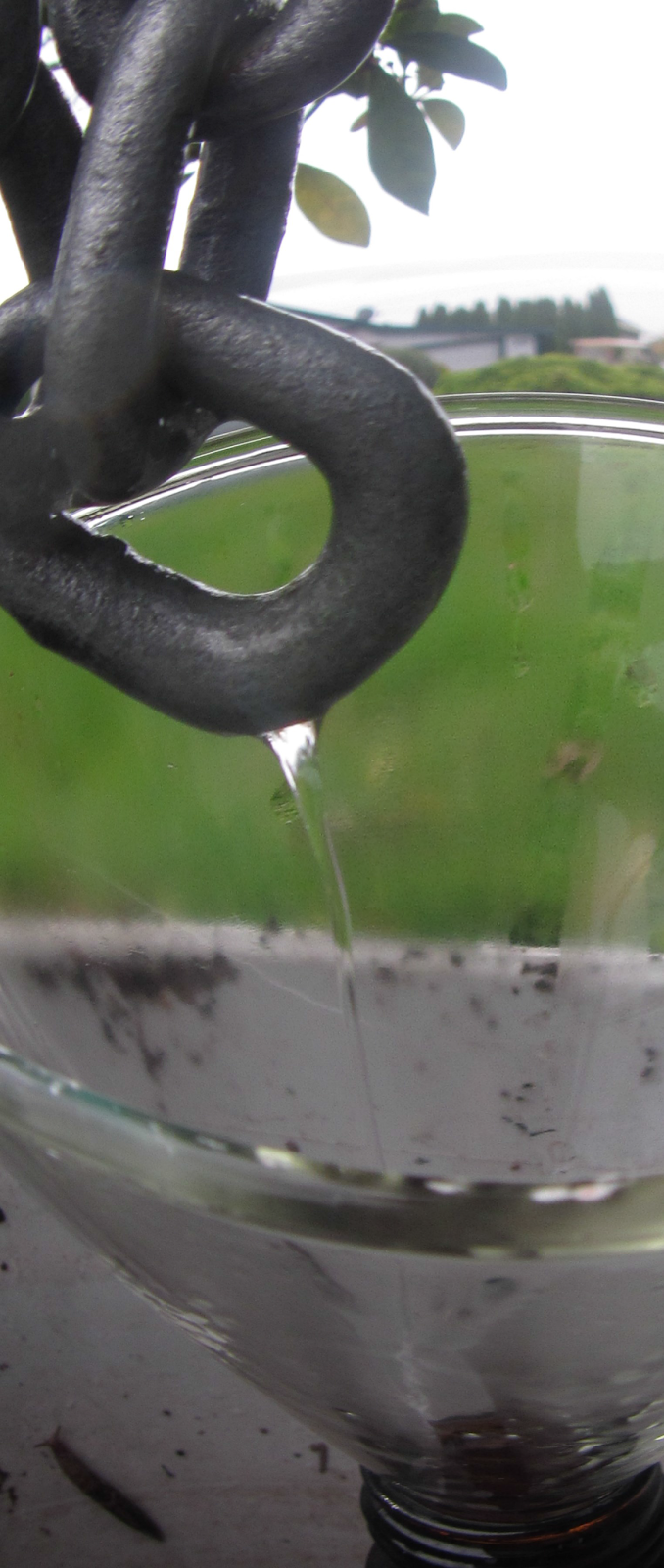
Runoff samples were collected during rain storms.
Conclusively, the total load of contaminants detected was low. Similar studies in more industrialized areas of the world show higher levels of detection. However, it is important to remember that this study sampled a small percentage of residential roofs in Port Townsend. Although the contribution of PAHs from a single roof may be small, the collective contribution from all Port Townsend roofs can be significant when considering health impacts on people and the marine environment. Furthermore, the contribution of PAHs (and other chemicals of concern) from all Salish Sea residential roofs is an important element of scale to consider.


Although in small concentrations, nearly all PAH's tested for were present in roof runoff.