Tuesday, December 20, 2022

Meet Ruby, a young PTMSC fan

It would be hard to imagine a more enthusiastic fan of the Port Townsend Marine Science Center than Ruby.
Ruby arrives at Fort Worden for her
visit to the aquarium. Photo: Sarah Wright
 I first noticed Ruby visiting the museum one Sunday afternoon with her grandmother, Peggy Albers (a valued PTMSC volunteer), and grandfather. I saw a very small but nimble tow-headed little girl of about age two. She walked with purpose throughout the museum, and led her grandfather to the cormorant exhibit. 

 After talking with Peggy, I learned that Ruby visits PTMSC as often as she can, usually once a weekend on Sunday after she wakes up from her nap. At home, she talks about the marine science center daily, her favorite books are tide pool field guides and octopus books, and she is disappointed that the tides are high during the day, when she can't go see anemones at North Beach. 

 We arranged to have Ruby visit the aquarium to learn more about her fascination, and more about what makes Ruby, Ruby. 

I noticed her powers of observation first. Ruby, her mother Sarah Wright and grandmother arrived for their Monday morning visit and as she was ambling along beside the stroller her mom was pushing. Ruby suddenly stopped to peer into a crack in the decking of the pier. 

“It's dark down there,” she said. She was referring to the dark water she could see below the pier. Aquarium Curator Ali Redman welcomed us at the barn doors to the aquarium. We immediately stopped to check in on Sylvia, the giant Pacific octopus, and then Ali and Ruby spent some time assembling some shrimp-filled Duplo plastic blocks into an enrichment feeding toy for Sylvia. 
Aquarium Curator Ali Redman and Ruby
discuss adding shrimp to the Duplo blocks.
Photo: Sarah Wright

After the feeding, we let Ruby lead us and I watched as her eyes lit up as she scrambled deftly on the ‘rocks’ that serve as benches and steps at the base of each tidepool tank. 

As a child born during the midst of the pandemic, Ruby is just now emerging into public life, attending story hour with her mom at the library, and “the marine science center has been a big part of that, as well,” said Sarah. 

“There is just such a sweet legacy aspect of it too, with my husband and I both having grown up here and having had our own experiences at the marine science center, it's been a really sweet thing to bring Ruby into it as well,” said Sarah. 

When I asked Sarah how PTMSC has impacted Ruby’s life, she noted that PTMSC “makes everything so accessible … the fact that it is right on the dock over the water and we can just look into these tanks and see what we wouldn’t otherwise be able to see without snorkel gear – it’s just so amazing.” Sarah, along with her husband Reed Aubin, are both “really passionate about climate justice and the environment.” Sarah is an avid paddle boarder and is an open water swimmer right here at Fort Worden State Park. 

Part of their decision-making process to have a child in the current climate has been their hope to “cultivate and support her interest in our natural surroundings and the animals that inhabit it. Hopefully, this will contribute to a passion for conservation. If we can help her to just love all these things, then hopefully that will turn into her wanting to take care of it and protect it,” Sarah added. 

At the aquarium, each time the sea water flowed forth into the surge tank, Ruby took note, saying “high tide” as the bubbles and froth entered the tank. Ruby carefully examined all of the tanks and was excited to see the wolf eel emerge from its hiding space. 
A moment of wonder with Ali Redman,
Ruby. and her grandmother Peggy Albers

Ruby’s dedication has not gone unnoticed by PTMSC’s staff and volunteers. Ali Redman can often find time to engage with Ruby when she visits, and Sarah notes that Ai takes the time “to come out and speak to Ruby, really matter of factly, as a fully realized human being, which has been incredibly gratifying.” 

Although Ruby makes time in her life for other fascinations (chiefly: garbage trucks), her mother notes that Ruby is an “equal opportunity lover” of all the animals in the exhibit and does not just reserve her adoration for the giant Pacific octopus. 

“She loves everything equally and so she sees the animals and then she has a frame of reference, and is then excited to read books about sea animals and Pacific Northwest marine life. And that continues to tie it all together for her,” said Sarah. “Our trips create this common thread throughout the rest of her week.” 

While Ruby shares her appreciation of the animals, her mom recounted a story that highlights the specificity of her admiration. 

“Yesterday morning she was looking at a PNW marine life guidebook, and she got to the sea urchin page. In her little toddler voice, she told me, passionately, ‘sea urchins are really really pokey. I like sea urchins so much!’ 

 We hope that Ruby’s fascination with marine life and the Salish Sea continues, and we are thrilled to welcome this three-generation group into the exhibits whenever possible.

Written by Volunteer Program Coordinator Tracy Thompson

Wednesday, November 23, 2022

New bull kelp exhibit shares the wonders of this undersea ecosystem

Creating awareness and understanding of our undersea kelp forests


How can one create urgency and awareness for the protection of a largely unseen ecosystem? For the many scientists, designers, artists, educators and volunteers who worked on the Port Townsend Marine Science Center’s “Bull Kelp: Our Remarkable Underwater Forests” exhibit (BKE), the answer is through teamwork and artistry.


The first kelp forest exhibit was created in time for the 2018 Wooden Boat Festival, with creatures made out of upcycled fabric and found materials. PTMSC Program Director Diane Quinn, Aquarium Curator Ali Redman and exhibit designer Andrew Whiteman knew they could create a richer experience from this initial design.


Education Coordinator Carolyn Woods  and Outreach Coordinator
Mandi Johnson work together sewing bull kelp fronds to the exhibi
t.
A successful application for funding from the Washington Department of Fish and Wildlife’s Aquatic Lands Enhancement Account (ALEA) program helped PTMSC staff, volunteers, artists and artisans create this new experience: A multi-sensory exhibit that suggests a dive in a bull kelp dominated forest.


Visitors are surrounded by dynamic artwork, created by Timbul Cahyono, as they walk through the small structure. Cahyono’s images of sea otters, swimming puffins and other sea creatures are printed on translucent fabric, which provides a watery feel.


Port Townsend visual artist and former PTMSC AmeriCorps Marine Educator Mariah Vane created a host of kelp forest residents, including fluffy sea anemones, prickly sea urchins and realistic articulated crabs.


The bull kelp fronds and particularly, the bull kelp bulbs, are strikingly realistic and have been crafted from green microfleece around a hidden craft ball. A ball joint from an electrical supply store connects the stipes to the bulbs with a satisfying click.


Layers of bull kelp fronds composed of the same translucent fabric as the exhibits walls were carefully hand sewn into the exhibit’s “ceiling’ (or water surface) by PTMSC staff. That water surface also includes what can only be described as a”pigeon guillemot’s butt,” the swimming side when viewed from underwater.


The interpretive panels are printed on PET 100% recyclable material and PTMSC will upcycle them when the exhibit eventually ends — turning them into bags and other merchandise.


The kelp bulbs are made from upcycled holiday ornaments and the rocks that the holdfasts attach to are filled with upcycled packing foam. 


Mandi Johnson and Program Director Diane Quinn at work
hand sewing bull kelp fronds to the exhibit's ceiling.


The rewarding opportunity to sit together around a large table during a work day and hand-sew exhibit highlights proved to be a delightful chance for coworkers to get to know one another. Staff members brought in their sewing machines from home to hem the exhibit walls and attach fabric signs, and others donated bins of quilted batting and fiber stuffing to create the exhibit’s sea floor "rocks.”

The fact that the exhibit artist is married to the aquarium curator, and that the exhibit designer and the program director worked together at Seattle’s Burke Museum for many years, added to the fun of the whole project.


The beauty of the structure’s imagery extends to the carefully researched and thoughtfully written interpretive panels that accompany the exhibit. Andrew Whiteman took the lead on writing the narratives based on an outline that Ali Redman created. The text incorporates some of the work that the Puget Sound Restoration Fund did for their bull kelp StoryMap.The panels feature historical, cultural and even culinary uses of kelp with imagery freely offered by generous sources who believe in the importance of sharing the value of this vital ecosystem.


BKE visitors will learn that the kelp forest is one of the most productive ecosystems in the world. Found in cool marine waters around the globe, kelp forests’ diverse and dynamic communities are comparable to coral reefs and rainforests. In North America, kelp forests provide habitat for over 1,000 species of plants and animals such as fish, invertebrates, sea otters, sea lions and whales.


Interpretive materials also include 21 actions one can take at work, within one’s community, while on the water and as one goes about their day, including purchasing sustainable seafood products and supporting kelp farming by using toiletries, food and other household products containing sustainable kelp ingredients. Support for organizations working to conserve and restore kelp forests is also encouraged.


Hand constructed sea creatures populate the exhibit.
A handy field guide is provided at the exhibit, featuring the beautiful images from the installation, helpful for identifying the 40 creatures illustrated.

Designed to be a highly portable exhibit, the structure is basically a folding tent that features several enhancements, including a recorded soundscape that will play sea sounds on discreetly placed speakers. Ambient lighting simulates the nearshore habitat’s location to the sun and future plans include a live tank with sea creatures found in the forest. A video of a kelp forest underwater experience by well-known documentary videographer Florian Graner will be available as well. 


PTMSC volunteers have been very eager to sign up for opportunities to provide interpretation for the exhibit and have been provided resources and individualized training to effectively tell the story of this ecosystem. These volunteer docents will be on hand for the exhibit Friday through Sunday, November 25 through February 25, in our Flagship Landing Gallery located in downtown Port Townsend.


The nearshore, including kelp forests, are a priority habitat but comparatively few people in our area have access and means to explore them. We know that education and outreach are an integral part of their protection and recovery, and we are excited to introduce this immersive science learning experience to students, families and adults throughout the region.


Written by PTMSC Volunteer Coordinator Tracy Thompson.

Tuesday, November 22, 2022

Update: PTMSC's resident giant Pacific octopus

Sylvia weighs more than 20 pounds and is still growing


When our resident giant Pacific octopus (GPO), Sylvia, joined our collection in June 2020, he was a planktonic paralarva no bigger than a dime. Over two years later, Sylvia weighs more than 20 pounds and is still growing. GPOs live around 3-4 years and weigh 44-66 pounds when fully mature.
photo by Melissa Bixby

In the wild, GPOs are found from the rocky intertidal to the quiet depths, with many found in kelp forests. While Syvlia’s kelp forest is admittedly smaller than nature, it forms the base of the husbandry and enrichment program that keeps his physical and psychological needs met. 

As he matures, how we care for him adjusts to his changing needs. New and more challenging puzzle feeders, enhanced training, frequent meals, and a little extra attention are all components to providing the best possible experience for visitors and Syvia himself.

When mature, octopuses reproduce and then pass into their final life stage: senescence. To promote animal welfare, we aim to release octopuses as they reach maturity and before they enter senescence. 

Many visitors wonder how we determine when that is. Although age and weight can be general indicators, there are many additional physiological and behavioral indicators such as appetite, physical condition and changes in behavior patterns. So when will we release Sylvia? We don’t know yet, but we are watching carefully to find out. Until then, Sylvia continues to grow to maturity while showing visitors just how amazing and precious our marine environment and its inhabitants are.

Written by PTMSC Aquarist Ali Redman

Monday, October 24, 2022

Microbial ecology, aquaponics and more with Lee Bebout

Volunteer Spotlight


As a child growing up in Arkansas and Oklahoma, Leslie (Lee) Bebout’s family loved to go fishing. “What you did as a family on your weekends, or whenever you got together, you would go fishing,” she recounted.

Lee wasn’t that enamored with fishing. “My favorite thing was to sit by the side of the river or creek and watch the little fish or tadpoles. Sometimes I would build little dams to see what they were eating. There was something about the light and the breeze and the sun, I found it very fascinating and mesmerizing.”

This childhood activity of quiet contemplation and observation no doubt influenced Lee’s career as a microbial ecologist, which is the study of the interactions of microorganisms with their environment, each other, and plant and animal species. She holds a Master’s degree in geology from the University of North Carolina – Chapel Hill, and a Ph.D. in microbial ecology from the University of Aarhus, Denmark.

Lee met her biogeochemist husband Brad Bebout at Chapel Hill when they were studying for their Master’s degrees. They have been able to work at four different places together, most recently at NASA’s Ames Research Center in Mountain View, Calif.

“It has been amazing, how we have done this [career in academia] and managed to survive. What we do is similar, but different enough that I always ended up finding a position too,” she said.

The Bebouts made the move to Port Townsend from Bonny Doon, Calif., in December 2020. The pandemic and eventual shutdown of their research lab gave them a lot of dark hours to fill that winter, so they took a variety of Washington State University extension classes, including the Beach Naturalist, Stream Stewards and Cultivating Success courses, the latter of which taught them how to run a farming business.

Lee doesn’t currently have a plan to start a farming business but she and Brad continue to be fascinated with aquaponic farming. This system uses the ammonia and nitrates in the fish waste water and converts them into nitrates to fertilize the vegetables, while using less water than traditional agriculture.

They were active aquaponic farmers at their home in California, cycling through tilapia, koi and catfish along the way. Ultimately, however, Lee said they found the catfish “too cute” to eat. She is unclear as to which fish they might use for their Port Townsend efforts.

The couple hope to ultimately grow enough vegetables for their own use, for their friends and neighbors and to donate to the local food bank.

Lee began volunteering for the PTMSC in earnest this past spring. She has staffed a regular greeter shift on Sundays in the aquarium, a role she enjoys.

“I like greeting people, it's kind of fun! I really try to make it a positive experience for folks,” Lee said.

She’s gained a lot of knowledge about pinto abalone and giant Pacific octopuses but feels she has more to learn to be a docent.

Lee and Brad also commit time as volunteers for PTMSC’s SoundToxins program, pulling plankton samples from Discovery Bay. They are also involved in a mussel sampling program with the Washington State Department of Health.

Lee is interested in studying aquaculture for shellfish farming and hopes to learn more about zooplankton. She is becoming more familiar with the local phytoplankton thanks to her time behind the microscope in PTMSC’s ‘labacita’ and enjoys the diversity of specimens in the cold water of her new environment.

She credits her adult daughter, who attended college in Tacoma, with enticing her to the area. Her daughter is now an EMT and emergency room technician who also teaches kayaking and stand up paddleboard classes.

“We enjoyed visiting the Olympic Peninsula over the years and wanted to get away from the crowds, earthquakes and drought of California,” Lee said.

She and Brad both have plans to get more involved in PTMSC’s education programming. They have experience with valuable teacher education models used in California, including the STEP and Star programs, both of which focus on real-world applications for both students and teachers.

#volunteers, #marinescience, #marineeducation, #citizenscience

Thursday, October 20, 2022

Exec. Director Bee Redfield Interview Featured on KPTZ Local Public Radio


Our Executive Director Bee Redfield recently interviewed with KPTZ's Larry Stein, sharing her personal history leading to this new position.

She also talks with Larry about her plans in moving forward with the ambitious expansion of the PTMSC in their new home at the Flagship Landing building on Water Street.

Listen to the half-hour recording on KPTZ's Attention Please! Podcast page.


Tuesday, October 11, 2022

Volunteer spotlight: Darryl Hrenko

Darryl Hrenko has volunteered with
enthusiasm and creativity since 2007

A dedicated volunteer since 2007


A scheduled half-hour meeting to get to know Port Townsend Marine Science Center volunteer Darryl Hrenko stretched out to over an hour over tea at the Fort Worden Commons recently.

Darryl came bearing a couple of three-ring binders with sections marked for many of the projects he’s been involved with as a volunteer over the years. Suffice it to say, there is probably not a task or a role at PTMSC that Darryl hasn’t given a try, but his primary interest these days is any project with "a beginning, middle and an end” and he particularly prefers teaching and assisting with the youth education programs.

Among the many occupations this former Army and Vietnam War veteran has held, teaching science at Benson Polytechnic High School in Portland, Ore., remains a highlight.

He found his way to that job after completing his B.S. while working in electronics at the Multnomah County Jail.

“It was a brief walk across the courtyard from the jail to Portland State University, and my boss was open to flex time which made it very easy,” Darryl said about completing his education.

He followed that with a Masters’ in teaching from Lewis and Clark College.

Darryl’s most recent project for the PTMSC has been to create resin casts of European green crab specimens — he brought his two most recent creations with him to tea. The cast specimens will be an ideal way to train visitors and students how to identify this invasive species.

Darryl and his wife Lynn bought property in the Port Townsend area in 2000 and then built their dream house in 2005. Once that project was completed, he began volunteering in earnest and spent 3-4 years as a docent in the aquarium and museum and, since then, has spent time doing SoundToxins research, working on the Marine Mammal Stranding Network, helping assess and fix the aquarium’s hydrophone system, building a necropsy table and so much more, for a lifetime total of over 1,000 hours as a PTMSC volunteer.

He credits his fascination with marine life to his upbringing in Santa Cruz, Calif., and a childhood filled with fishing, swimming and diving “just for the fun of it.”

Darryl opted to join the Army once out of high school as a good opportunity to go to language school and learn a language, in his case, French. After serving for 13 months in Vietnam, he was then transferred back to Fort Bliss in Texas, where he “spent the worst and longest two years of my life.” He disliked Texas so much he volunteered to go back to Vietnam.

He is also very active with a number of other organizations in town, is the leader of Port Townsend’s “best” community garden (in North Beach, near his home) and also volunteers as one of the instructors for the Northwest Maritime Center’s Maritime Discovery program (co-taught with fellow PTMSC volunteer John Conley), which is taught to area 7th graders each spring.

Darryl has also been very active as a youth mentor for the YMCA’s Building Futures program and also works part time at Redfish Kayak here in Port Townsend.

Darryl and his wife are big fans of rail travel, and have notched a couple of cross country trips on Amtrak, with plans to use Rail Canada to visit Nova Scotia in the future.

It was a treat to get to know this dynamic and capable-of-just-about-anything volunteer!

Wednesday, October 5, 2022

Lorna Smith awarded the 2022 Eleanor Stopps Environmental Leadership Award

Port Townsend Marine Science Center honors longtime environmental activist
Lorna Smith, recipient of the 2022 Eleanor Stopps Environmental Leadership Award

The Port Townsend Marine Science Center has selected Lorna Smith as the recipient of the 2022 Eleanor Stopps Environmental Leadership Award. The award was announced at the annual PTMSC Stewardship Breakfast Fundraiser, held at Fort Worden State Park on Oct. 5.

Lorna (Campion) Smith started her environmental career in 1978 as a volunteer for Seattle Audubon, when she became involved in the dam proposed for the Skagit River system at Copper Creek. Her analysis revealed the environmental impacts the dam would inflict on the river, the salmon and the bald eagles that rely on them. She recommended that Seattle Audubon register its opposition to the project. The ensuing groundswell of opposition eventually halted the dam’s construction.

Smith went on to become the conservation chair and a vice president for the organization. In her role, one effort in particular affected the Olympic Peninsula and its citizens: the creation of a wildlife refuge for Protection Island, home to 70% of the seabirds that nest in Washington state's inland waters.

Smith closely coordinated with Eleanor Stopps and together the formidable duo established an extensive grassroots campaign. Working with with U.S. Reps. Mike Lowry and Don Bonker, a bill was drafted to establish the Protection Island National Wildlife Refuge. In time, the entire Washington delegation supported the legislation and ultimately the effort proved successful, resulting in one of the few federally protected marine refuges established by an Act of Congress at that time.

Smith also became involved in the campaign to halt construction of the Northern Tier Pipeline involving a proposed oil export terminal in Port Angeles. The plan called for an underwater pipeline spanning the Salish Sea (including up and over Whidbey Island) to a terminus on the mainland. The pipeline’s safety technology was called into question, as well as the environmental review process.

Smith helped mobilize an army of like-minded organizations and letter writers from the Olympic Peninsula and the greater Seattle area, and persistent grassroots opposition grew. A lawsuit to halt the pipeline on environmental grounds was undertaken and eventually the project was abandoned.

Smith's environmental and political career has spanned decades. She has served as the executive director of the nonprofit Western Wildlife Outreach, as a board member of the Washington Environmental Council and the Olympic Forest Coalition, and as a volunteer for Jefferson Land Trust and Jefferson County Conservation Futures Committee. She was appointed by Governor Inslee to the Washington Fish and Wildlife Commission in 2020 and is currently a member of the Jefferson County Planning Commission.

“It is the highest honor I can think of, to be the recipient of the Eleanor Stopps Environmental Leadership Award,” Smith said. “Knowing Eleanor and working so closely with her makes the award particularly meaningful to me. We were a great team and achieved what many thought would never happen, when Congress decreed Protection Island a National Wildlife Refuge.

“Eleanor was, and remains my hero for her tirelessness, cheerfulness and unshakeable faith in achieving permanent protection for the tens of thousands of seabirds who nest on Protection Island,” Smith said.

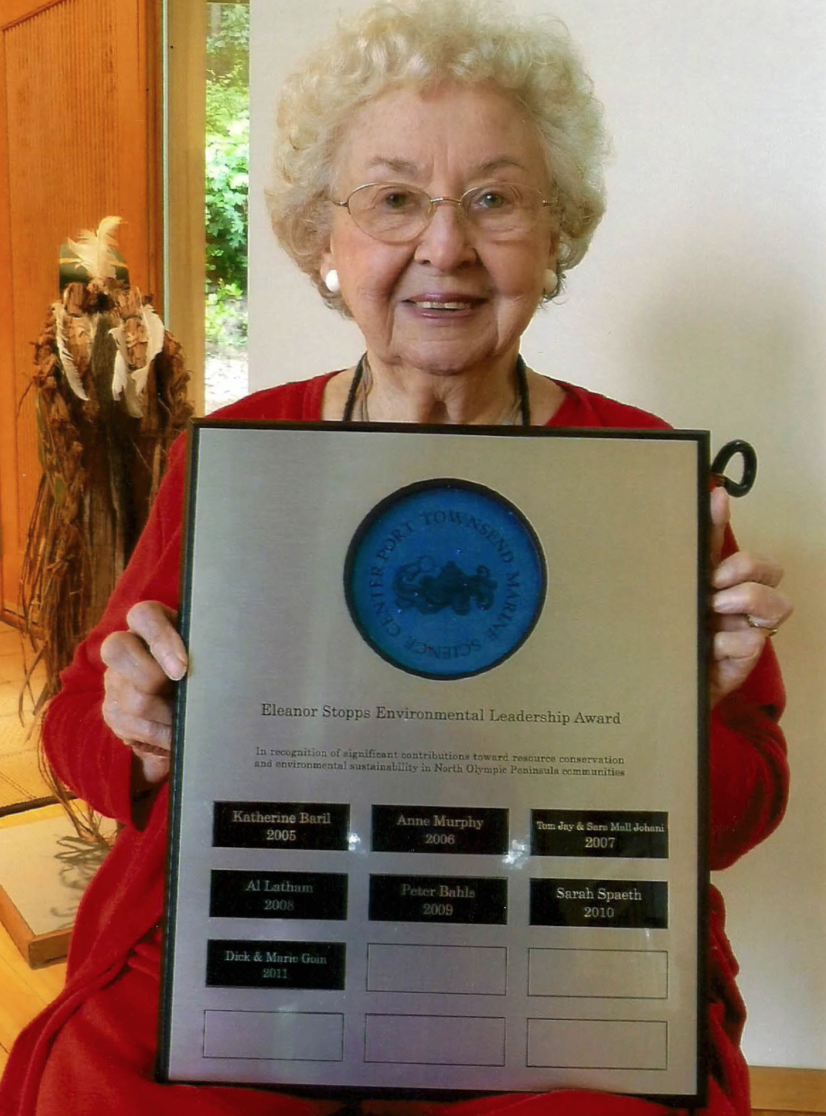
About the Eleanor Stopps Environmental Leadership Award
Eleanor Stopps

From the 1960s through the 1990s, Eleanor Stopps was an active member of the Pacific Northwest conservation community. She founded the Admiralty Audubon Chapter and was a primary driver behind the establishment of the Protection Island National Wildlife Refuge in 1982. Today it is a critical habitat link in the preservation of the entire Salish Sea ecosystem, providing breeding grounds for pigeon guillemots and rhinoceros auklets, bald eagles and peregrine falcons, harbor seals and elephant seals, and myriad other species.

Stopps died in April 2012 at the age of 92.

The leadership award created in her memory is presented annually to a citizen(s) of the North Olympic Peninsula (Jefferson and Clallam counties) who has led a successful resource conservation effort that benefits the North Olympic Peninsula and its residents directly; acted as a community catalyst for programs, initiatives or ventures that demonstrate a commitment to the future of the earth and its biodiversity; become a model for future leaders in business and education; or has been an exemplary citizen or policy maker who has implemented decisions that, though they may entail risks, have helped our communities take the next step towards environmental sustainability.

The PTMSC has sponsored this annual award since 2009.