Thursday, June 28, 2018

PTMSC Volunteer Trades Oars For Bike Pedals To Motivate Environmental Action


Row4climate.com

At age 10, Eliza Dawson volunteered at PTMSC on the Orca Project, preparing the bones of Hope the orca for display.

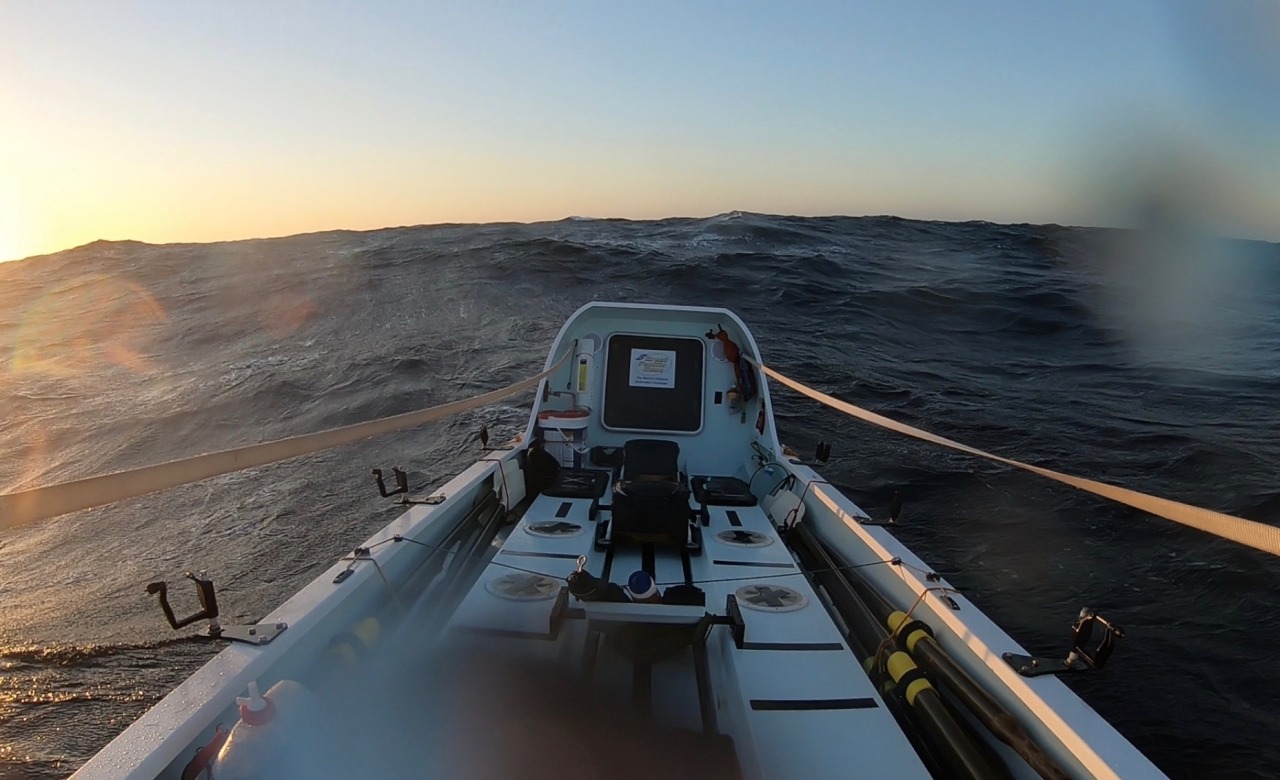
This summer, Eliza now 22, participated in the Great Pacific Race with Team Ripple Effect, an international team of young women to row across the Pacific from California to Hawaii to motivate environmental political action. Team Ripple Effect's guiding principle was that "while crossing the Pacific will be a monumental challenge, the challenges facing our planet are even greater. Each of us is working in our local communities to tackle issues threatening our planet and future. Together, we hope to have a global impact."

While the team had to end the row due to a medical emergency, Eliza has chosen to continue the mission on terra firma.


From Eliza's blog:

"This is my new plan: For the first two weeks of July, I will cycle 400 miles through the remote Alaskan and Canadian wilderness, getting an up-close view of rapidly receding glaciers, as well as bountiful wildlife and scenery. I remain determined to bring awareness to the impacts of climate change and I am looking forward to documenting my cycling journey."


Prior to her rowing journey, the Port Townsend Marine Science Center awarded the Anne Murphy Ocean Stewardship Scholarship. “We continue to be inspired by Eliza,” said PTMSC Executive Director Janine Boire. "We cheer her efforts to raise the consciousness of people everywhere about the threats to our marine environment."


Follow Eliza's blog www.row4climate.com to read more of Eliza's own words and for updates on her cycling journey.

Tuesday, June 26, 2018

Crabbing Season is here!


Summer is here, and that means crab season! Crab season in our local waters around the Port Townsend Marine Science Center will open this year on June 30. Other opening days in the Salish Sea region can be found here on the Washington Department of Fish and Wildlife website.

Opening of crab season at the PTMSC means a lot of hustle and bustle. The sea becomes a minefield of bobbing red and white crab pot buoys, people hauling out crab pots from over the pier, and people checking their crabs to make sure they are the right sex and size (more info here). The picnic tables are full of children and parents getting their haul ready to take home. The waters are speckled with boaters doing the same things.

Every year it is estimated that sport fishermen will catch over a million pounds of Dungeness crab!

When returning crabs that don't meet WDFW catch standards, remember to use the 
PTMSC crab elevator to safely lower your crabs back to the Salish Sea. 

So, how do these lucky people catch all those crabs? Here are a few tips to keep in mind when crabbing.

First things first. Get your license from the WDFW. Anyone over the age of 15 is required to carry a current fishing license with a crab endorsement on it. 

Once you have your license, or are in the process of getting it, it's time to choose your catch method. The most common way to catch crab in the Salish Sea is by using a crab pot. Crab pots can be purchased or created according to WDFW standards found on their website.

When creating and setting your crab pot, make sure to follow these tips to make sure that your pot and catch are not lost. 
  • Avoid marine transit and ferry lanes.
  • Check tides and currents: Avoid crabbing during strong tidal changes and currents.
  • Use high visibility buoys to clearly mark your gear.
  • Use a weighted line to sink below the surface and avoid being cut by passing boats.
  • Weight your pot so they do not move in high currents or tidal changes.
  • Use longer line. Use 1/3 more line than water depth to allow for changes in tides and currents.
  • Secure lid and escape panels with biodegradable cotton escape cord. This allows crabs to escape from lost pots after the cord degrades.


Here are a few helpful videos:

How to weight your pots

How to rig your line

When to set your pot

How to set your pot

How to modify your crab pot


You are now ready to catch some crab! These helpful hints will help you keep your catch and prevent your pot from becoming one of the 12,000 crab pots that are lost every year. Once lost at sea, crab pots become derelict or abandoned fishing gear. 

Derelict gear is considered to be a long-lasting marine debris and can include abandoned or lost nets, lines and pots. Most synthetic fishing gear can take decades (or more) to degrade and will continue to "ghost fish" or catch animals until removed from the ocean, as well as damage important habitat for animals. This gear is also a fiscal loss to the owner and becomes a hazard for divers, plus it can entangle boat motors and cause significant damage.


AmeriCorps member James with recovered derelict crab pots 
from under the PTMSC pier. Photo by Wendy Feltham

Thanks to the Northwest Straights Commission and WDFW, thousands of derelict fishing gear has been removed from the Salish Sea. With the help of fishermen all around the Puget Sound, WDFW has been able track and remove lost gear. If you are unable to recover your crab pot during crab season remember to contact WDFW or the Northwest Straits Commission.

There are no penalties when reporting lost or abandoned gear! Report your lost crab pot or fishing gear here.

Written by AmeriCorps Natural History and Volunteer Educator Emilee Carpenter.


Tuesday, June 12, 2018

Coastal Explorers -- July 9-13


Attention parents and grandparents!


We’ve got the perfect summer activity for 8 and 9 year olds: PTMSC Coastal Explorer day camp, July 9-13.

During the 5-day session, campers will discover how the beach, pond, glacier, and forest ecosystems support life on the Salish Sea. 

Our skilled camp counselors will guide your child in exploring the vast and wondrous underwater world that our marine environment has to offer.

Camp is $285 ($10 off for PTMSC members).

Only a few spaces remain, so sign up today!

Monday, June 11, 2018

Best Tidepooling


When I started my service term at the Port Townsend Marine Science Center, I found that I had been left a letter of advice from Brooke Askey, the AmeriCorps member in my position before me. It contained all sorts of wisdom and included one sentence in particular that intrigued me: “Salt Creek Recreation Area has the best tidepooling I’ve ever seen.”

My first view of the recreation area

So I am not exaggerating when I tell you that I have been looking forward to our Salt Creek Education Program with the Blue Heron Middle School 8th graders since my first day here.

PTMSC Education Coordinator Carolyn Woods showing off some seagrass

The Blue Heron students have been going to Salt Creek for many years now accompanied by PTMSC staff, AmeriCorps and volunteers to do a monitoring project that looks at how water quality relates to efforts to protect salmon habitat. They collect data at Salt Creek with their teachers and look at plants, animals and substrates in the intertidal zone with us.

Students surveying their plot

It was so fun to watch the students test out their scientific field surveying skills and discover their monitoring plots. Often when students first arrived at their plots they would proclaim with disappointment that there was nothing there. However, once they were encouraged to look more closely and move the top layer of seaweed, they were amazed at the beautiful world of bizarre life forms they uncovered.


We found tidepools full of juvenile sculpins darting between shadows, mating spotted leopard nudibranchs, vast swaths of mussels and barnacles, little shore crabs at every turn and the biggest gumboot chiton I’ve ever seen!

Volunteer Sue Long examining a large gumboot chiton

I can now say with confidence that Brooke was right and I will pass on this tidbit to the next AmeriCorps in my position: Salt Creek Recreation Area has the best tidepooling I’ve ever seen.

AmeriCorps James Swanson and I, clearly excited about the inter-tidal zone! 
Photo by Jo Ferrero 

Written by PTMSC AmeriCorps Citizen Science Educator Lily Evanston 

Wednesday, May 23, 2018

Earth Day Beach Clean Up: A Marine Debris Debrief

The beaches and waterways around Port Townsend look so beautiful and pristine, it is hard to believe they are facing some very serious threats from pollution. Especially in the Salish Sea, a unique binational estuary that is home to some very large metropolitan cities such as Seattle, Vancouver, Victoria, Tacoma, and smaller port towns such a Bellingham, Olympia, and Port Angeles.

The beaches in the Salish Sea are used for recreational, residential, commercial and industrial purposes but they are also home to many unique species.

Marine debris is one form of pollution that can impact human and wildlife health. Marine debris is defined as:

Any persistent solid material that is manufactured or processed and directly or indirectly, intentionally or unintentionally, disposed of or abandoned into the marine environment.
Marine debris may enter directly due to human action, or indirectly when washed out to sea via rivers, streams and storm drains. Marine debris has become one of the most pervasive pollution problems facing the world’s oceans and waterways.*

Some of the most commonly found marine debris items are:


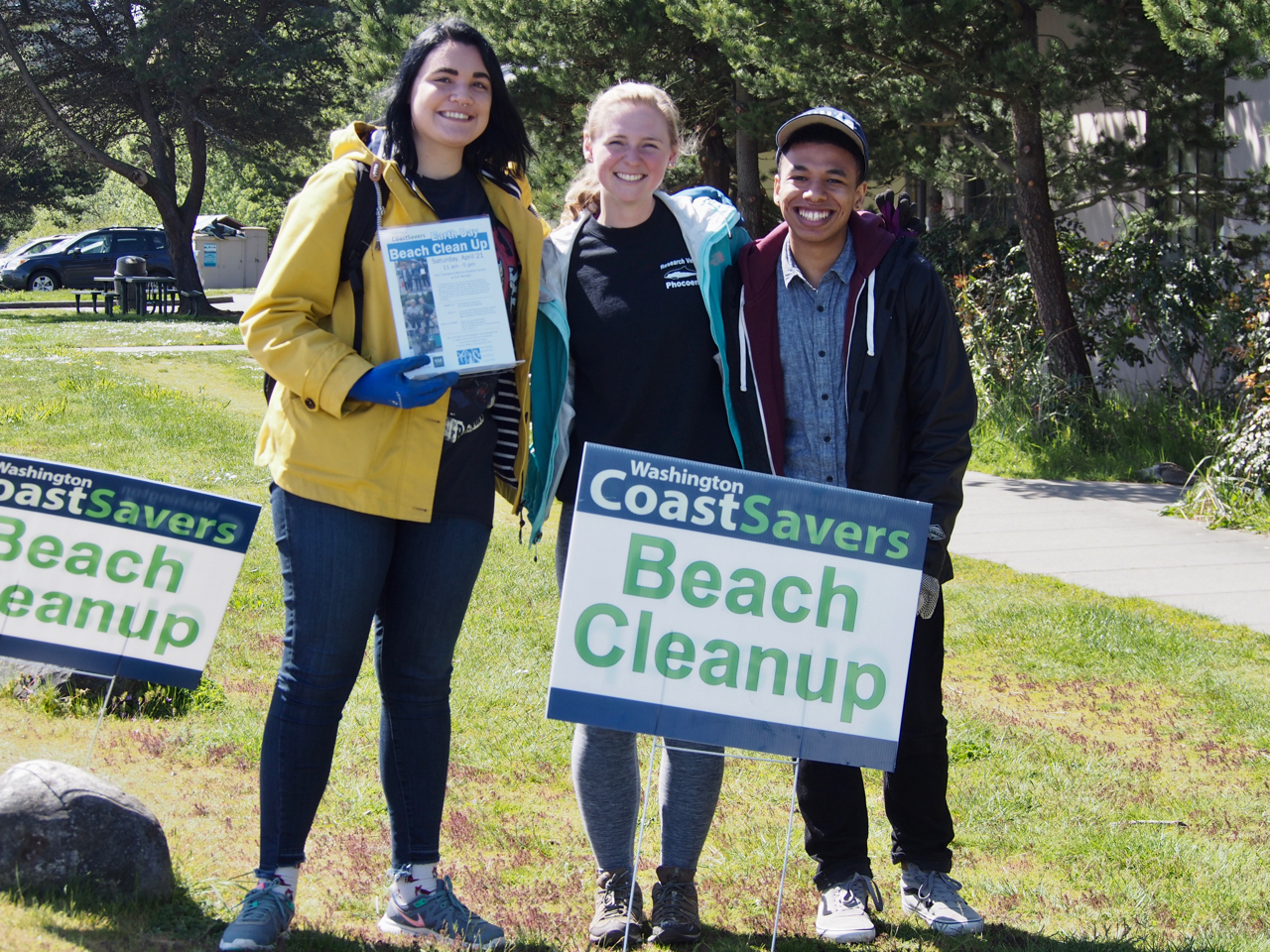
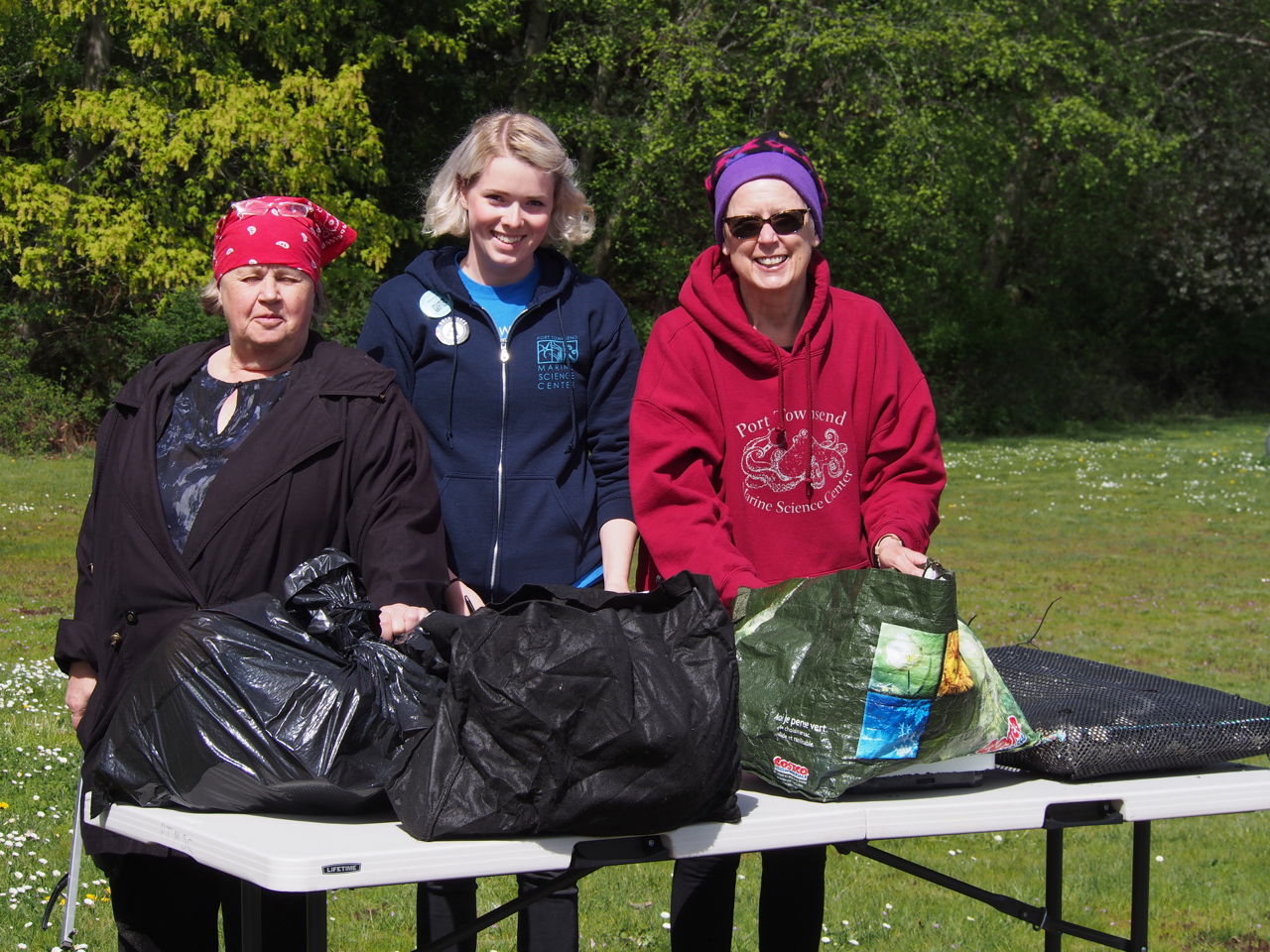
On Earth Day weekend, 2018, the Port Townsend Marine Science Center partnered with Washington CoastSavers and the Port Townsend Food Coop to host a local beach cleanup to remove marine debris from our local beaches.

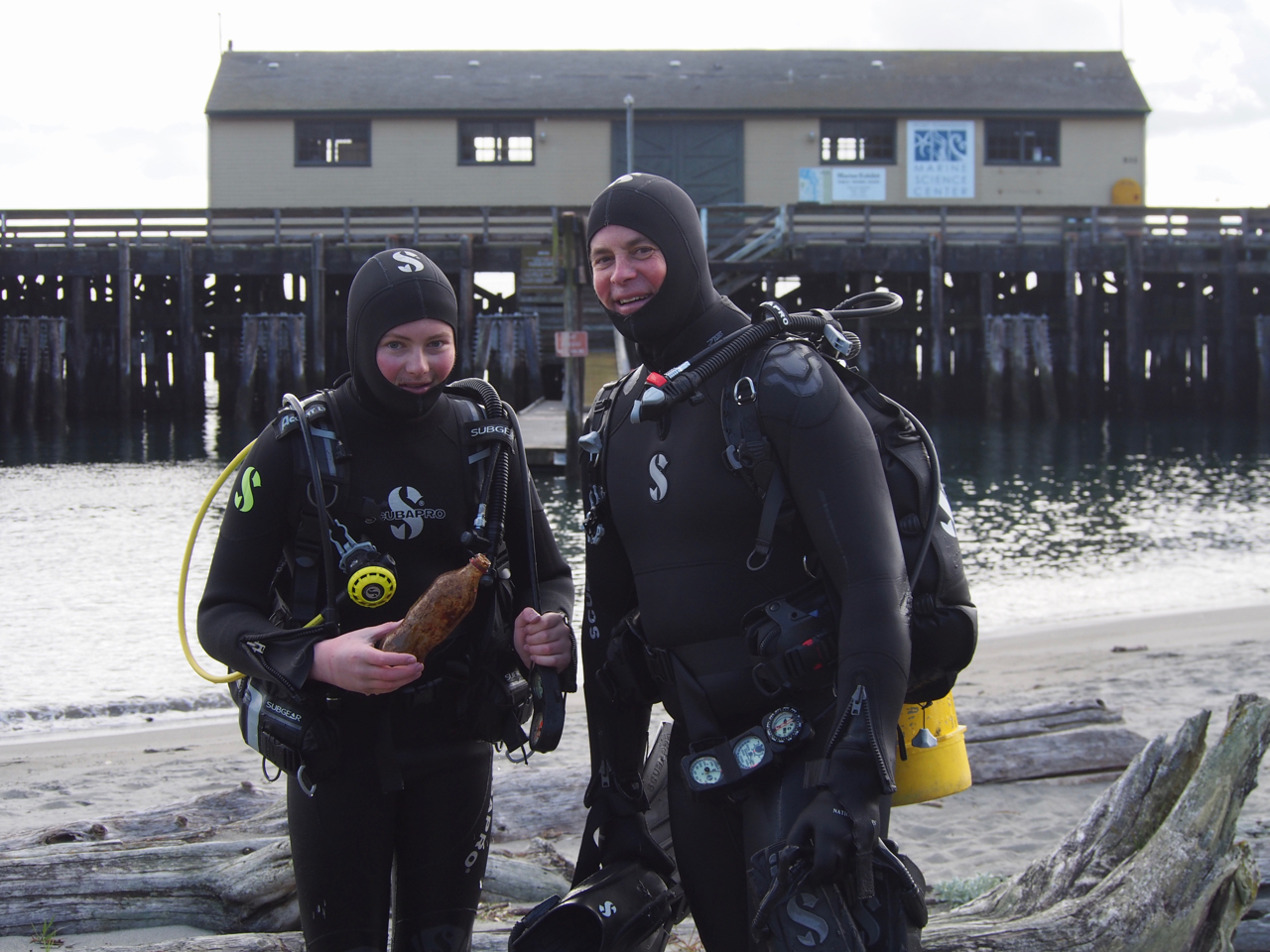
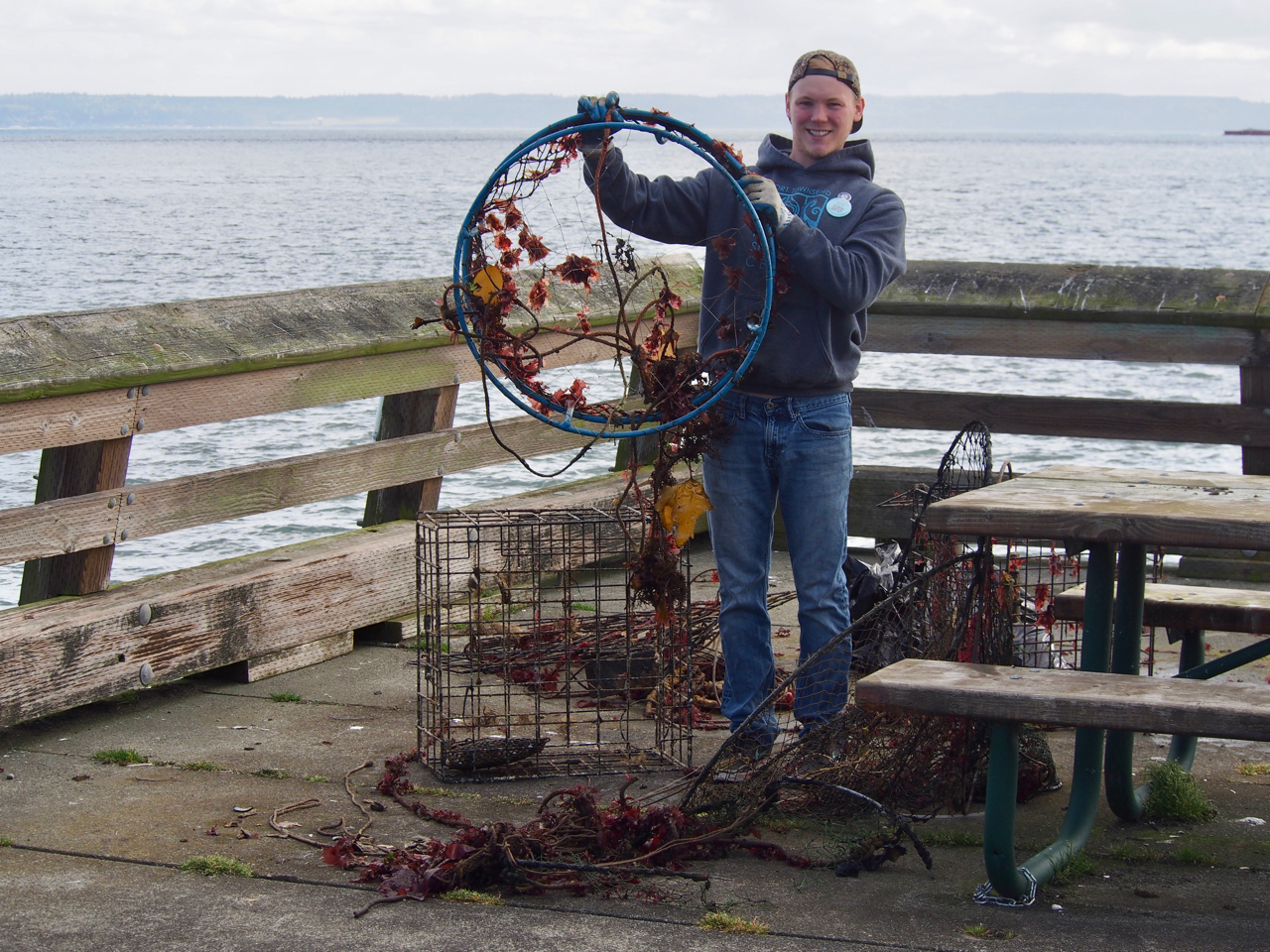
The day started early with volunteer divers Howard, Tim, and Tusker gearing up and heading out right under the PTMSC pier. They worked together to remove five abandoned crab pots tangled on the pier pilings. These pots were sitting on the bottom and posed a threat to animals living there (see upcoming post by AmeriCorps Emilee on derelict fishing gear).

Volunteer diver, Howard. Photo by W. Feltham
Volunteer divers, Tusker and Tim. Photo by W. Feltham


AmeriCorps member James (and PTMSC Aquarist Ali ) helped 
pull the pots up onto the pier once they were cut free. Photo by W. Feltham
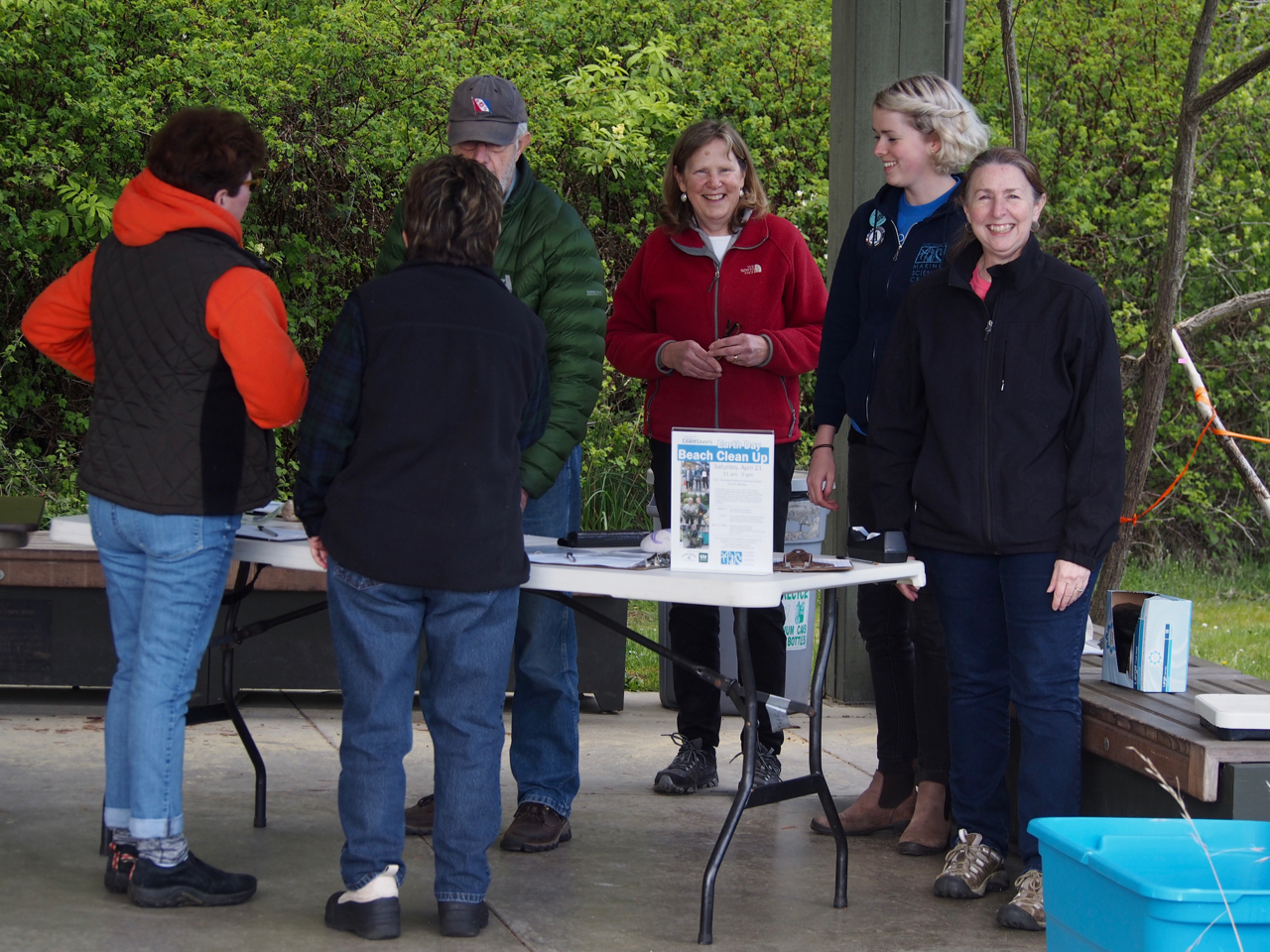
Volunteers stopped by the Natural History Exhibit portico to sign in and get their beach assignments. Photo by W. Feltham

We had volunteers remove debris from North Beach, Chetzemoka, Downtown Port Townsend, Boat Haven, Fort Worden, Fort Flagler, and a few places in between.


Thanks so much to all of the PTMSC volunteers who enthusiastically 
ran the check-in station, helped sort debris, fill out data cards, and 
connect the clean up with the significance of caring for the Salish Sea.
What a great crew! Photo by W. Feltham


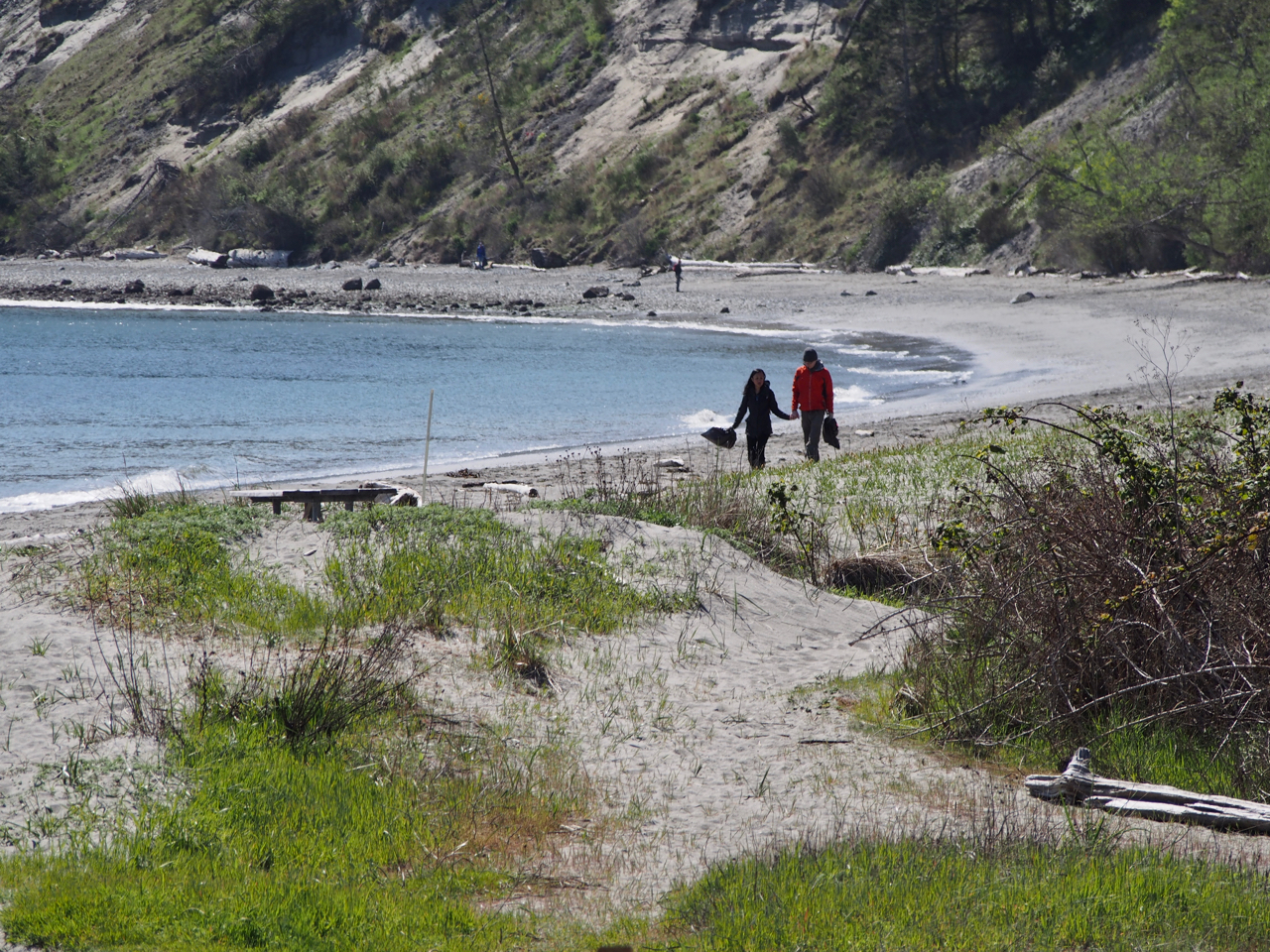
Beach Clean Up volunteers embark on their beach walk, scanning the ground for man-made debris while also enjoying the beautiful weekend day.
Photo by W. Feltham

Over 130 people volunteered their time to clean up Port Townsend’s beaches. Many were locals but we also had participants visiting from Seattle and elsewhere.

Photos by W. Feltham
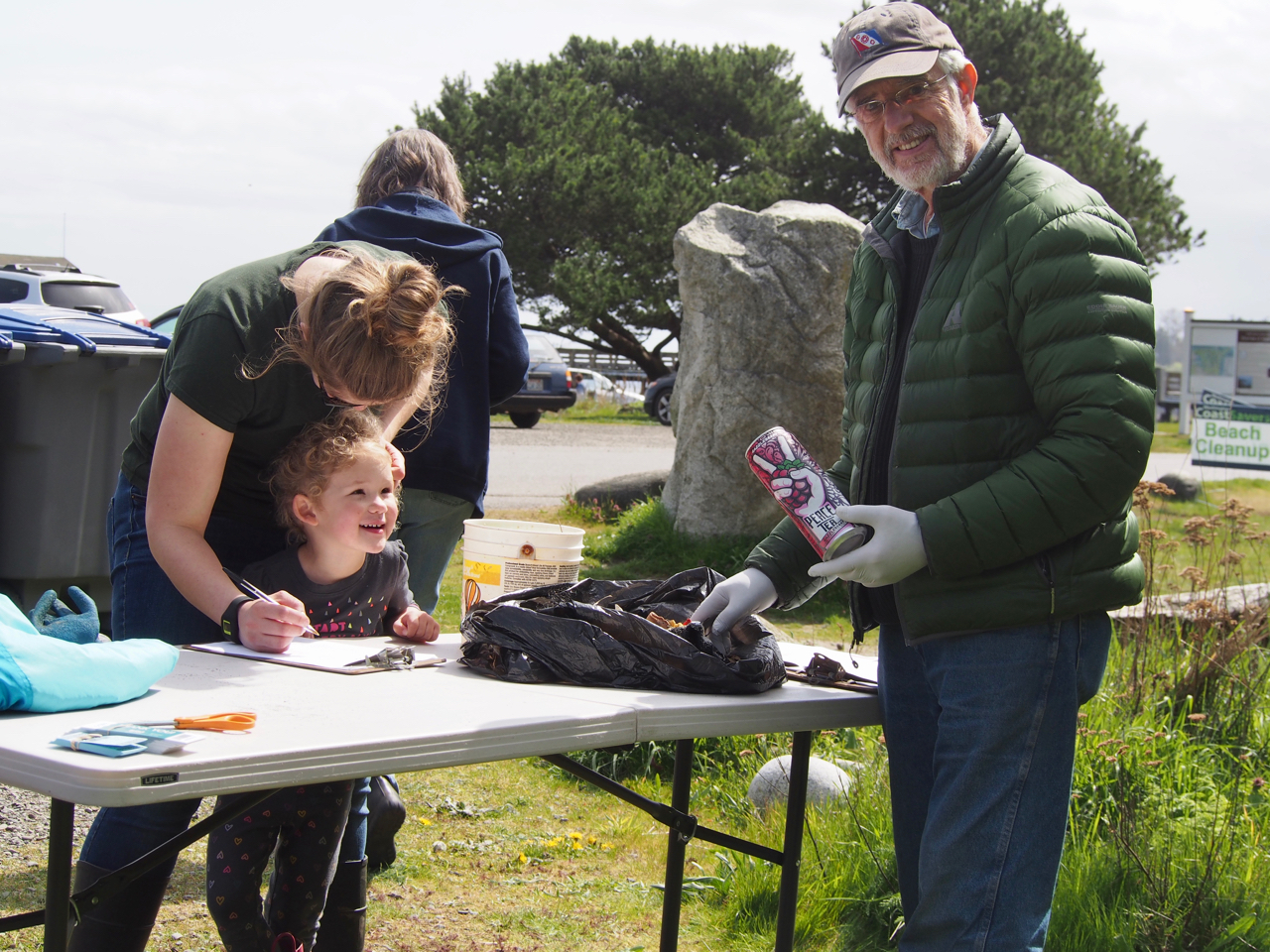
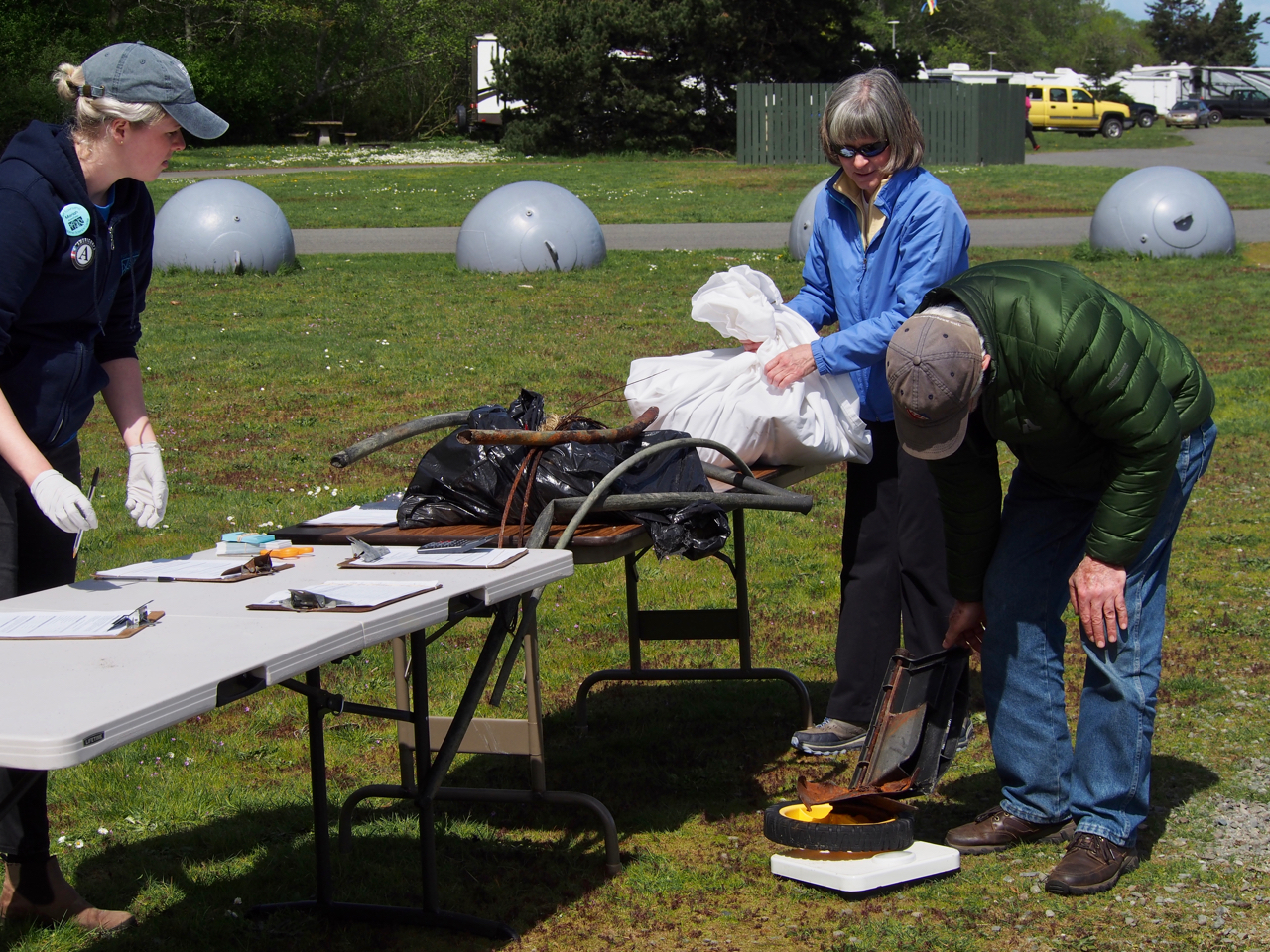
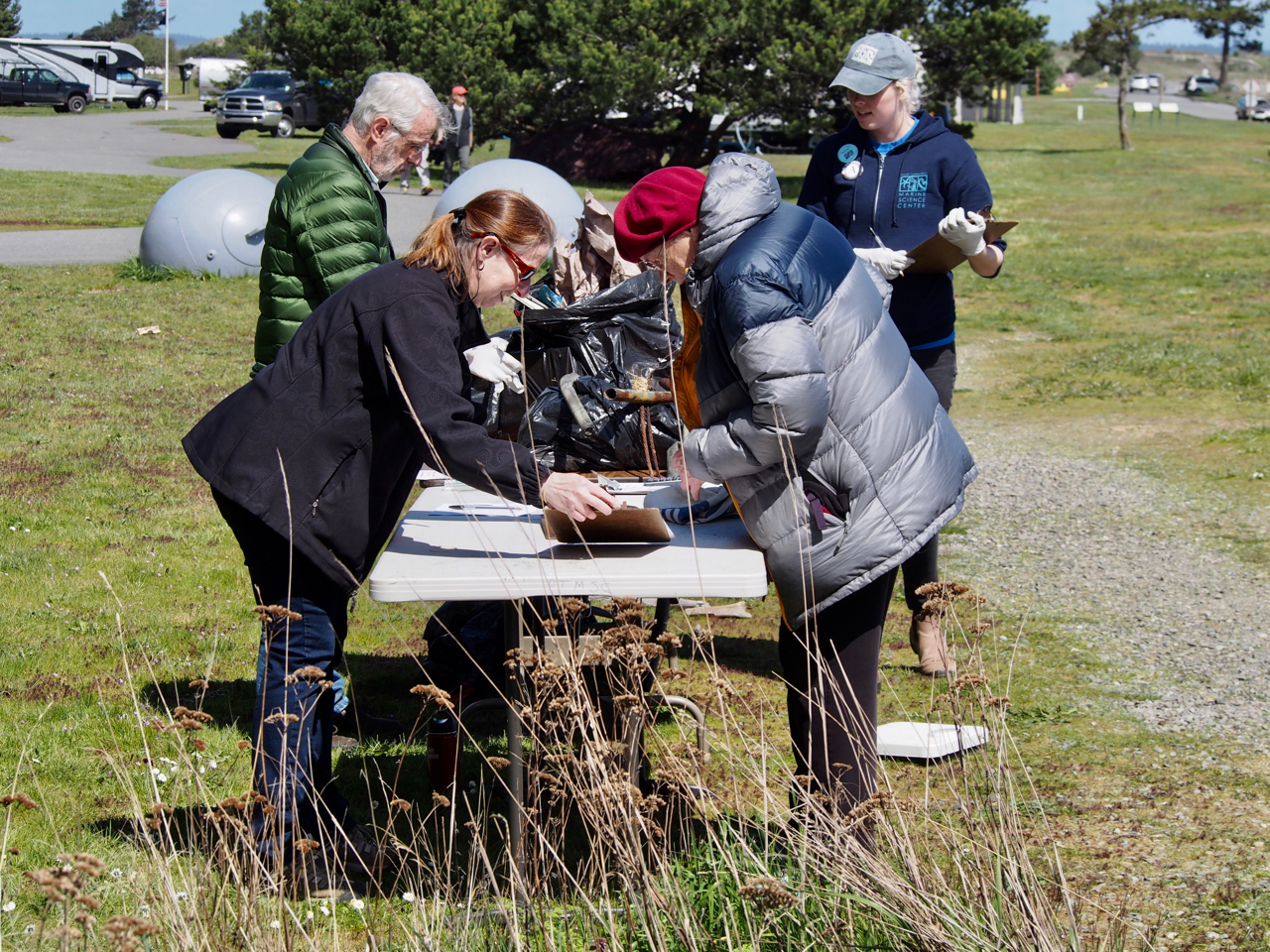
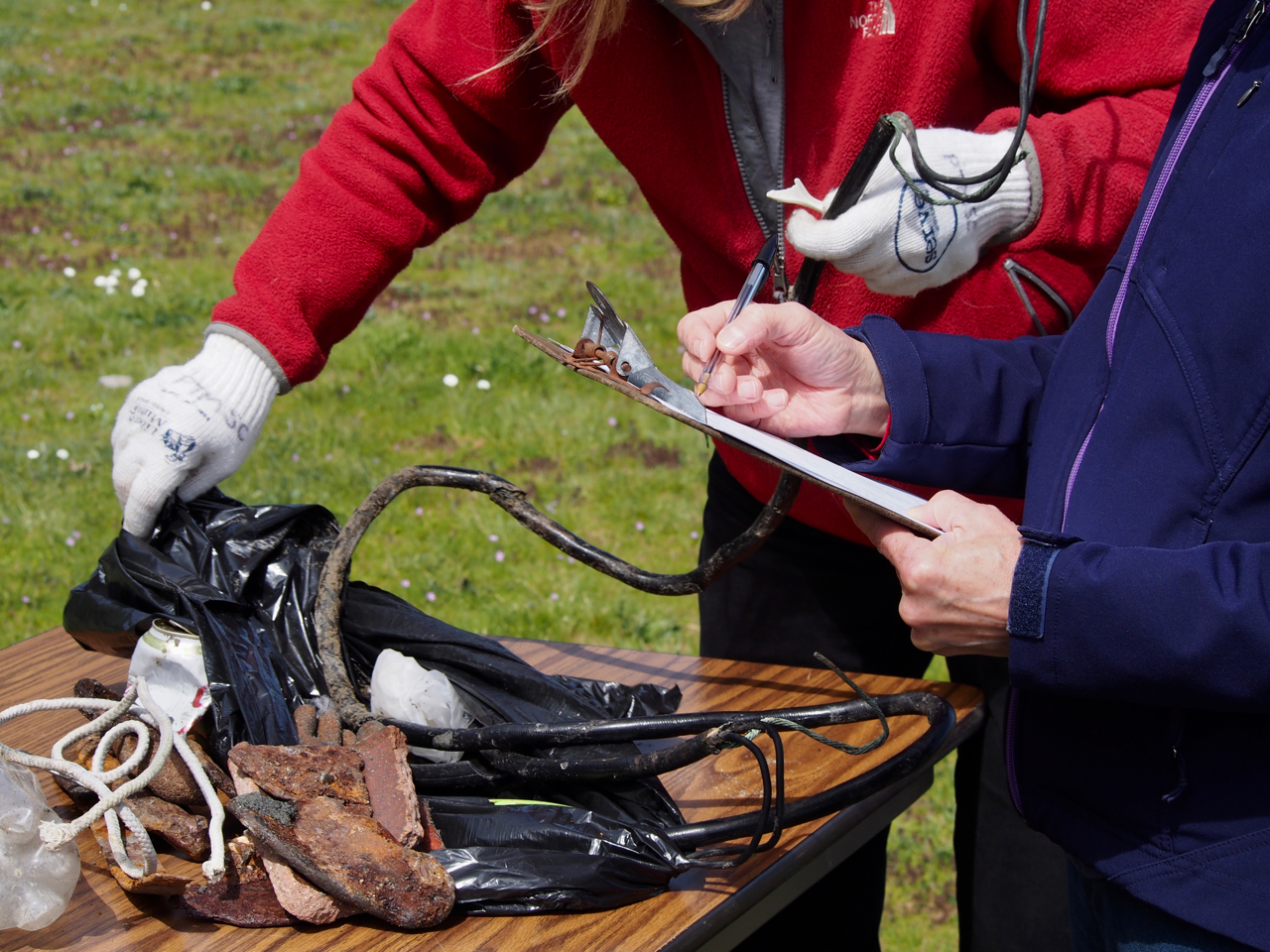
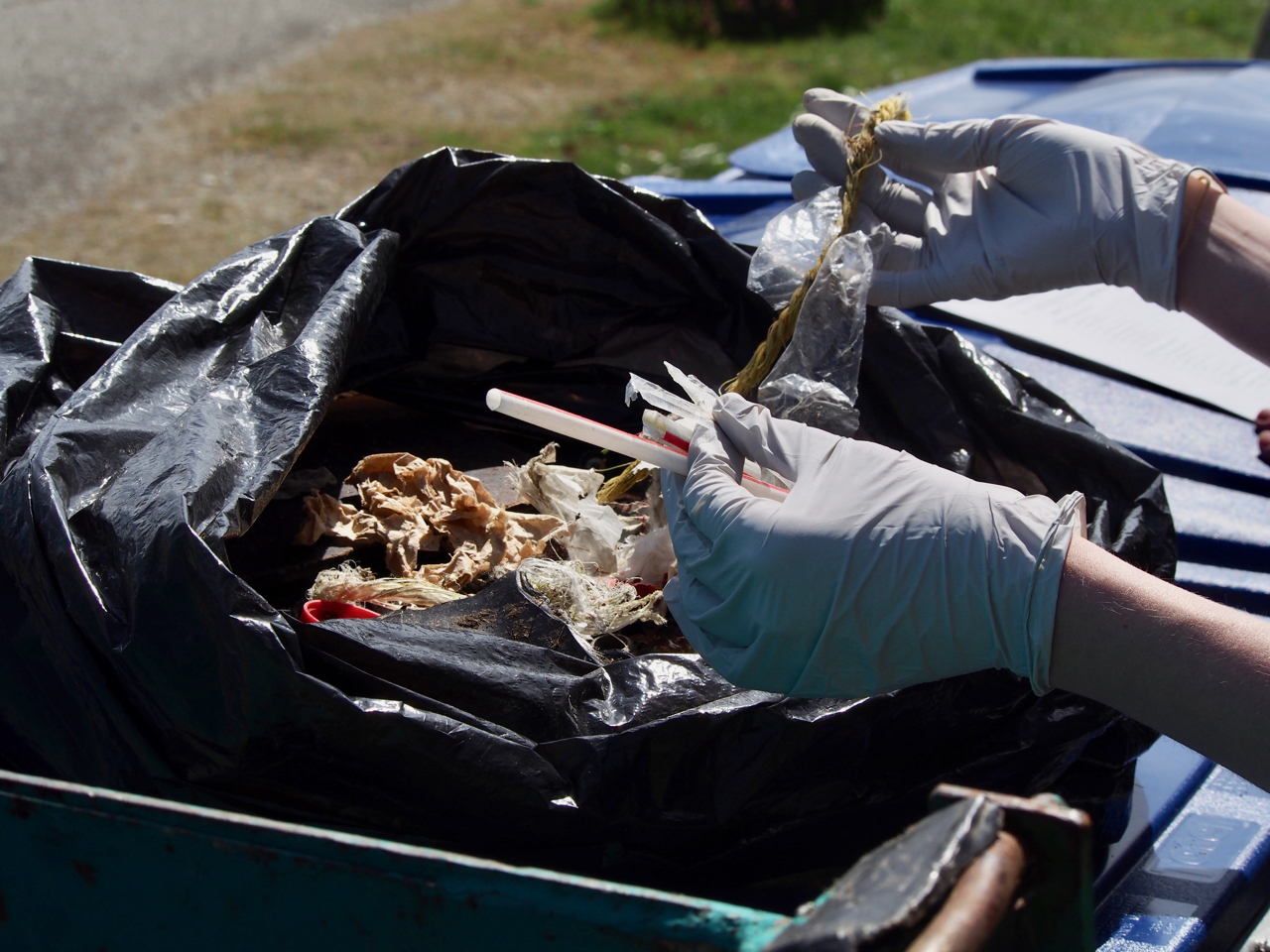
Once volunteers returned with their loot, the debris was weighed and sorted. We threw on gloves and dug into the garbage to document and itemize our findings. We recycled cans and bottles and completed a Washington Coast Savers data sheet so we could track what we were seeing.

Photos by W. Feltham
We saw a lot of cigarette butts, straws, bottle lids, shotgun shells, plastic food wrappers, rope bits, and construction debris. All of this debris can be harmful to wildlife and humans.

Plastic is especially dangerous. As it sits in the water, it breaks into smaller and smaller pieces and begins to absorb pollutants in the water, becoming extra concentrated with contaminants. As it degrades, it becomes harder to remove. 

Plastic can also begin to take on a fishy smell as it sits and absorbs toxins and collects marine life. It is easily mistaken for prey and ingested by marine animals. Once consumed, this debris can cause illness from toxins or can block digestive pathways causing starvation. Plastic has been found in the bodies of small bait fish (a staple of marine food webs), seabirds, whales, and a plethora of other animals. It has even made its way into shellfish and fish markets for human consumption. Gross huh?

There is an unimaginable amount of marine debris in the world’s oceans and the Salish Sea. Beach clean ups are a great way to remove what washes ashore. But what if we could prevent human debris and plastics from entering our waterways in the first place? One way to do this is to stop supporting the creation of single-use plastic products by:
  • supporting reuse 
  • considering the lifespan of the products we are buying 
  • seeking out products with little or no packaging 
  • saying NO to straws 
  • considering where you are creating waste and try to reduce it 
Collectively, during this clean up, we removed 659 lbs of garbage from Port Townsend beaches!

Thank you so much for all of the attention to detail and love you brought with you to clean up our beaches! What a great way to appreciate this amazing ecosystem we all call home!

All photos by PTMSC volunteer (and past PTMSC Board President) Wendy Feltham -- Thank You Wendy!

* U.S. Environmental Protection Agency, “Report to Congress: Impacts and Control of Combined Sewer Overflows and Sanitary Sewer Overflows” August 26, 2004, (EPA Publication 833-R-04-001), http://cfpub.epa.gov/npdes/cso/cpolicy_report2004.cfm


Written by AmeriCorps member Mariah Vane


Friday, May 18, 2018

Spring Off The Pier

Coming from the Midwest, my experience of spring has been a bit different from the way it is out here on the Olympic Peninsula and the Salish Sea. I figured it would be fun to share a few of the new things I’ve encountered so far this spring at the Port Townsend Marine Science Center.

Since spring is in the air, many animals have been feeling frisky. The kingfishers have been out and about chattering away with each other. I’ve even witnessed them diving for schooling fish under the pier a few times.

There is always something new to see when looking off the pier into the water below. Since April has started, this is especially true. Jellyfish and ctenophores are frequently visible. On first glance I only saw a few, however when I focused more I noticed hundreds of them. I have never seen so many live jellies in the wild before, so this really was an experience.


Ctenophore caught off the pier.


Each of these jellies was about the size of a quarter.

Large schools of sand lance, tube snout, and herring (known as bait balls) have been coming into the pier for its sheltered waters. These large schools sparkle and shine in the water due to their counter shading. Counter shading is a technique used to disorient their predators. It looks like an underwater light show! 

The plankton we’ve sampled in the last few weeks have had a lot more activity in them. Baby barnacles, crabs, copepods and more were common in our samples. This increase in plankton has to do with sunlight being stronger and nutrient availability greater than in the winter months.

Even the animals in the aquarium have got more energy. Over the winter, most of their appetites were reduced, but in the last couple of weeks everybody is eating a lot more food. Many have been spawning, including the invertebrates that are broadcast spawners. This means they release their sperm and eggs into the water, hoping they mingle and fertilize. This makes for some murky water conditions in the tanks when it happens.

We also have been collecting animals lately to add to the exhibits. Recently we netted some eelgrass right off the pier. Babies critters were everywhere: juvenile flounder, gunnels, crabs, and sculpins were coming up in the net. This was so exciting to see since eelgrass beds are nurseries for juvenile fish. That is one of the reasons we have two tanks dedicated to eelgrass because it is so important for the early life stages of certain species, especially salmon.


Two juvenile flounder hiding in the sand of the eel-grass tank.
(There is also an orange-tipped nudibranch hiding in the back)

There is too much for me to mention in one blog post, but not being from the Northwest and witnessing all this going on I can only think one thing: The Salish Sea is one productive body of water, especially this time of the year. The PTMSC Aquarium and pier here are the perfect place to showcase that richness!

Written by AmeriCorps Marine Science Educator James Swanson.

Thursday, May 17, 2018

Explore the Salish Sea: Joe Gaydos Beach Walk and Book Signing


Image courtesy Little Bigfoot Books
Saturday, June 2
12:30-2:30pm

Orca Exhibit Classroom

Joe Gaydos, VMD, PhD
photo by Wendy Shattil
Lead scientist for the SeaDoc Society Joe Gaydos, co-author of "The Salish Sea, Jewel of the Pacific Northwest," wildlife veterinarian, self-proclaimed science nerd and wildlife fanatic has just published the much anticipated "Explore the Salish Sea, A Nature Guide for Kids."

In this special meet-the-author family event, Joe will be giving a short kid-friendly presentation in the Museum classroom based on his book before leading a beach walk here at Fort Worden. Copies of both books will be available in the Gift Shop, or bring your copy for a signature.

The talk is most suitable for children over 8 years of age. The program and beach walk are free with admission to PTMSC on a first-come, first-served basis. Space is limited.

Reservations are encouraged -- Click here to RSVP!