Thursday, June 23, 2011

Orca Saturdays

June is Orca Month and here at PTMSC we celebrated with two Orca Saturdays.  These events were all about sharing our orca knowledge with the public.
Young visitors got creative at the craft table!
Up until recently, the majority of our interactions with the public have focused around the articulation of the orca skeleton, Hope (learn more HERE).  Of course Hope's presence and stories were with us for our events, but it was also nice to incorporate other orca-related activities into our celebration.  Many of these activities were new to the public and our volunteers because most of them were adapted from orca curriculum developed and taught here at PTMSC.

A family worked together to build an orca family tree!


Visitors learned about hydrophones (underwater microphones) and how they are used to listen to sound underwater.

In our local waters, scientists use hydrophones to listen to orca vocalizations and have learned many of the different calls orcas make.  At our Orca Saturday events, we set up a portable hydrophone and let visitors create and listen to how a variety of objects create sound underwater.

At one point, the craft table was filled with kids, orca volunteers were immersed in conversation with visitors, and a father and daughter read an orca storybook in the corner of the room.  I stepped back, took in the moment and smiled like a proud parent.

Although our Orca Month festivities have come to an end, June isn't over yet!  I encourage you to find your own way to acknowledge, celebrate and learn about these amazing creatures.

Enjoy!
Heather Jones

Tuesday, June 7, 2011

"Catch a falling star and put it in your pocket"

Remember our blog from April about the brooding six-rayed stars? Well the babies are hatching and decorating our tank now! They have been very popular with the visitors gaining the nickname 'sea sprinkles.' 

A six-rayed sea star under a microscope

Two little 'sea sprinkles'

Baby six-rayed sea stars and the mom decorating the tank

Watch the video below to see their tiny tube feet move!


Observe the 'sea sprinkles' yourself during our summer hours starting Friday June 10th we are open 11-5 Wednesday-Monday.


Valerie Lindborg
PTMSC Lab Coordinator

Wednesday, June 1, 2011

Grunt Sculpins Galore

During the fall, our grunt sculpins lay their eggs in empty giant barnacles.  They care for them throughout the fall and into the winter.  This year, the first eggs hatched in early December and the eggs continued to hatch until the end of April.
Grunt Sculpin

 Some days, either no eggs would hatch or just a few would, but occasionally we had almost 200 hatch in one day!  In total we had 1,092 grunt sculpin babies hatch!!  Since we were not able to successfully raise the baby grunt sculpins last year, we released them off our floating dock and hope they found shelter in the nearby eelgrass bed.

This graph shows how many grunt sculpin babies hatched from December to the end of April.  You can see there is no pattern.  You can compare this year's graph to last years here: Baby Grunt Sculpins 2009-2010.  Be careful, the two graphs have a different scale; for the "Number of babies hatched", it goes up to 200, last year's graph only goes up to 100.

Although the grunt sculpin babies no longer grace our tanks, we still have a lot of other baby (and adult) animals to see.

We're open Friday-Sunday 12-4pm. 
And starting June 10th, we will be open Wednesday-Monday, 11am-5pm.

Julia Ledbetter
Marine Exhibit Education Coordinator

Friday, May 27, 2011

WaterWorld 2011


Water World is an annual, week-long residential program offered jointly by the Port Townsend Marine Science Center and Centrum.  As such, it is a wonderful fusion of science and art. 5th and 6th grade students from schools in Port Townsend are joined by groups from as far away
as Spokane, Yakima, and the Methow Valley. I believe that these varied backgrounds combine to create a far richer experience for the students than they might have if they were all from the same geographic area. It was really wonderful to watch the students from landlocked areas revel in the newness of our marine environment. Of course, at the same time the local PT students got to learn more in depth about the marine and aquatic life they’re already fairly familiar with.


a student's drawing depicting their journey across the state to WaterWorld
photo by Darwin Nordin

While here, the students take a number of classes with us as PTMSC instructors. This year Valerie and I taught “Marine Birds” (with a section on plastics in the marine environment taught by Nancy), “Plankton Lab”, “Sound Underwater: Awesome Orcas” and “Marine Invertebrates”. These classes span a broad variety of topics and are some of our favorite classes to teach. We also pull a 150 foot seine on the beach, allowing the groups to witness first-hand the diversity of life in the eelgrass beds just off shore. 
examining a cormorant in "Marine Birds", photo by Melinda Pongrey
pulling the seine net in the final few feet,
photo by Melinda Pongrey

Plankton drawn during "Plankton Lab"
photo by Darwin Nordin

The teachers associated with Centrum (rather than PTMSC) were:
 Nisi Shawl, a creative writer who did an amazing job of successfully encouraging the students to write creatively about their experience here and about the various organisms they encountered or imagined during the program
Christian Swensen, who taught movement classes, coaxed the students into contorting their bodies into shapes and movements that mimic marine life (or any other zany creature they chose to focus on). The skill, energy and enthusiasm that Christian brings to his work certainly inspired the students.
Darwin Nordin led the visual art component. Quite a few of our classes at PTMSC involve a drawing component but the students in WaterWorld were intensely engaged in the drawing process; far more than most groups. I credit Darwin for this open creativity.

One of the most unique parts of WaterWorld is the entire day that students spend outdoors, walking on the beach from the Marine Science Center, around the lighthouse and to North Beach. This is followed by guided investigations of the lagoon and one of the secluded ponds. The beach walk portion of the day is fairly unstructured and it was marvelous to see everyone; students, chaperones and my fellow teachers explore the sandy and rocky shores. All of the classes at PTMSC prepared the students to recognize and appreciate the organisms and processes we observed. I always love being able to take students outdoors to actually SEE the animals we’ve talked about in class; it makes it feel much more relevant for them (and me!).
Tide-pooling, photo by Darwin Nordin
Sunflower stars live in the wild too!
Photo by Valerie Lindborg

Trekking over to the lagoon
Photo by Valerie Lindborg
Journaling by the lagoon
photo by Jess Swihart
Since everyone involved with WaterWorld is holding a mindset of combining science and art, some wonderful fusions of the two emerge during the walk:
Beach art, photo by Darwin Nordin
launching a driftwood vessel, photo by Valerie
The final night of the program is spent allowing all of the students to present writing, drawing and movement pieces they’ve created during the week. As teachers it’s always very rewarding to see that your students learned something from your classes that they find meaningful or interesting enough to carry into another arena. Further, witnessing how profoundly and perceptively all of these 5th and 6th graders can express themselves, combining personal experiences with the subjects we discussed during classes and the beach walk made it a beautifully inspiring night. There were some incredible poems written, some hilarious movement acts and many gorgeous drawings.


WaterWorld is a very special program; it’s so rare for science and art to be presented and understood in such complementary ways. It gives me hope that in coming years we’ll continue to break down the perception that there is a strict dichotomy between creativity and science. In settings such as this, art and science enhance and support each other in wonderful, engaging ways.

Jess Swihart
Natural History Exhibit Coordinator

 * * * * * * * * * 


Tuesday, May 24, 2011

Celebrate World Ocean's Day!


Celebrate World Oceans Day! Participate by helping clean up Fort Worden`s beachside. We will meet at the end of the Fort Worden Pier on June 8th at 10:00 AM.


http://worldoceansday.org/

Thursday, May 19, 2011

Plastic--Mandy's story

During Plastics Awareness month, PTMSC has decided to share inspirational stories about plastics instead of the usual 'doom and gloom.' Mandy is one of our volunteers and has offered to be a guest blogger. Enjoy her story!

* * * * * * * * * * * * * *
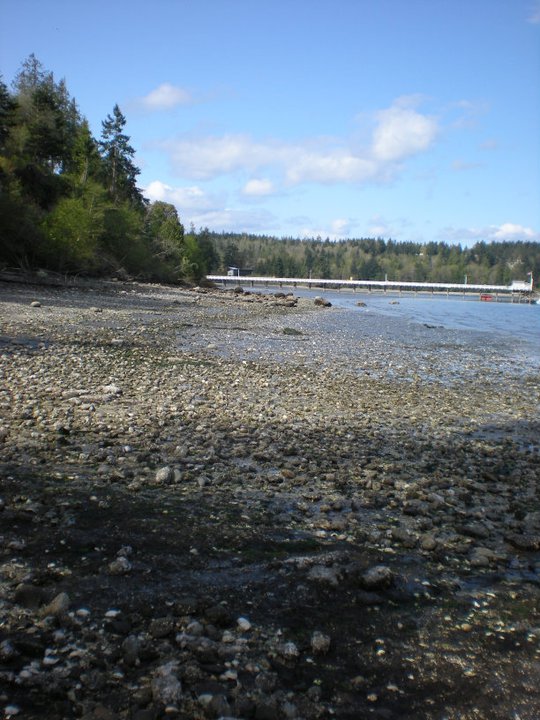
"Somehow a stretch of beach, about a half of a mile long, managed to take hold of me this winter. Without intending to, I became its steward.

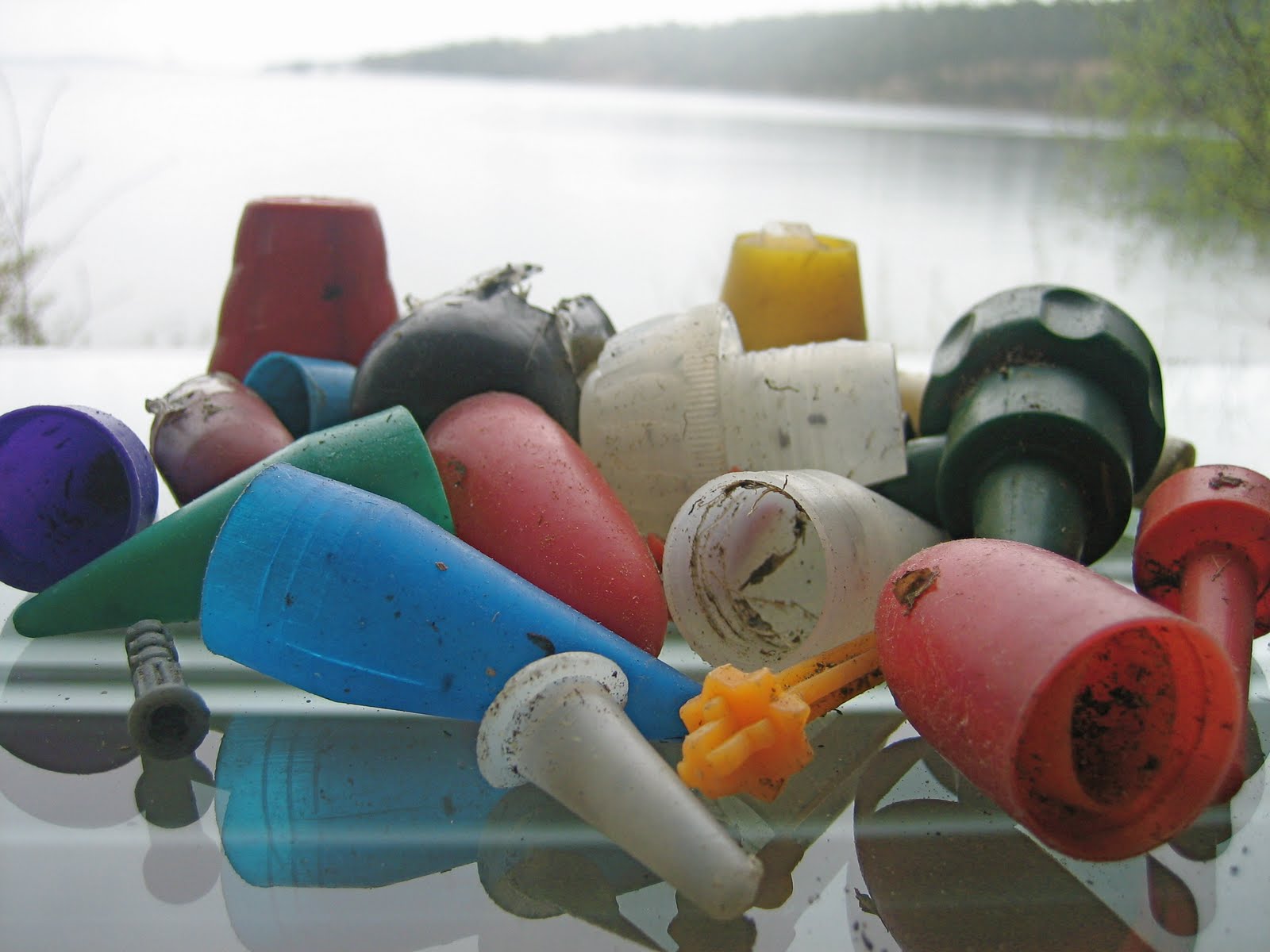
It started, quite literally, on a dark and stormy night. A Northwesterly bellowed in, producing gales with rollers uncommonly large for the 5-mile fetch behind them. A number of boats on moorings--which had sat in their anchorage unaffected by countless other passing storms--dragged or broke free. They stopped their all-night migration when they hit the concrete breakwater of a marina to the south. With no place left to go, the boats pounded into concrete and into each other until a few eventually broke into pieces and sank. The next day, working in treacherous and still confused waters, the Coast Guard arrived to survey damage. Vessel Assist towed still-floating boats off of one another and hauled them north for immediate haul-out and repairs. For a week, divers came to lift sunken boat parts and engines and towed them away. Chunks of boat of various sizes, along with their contents, began washing ashore. Every high tide brought an assortment of ropes, foam, plastic bags, blankets, tarps, DVDs, cassette tapes, zipper bags, zip ties, and other non-biodegradable relics.

Originally, I saw this arriving junk as a one-time event caused by an unusually destructive storm. My mind traveled to images of birds and animals ingesting plastics http://www.hawaiianatolls.org/research/June2006/albatross_death.php and tangling themselves in ropes, and I took it upon myself to clean the beach. The storm, I reasoned, was the cause of the persistent mess.
Weeks passed, until finally one day I declared that I was "done." The beach was clean of all the chaos of the storm. It wasn't until the next day, and the next, and the next that I really saw the problem. I wasn't done. I would never be done. There was always more trash coming ashore. The new trash wasn't the the muddy, sunken boat trash, but shiny and mostly clean trash that hadn't faded from sunlight and didn't have barnacles growing on it.

By this time, the beach and I developed a relationship. I would come and take away the trash regularly, and it would teach me the impact of human action, or human inaction, depending on my viewpoint of the day. My thoughts centered on what I found the most of: non-biodegradable single-use plastics.

My mind got caught in a downward spiraling loop of questions. How could we, as a culture, care so little? How could we be doing this to our own planet? Where will an intervention to this problem come from?"


* * * * * * * * * * * * * * * * * * * * * 
Thank You Mandy for being a guestblogger during Plastics Month, you truly have an inspirational story!

Do you have an inspirational story about Plastics? Share it with us in the comments section or on our Facebook page: http://www.facebook.com/pages/Port-Townsend-Marine-Science-Center/64955379712

Next Plastic Events:
Wednesday May 25th- A movie showing of 'Bag-it;' a short documentary about one man's journey with the plastic in his life. Join us for the movie and a short discussion afterwards in the Natural History Exhibit located at Fort Worden State Park, (6-8PM).

Wednesday June 8th- World Ocean's Day. Celebrate this beautiful day by helping with a beach clean-up at Fort Worden State Park. Volunteers are meeting at 10AM out on the marine exhibit pier.

Wednesday, May 11, 2011

Don't underestimate a cranky Slime Star

When we collect animals for our tanks, we often have to rearrange the animals we already have to find everyone the perfect home.  Usually we don't get much protest to being moved, but this year our baby slime star fought back aggressively against its new home. 

We decided to move it from its home in a wall tank to the smaller jewel tank so visitors could easily admire it.  The baby slime star's new tank mate was a baby Puget Sound King Crab and we thought they would get along fine.  As Jess, Heather, Valerie and I were finding homes for other new critters, we noticed that the baby slime star was floating off the gravel!  On closer inspection, we could see that it had started to slime.  We kept an eye on the tank, but continued to deal with the other animals, assuming it would calm down.

The baby slime star after the "slimy ordeal"

We had our backs to the jewel tank, when all of a sudden Jess and I heard water falling onto the floor.  We turned around to see the jewel tank flooding and water pouring over the top and onto the floor.  The baby slime star did not like its new home and tank mate!  We discovered that the slime star had produced enough slime to block the water outflow tube and flood the tank.  We quickly pulled the star out of the tank and placed it in a tub for it to calm down and stop sliming. 

Check out this video of the amount of slime produced by this small star!


Because of this tantrum, we ended up putting the baby slime star back where it had started, in the small wall tank, where it is happy and hasn't slimed since.

The slime star, or Pteraster tesselatus, has short stubby legs and cran grow up to 24 cm across.  It can release A LOT of slime for protection against predators.  It can be found from the Bering Sea to Monterey Bay, California.  Its slime can be toxic to animals that are submersed in it for 24 hours!

Come check out our slime stars (we have two!) and all our other animals, Friday-Sunday 12-4pm.

Julia Ledbetter
Marine Exhibit Education Coordinator