Monday, May 4, 2020

LIVE From The Aquarium


In our aquarium, spring is in the air: there's new creatures in our tanks. Our aquarium curator Ali Redman will guide you through the tanks on a personalized tour!
Even though our aquarium is closed to the public, we can still bring the aquarium happenings to you with Facebook Live!
Part of our GiveBIG 2020 Fundraising Campaign to raise $20K to support our mission to inspire conservation of the Salish Sea.

Wednesday, April 29, 2020

Anne Murphy Ocean Stewardship Scholarship

Accepting applications for the annual Anne Murphy Ocean Stewardship Scholarship
Please share this information!

The Port Townsend Marine Science Center is pleased to announce the annual $1,500 Anne Murphy Ocean Stewardship scholarship for a graduating East Jefferson county senior.
Applicants should be graduating seniors from a public or private school, or a home-schooled student who expects to complete high school level instruction by June 2020.  The person who wins this scholarship will be selected on the basis of his or her demonstrated interest in science and the environment. Having volunteered on behalf of education about or conservation of the Salish Sea is especially desirable, particularly at the Port Townsend Marine Science Center. The scholarship may be used for tuition, books, or living expenses while pursuing higher education.

To apply for the scholarship, please go to https://thewashboard.org and search for "Anne Murphy Ocean Stewards Scholarship". Questions, please contact Liesl Slabaugh, Development and Marketing Director, at lslabaugh@ptmsc.org or 385-5582 x101.

Applications are due by May 22, 2020. The winner will be selected and notified by May 30.  The award will be given at the school’s award ceremony or another event TBD.

Friday, April 24, 2020

Nature Break: Sound Mapping

If you’re looking for a reason to get outside (and learn something new at the same time) nature journaling is a great way to get started! We’re going to be posting prompts and ideas for journaling each week and encourage you to follow along and share what you create.  

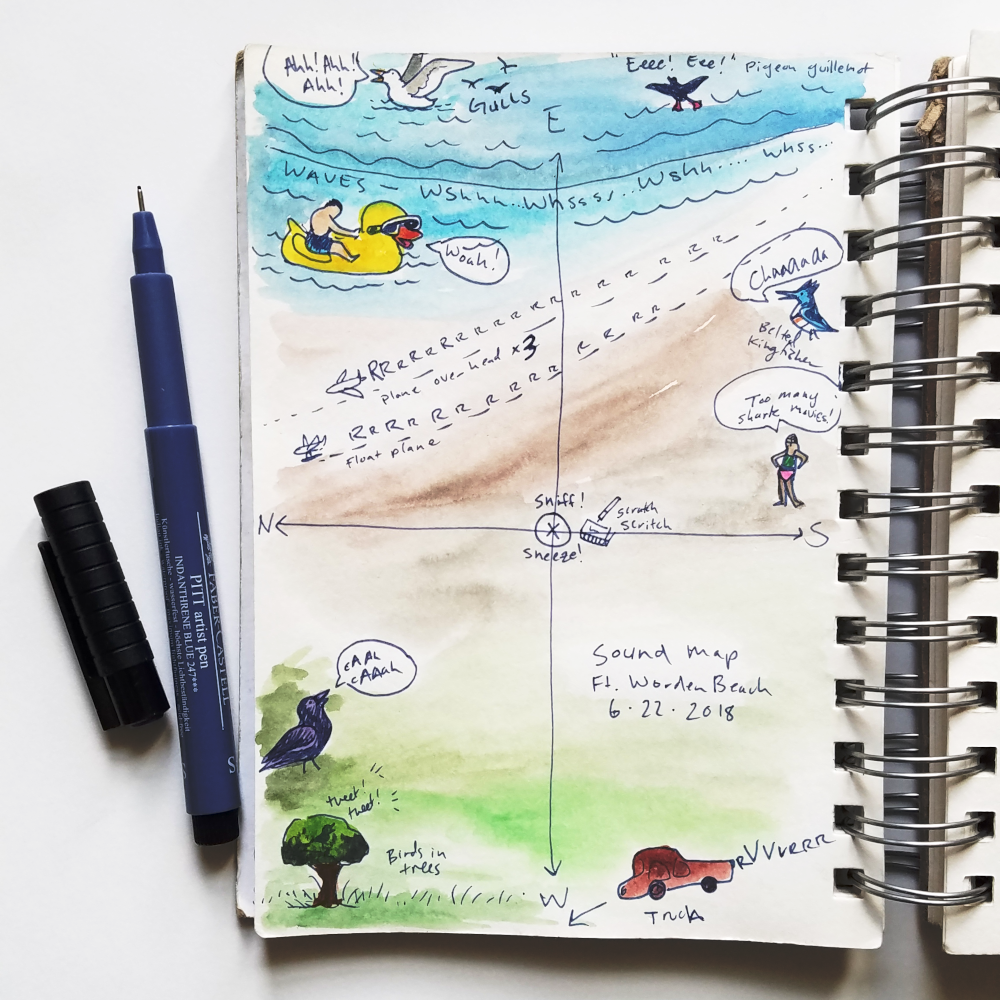
Everyone’s heard the advice to stop and smell the roses but what about stopping and listening to the sounds of nature and your neighborhood? You might be surprised at what you hear when you focus on just one sense! Making a sound map can be a great way to keep track of what’s in the environment around you. What might be something nearby that you can hear, but not see?

Try this: divide your page into four equal sections, with yourself at the middle. You can label your quadrants like a compass if you know which way is North; or mark your orientation with landmarks you choose. Set a timer for a brief listening period (try one minute) while you close your eyes and focus on listening. Then, mark down what you heard!

Sound Map of Fort Worden beach, June 22nd 2018


Extensions: 
  • How do the sounds you hear change depending on the time of day? What about changes depending on the day of the week, or the change of seasons? Make a series of sound maps to find out.  
  • How does what you hear compare with someone else? Create a sound map in the same time and place with someone else in your household, and compare/contrast!
  • Want a resource to identify the bird sounds you’re hearing? The Audubon Bird ID app is a great field guide for North American birds - and it’s free! 

If you choose to go outside for nature journaling, be sure to stay safe and follow public health guidelines for social distancing and local closure notices. Nature journaling can be done safely from home in your backyard, porch, balcony, or even a window! Tag us on Instagram @ptmarinescictr to share your journal. 

Friday, April 10, 2020

Take A (Nature) Break!


You can find things to journal about in your own backyard!

If you’re looking for a reason to get outside (and learn something new about the natural world at the same time) nature journaling is a great way to get started! It's a practice we often use in education programs and can easily be done at home. We’re going to be posting prompts and ideas for journaling and encourage you to follow along and share what you create by tagging us on Instagram: @ptmarinescictr


Not sure where to start? Here’s a previous post with some ideas on what tools might help you get started.

If you don’t have a journal or sketchbook handy, you can make your own! Here’s one method for a DIY journal; for an even easier version, you can find instructions on how to fold an 8-page mini zine online.

You can also use a stapler in Step 3 instead of a needle and thread. 


While taking breaks in nature is a great way to learn, it’s important to follow current public health guidelines to keep yourself and others safe. Keep trips local (ideally walking distance within your own neighborhood!) and avoid any unnecessary stops.


Happy journaling!

Wednesday, April 1, 2020

BIOBLITZ 2020: Social Distancing Friendly!


Saturday, May 9th, 10 am 
to 
Sunday, May 10, 10 am


Fort Worden State Park*

The Port Townsend Marine Science Center will be conducting its third annual iNaturalist BioBlitz! The goal for this project is to document as many living species as possible within a 24-hour period in Fort Worden State Park. For this year's event, we are making the entire experience available while still following all the guidelines for social distancing. If you aren't going to be outside of your home, you can still follow along throughout the day by watching the results roll in.

It's very easy to participate, and everyone is welcome. Before May 9th, sign up for a free iNaturalist account on their website (https://www.inaturalist.org) or with the iNaturalist app. On May 9th, head to Fort Worden State Park and photograph any living thing (including plants, animals, fungi, and everything else) you encounter, then upload your observations to iNaturalist. You can take photos with your smartphone and upload them to the iNaturalist app, or with a camera and upload them to the iNaturalist website when you get home. All of the observations that you make in Fort Worden State Park during the BioBlitz will be automatically added to our iNatualist BioBlitz page.

PTMSC staff and volunteers will be online to review your observations as they are uploaded and help you identify what it is you saw. If you are interested in participating remotely, this is something you can do as well! As long as you have an iNaturalist account, you can review any observation on our BioBlitz page and help identify it.

The BioBlitz will officially begin on May 9th, 2020 at 10:00am and end on May 10th, 2020 at 10:00am. Any observation that you make during this time will be added to our BioBlitz.
PLEASE observe all social distancing guidelines. In order to help visitors to Fort Worden State Park maintain a safe social distance, we are requesting that all BioBlitz participants register for the event.
Register here

If you have any questions, please send them to the PTMSC Citizen Science Educator AmeriCorps Michael Siddel at msiddel@ptmsc.org

A guide for getting started with iNaturalist is available at https://www.inaturalist.org/pages/getting+started

Helpful iNaturalist video tutorials are available at https://www.inaturalist.org/pages/video+tutorials


photo by Wendy Feltham

Thursday, March 5, 2020

Salish Sea Science

A Field Trip Program for Local Third and Fourth Graders


The articulated skeleton of Hope, the transient orca, hanging in the PTMSC Museum. 

Since 2008, the Port Townsend Marine Science Center’s Salish Sea Science Program (formerly Free Science Classes) has served more than 8,575 children from East Jefferson, East Clallam, and North Kitsap counties, including Whidbey Island. This program brings third and fourth graders to the PTMSC where they participate in activities that help them decide how to think about the sustainability of our Salish Sea.

The classes are held mid-January to mid-March. Carolyn Woods, PTMSC education coordinator, also attends the classes and interacts with the children when they break out into groups.

Salish Sea Science Program participant Arianna Beringer. 
“The Salish Sea Science class provides hands-on science field trip programs for third and fourth grade students in the region that lets them connect with their local marine environment and inspire them to protect it,” Woods said. “We don’t charge for the program and we also provide bus stipends to schools to make it as accessible as possible for the teachers and students who would benefit most from a field trip experience.”

On February 12, a big, yellow bus full of students from Chimacum Elementary arrived at the PTMSC. The classes split in two groups, one headed for the Aquarium on the pier and the other for the Museum across the street.

The energy and enthusiasm was contagious, and not just because the students were outside of their normal routine — their interest in the material was clear. They excitedly raised their hands or shouted out answers to questions.

AmeriCorps members Marley Loomis (PTMSC aquarium educator) and Ellie Kravets (PTMSC museum educator) taught the interactive classes. AmeriCorps, which is sometimes referred to as the domestic Peace Corps, is part of the Corporation for National and Community Service. It was created by President Clinton in 1993 with the goal of assisting nonprofits with their work.

The children attending the Salish Sea Science Program sat on the Museum floor surrounded by buckets and backpacks. They participated in experiments that modeled concepts like sustainable fishing techniques, using corks in a kid’s pool to represent desired fish species versus bycatch. Bycatch can be a different species, the wrong sex or size, or juveniles of the target species (NOAA: Understanding Bycatch). The morning and afternoon sessions lasted 90 minutes each, with lunch in the middle.

Sam Thompson learning about marine toxins. 
The students learned about different gear, the length of the fishing season, how much bycatch was acceptable and how many fish they needed to sustain an imaginary fishing business. Using this information for three levels of experiments, they decided which combination of methods worked best to limit over fishing or killing too much bycatch.

The first experiment was an eye opener for the youngsters. A free-for-all left the pool mostly empty with “dead catch” covering the floor between the fishing area and their bucket boats. They soon realized that there were no fish left to reproduce, and wide segments of the food web had been taken out of the picture, leaving no food for any creature. The students quickly decided this wasn’t the way to go.

By the third experiment, the youths had determined the necessary balance to sustain the fishery and maintain their fishing business.

The Aquarium session was centered around the food web (Food Web/National Geographic). Students learned about organisms, producers, consumers, predators and prey and how they eat, or feed, each other.

The intertwined cycle begins with producers, generally a plant that transforms energy from the sun for its own nutrition. Students used photos to create a diagram of the interactions between various organisms that show they can serve more than one purpose in various food chains. They also learned that if only one organism is removed from the web, all the other organisms could be affected.

Reilly Goss and Adele Fordham in the Aquarium. 
Reilly Goss and Adele Fordham had attended the program several times. When asked whether they learned something new this year, Reilly realized that a food chain is not the same as a food web. In a web the lines can go to different organisms and directions.

“It was a lot of fun. It would be fun to visit with family, too,” said Reilly.

Adele Fordham said: “I didn’t understand before that an organism is everything from the littlest to the biggest things. I learn so much, and different things, each time I come here.”

The Salish Sea Science Program isn’t all fun and games though. Students take a test after each session to reinforce what they learned that day. The tests are also used to verify if the program is working as intended.

“Having worked for the National Marine Fisheries Service [part of NOAA], I am extremely impressed with the sophistication of scientific concepts anchoring this lesson,” said Kit Pennell, Chimacum Elementary teacher. “Students actively learn how gear types, bycatch and population dynamics affect a food web, and how to attain sustainable practices. What a brilliant example of modeling the complexities of a marine system for our kids! Bravo PTMSC team!”

Janine Bolling’s Fourth Grade Chimacum Elementary class also participated in the sessions.

Isabelle Spears and Liam Reid pose in front of a whale skull. 
What will the children do when they go home? In their words, “I will protect the Salish Sea from litter.” “Use less plastic.” “Don’t overfish the place.”

If you are concerned about the environment and the health of our planet, the Salish Sea Science Program is one of a number of programs offered by the PTMSC to inform and educate children and adults.

Please visit PTMSC.org for more information about how to participate in classes and events, support this and other valuable programs, become a volunteer or citizen scientist, or make a donation.

Text and photos by Sandra Smith, PTMSC volunteer.

Tuesday, February 18, 2020

Bone Project Protects Elephant Seal Legacy

Photo courtesy of NOAA Fisheries

What started as a decaying elephant seal, washed up on the shores of Marrowstone Island, is now much more than a pile of blubber and bones.

It’s a stunning success story celebrating the renaissance of a species hunted to near-extinction for its oil, one that can inspire future marine biologists.

More than a year has passed since we checked in with Mandi Johnson, AmeriCorps volunteer program educator at the Port Townsend Marine Science Center working on the Northern Elephant Seal Project, and things are moving ahead rapidly.

Last we heard, after recovering the deceased male elephant seal (estimated to be 8 or 9 years old) with the gracious help of Dyanna Lambourn, marine mammal biologist and pinniped* expert at the Washington Department of Fish and Wildlife, Johnson and a team of volunteers and other staffers transported the seal’s bones to hang beneath the Fort Worden pier. There, the soft tissues were decomposed in the salt water, an early step in preparing the skeleton for education and possible exhibit use.

After soaking the bones in various mixtures of salt water, soap and ammonia, and peroxide and water, the team carefully moved the bones into a historic Fort Worden building, generously on loan from the Washington State Parks, for further preservation and articulation.

Rib bones and vertebrae, photo by Margot Desannoy.
The bones are now almost all cleaned and coated with resin to preserve them and make them safer and easier to handle for display and teaching purposes.

Also, a bone count is underway. Specialists estimate elephant seals have more than 200 bones compared to the 206 bones in the adult human skeleton.

PTMSC is currently seeking a grant to fund the design of what could be described as a “3D sculptural puzzle” of the seal’s skeleton parts that can be used in the classroom to recreate its structural beauty, bone by bone, flipper by flipper. The idea is to create a hands-on “Elephant (Seal) in the Room” kit, transportable in a sturdy box or frame, along with curriculum materials, bone diagrams and charts. 

Tiny bones from the flippers shown with toothbrush to
indicate relative size
. P
hoto by Margot Desannoy.
“As a child I found puzzles to be frustrating and boring,” Johnson noted, “but I loved to build sculpture-type things. This project is so dynamic, it’s all learning as we go. I am excited about seeing the full skeleton laid out and ready for exhibit, as well as the school project.”

Since December 2019, the elephant seal bone-cleaning team, including Johnson, PTMSC Citizen Science Coordinator Betsy Carlson and four energetic and knowledge-hungry volunteers -- Mary C., Sally Davis, Mike Hilt and Joanne LaBaw -- has worked more than 30 hours sorting and preparing the bones. For guidance, they relied on books such as the "Pinniped Projects, Vol. 4" by Lee “The Boneman” Post, a renowned expert on saving, cleaning, restoring and recreating skeletons of birds and large mammals.

Mandi Johnson with seal dancing ‘cheek to cheek.’ Photo by Margot Desannoy.
Once the bones are consolidated, the team will line them up in order. They hope to complete this phase of the project by late spring or early summer. Then, if the grant application is successful, work will begin on crafting the portable teaching kit.

“This is such a great learning opportunity for the community,” Carlson explained. “Periodically, we process a dead marine mammal to use for display in our exhibit or for educational programs. Our agreement with the National Oceanic and Atmospheric Administration allows us to curate these items.

Betsy Carlson mixes up some resin using Paraloid B72 in a jar to dissolve overnight. Respirators and gloves are safety-first essentials when mixing water with volatile and flammable acetone to create the resin. Photo by Margot Desannoy.

“We are very grateful to Dyanna Lambourn for her invaluable, on-going assistance and to the Washington State Parks for letting us use the Fort Worden space which is well-ventilated and heated, perfect for the bones to be left out safely,” she said. “And of course to NOAA, the Marine Mammal Stranding Network and the wonderful volunteers who are putting it all together.”

* The pinnipeds (from the Latin meaning ‘fin-footed’) are a group of marine mammals which includes seals, sea lions and walrus (https://www.sciencedirect.com/topics/earth-and-planetary-sciences/pinniped).

Written by Margot Desannoy, PTMSC volunteer.